
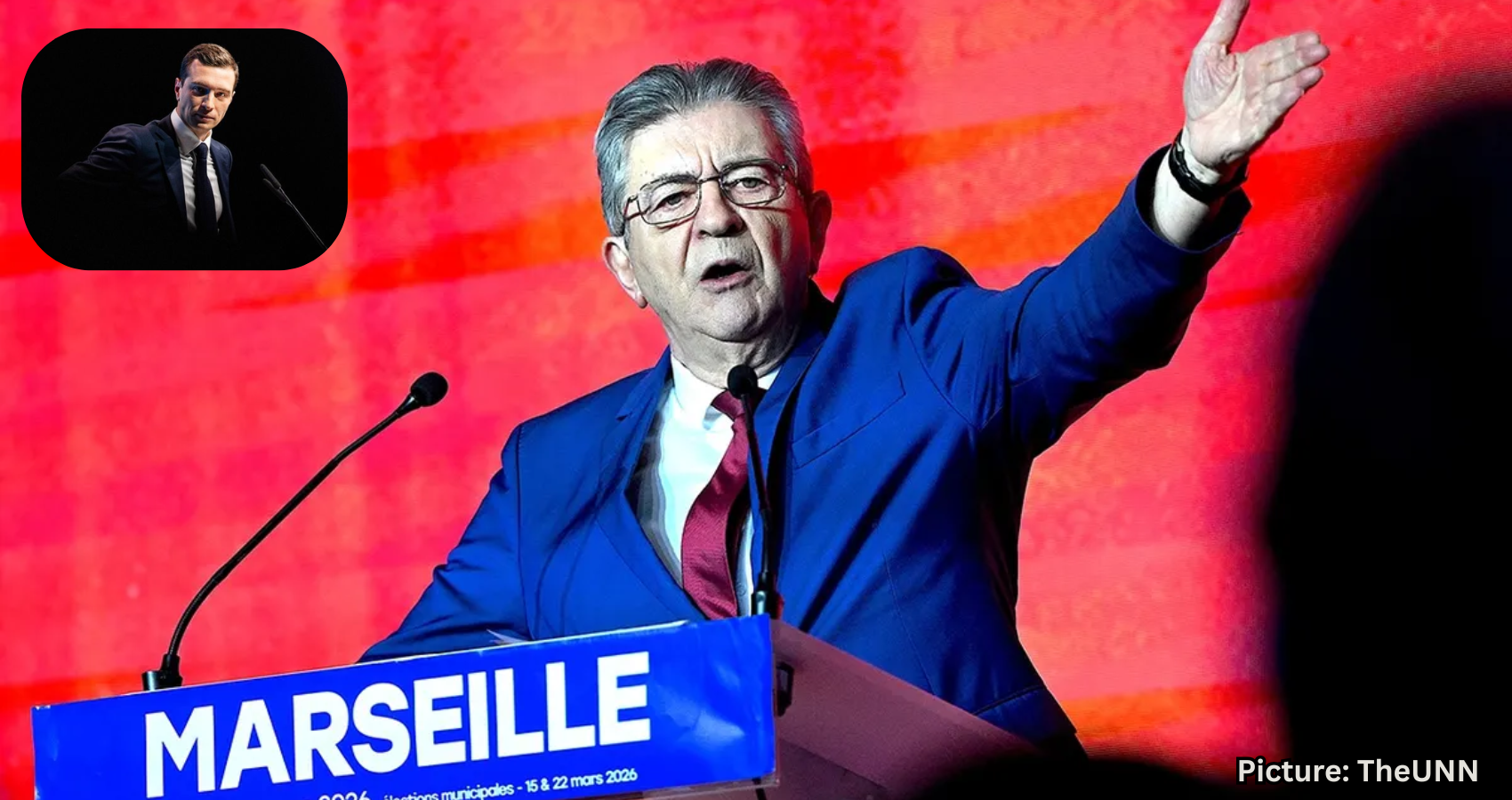
Israel’s ambassador to France warns of rising antisemitism linked to far-left rhetoric, as Jewish families adapt their daily lives amid a surge in antisemitic incidents across the country.
PARIS, France — Israel’s ambassador to France, Joshua Zarka, has drawn a stark comparison between the rhetoric of far-left leader Jean-Luc Mélenchon and Adolf Hitler, amid a troubling rise in antisemitism in the country. Zarka’s comments come as France recorded 1,320 antisemitic acts in 2025, a significant increase from 436 incidents reported in 2022. This alarming trend has led some Jewish families to alter their daily habits to avoid being identified.
Zarka pointed out that France is home to Europe’s largest Muslim community, which he believes contributes to the high volume of antisemitic incidents reported daily. He emphasized that France also has the continent’s largest Jewish community, making the situation particularly concerning.
“The number of events is extremely high — not because the French government does not fight it, but because there is this base in which antisemitism is growing,” Zarka stated. He attributed this growth to foreign influences from countries such as Iran, Russia, Turkey, and Qatar. According to Zarka, these state actors are fueling antisemitism from abroad, while certain French political figures exploit it for electoral gain, with Mélenchon’s party, La France Insoumise (LFI), being a prime example.
“The way [LFI leader] Jean-Luc Mélenchon speaks in front of a crowd reminds me of Hitler,” Zarka remarked. “The way he uses the idea of uniting against one enemy by speaking of Israel is similar to the way Hitler used to speak about the Jews.” His comments follow a February incident where the Human Rights League criticized Mélenchon for mocking the pronunciation of Jewish names, including that of MEP Raphaël Glucksmann.
Mélenchon has previously downplayed the severity of antisemitism in France, claiming it remains “residual,” a statement that critics argue fails to acknowledge the surge in antisemitic incidents following the Hamas-led massacre in Israel on October 7.
In a broader context, Zarka noted a shift in the Jewish community’s perception of the political landscape. Many now view the National Rally, formerly led by Marine Le Pen, in a different light. “Let’s not forget that [National Rally president] Jordan Bardella went to Israel and, at Yad Vashem, made a formal commitment to fight antisemitism, be it from the right or the left, and that is significant,” Zarka said.
Recent antisemitic incidents in France have included the partial cutting down of a tree planted in memory of Ilan Halimi, a Jewish man abducted and murdered in a 2006 antisemitic attack. Other incidents include the assault of a young boy wearing a kippah and attacks on kosher restaurants in Paris. In March, two brothers were arrested for allegedly plotting a deadly antisemitic attack, which authorities described as “deadly and antisemitic.” Rabbi Elie Lemmel has also faced violence, experiencing two attacks in a short span, which he attributes to heightened tensions following the recent conflict.
Lemmel expressed understanding for those who choose to conceal their identities, stating, “You have to be vigilant. Unfortunately, some people see a kippah and it bothers them. Those who want to do harm will always find reasons.” He emphasized the importance of visibility, saying, “If we start hiding, it is the beginning of the end.” He continues to wear his kippah proudly, despite the risks.
Yonathan Arfi, president of the Conseil Représentatif des Institutions juives de France (CRIF), reported that some Jewish families have begun to take precautionary measures, such as forgoing displaying mezuzahs or using different names on mobile apps to avoid identification. “On the one hand, there is a rise in antisemitism that leads to precautionary behavior,” Arfi explained. “On the other hand, Jewish life remains more vibrant than ever, with synagogues full and more kosher restaurants than ever before.” He urged the community not to let fear dictate their lives, stating, “Wherever possible, Jewish life must continue openly and proudly.”
Despite the challenges, Arfi noted a significant increase in immigration to Israel, which he views as a warning sign that some Jews no longer see a future in France. Historically, French immigration to Israel averaged between 1,500 and 2,000 people annually after the Six-Day War, peaking at around 8,000 annually between 2012 and 2015. The numbers fell to about 1,000 in 2023 but rose again to more than 2,000 in 2024 and 3,500 in 2025, with an estimated 4,000 immigrants from France expected in 2026.
Zarka acknowledged that French authorities are taking the fight against antisemitism seriously, labeling France as a relatively safe place for Jews. However, he cautioned Israelis to exercise caution when traveling to other European countries, such as Spain, Belgium, and the Netherlands, where antisemitism is reportedly flourishing.
In a recent ceremony commemorating Ilan Halimi, French President Emmanuel Macron condemned the “antisemitic hydra” that has infiltrated various aspects of French society. He remarked on the persistent nature of antisemitism, stating, “In 20 years, and despite the resolute efforts of our police officers, gendarmes, judges, teachers, and elected officials, the antisemitic hydra has kept advancing.” Macron also highlighted the rise of “Islamist antisemitism” following the Hamas-led massacre and noted that “far-left antisemitism” rivals that of the far right.
Despite the ongoing challenges, Zarka emphasized the importance of vigilance and resilience within the Jewish community, urging them to continue their lives openly and without fear. His remarks underscore the urgent need for a collective response to the rising tide of antisemitism in France and beyond, as the community grapples with an increasingly hostile environment.
According to Fox News Digital, the situation remains critical as Jewish leaders advocate for continued vigilance and community solidarity in the face of rising antisemitism.