
The government contracting industry is experiencing a transformative shift as artificial intelligence reshapes its landscape, presenting new opportunities for innovation-driven outcomes.
The government contracting industry is undergoing one of the most significant transformations in its history. Artificial intelligence (AI) is reshaping software development, with federal agencies increasingly demanding outcomes rather than labor hours. Emerging technologies are redefining national security, healthcare, and public services. For entrepreneurs willing to adapt, the opportunities have never been greater, as highlighted during a panel discussion at the “Startup Bazaar: GovCon” event held on June 13 at the University of Maryland’s Robert H. Smith School of Business.
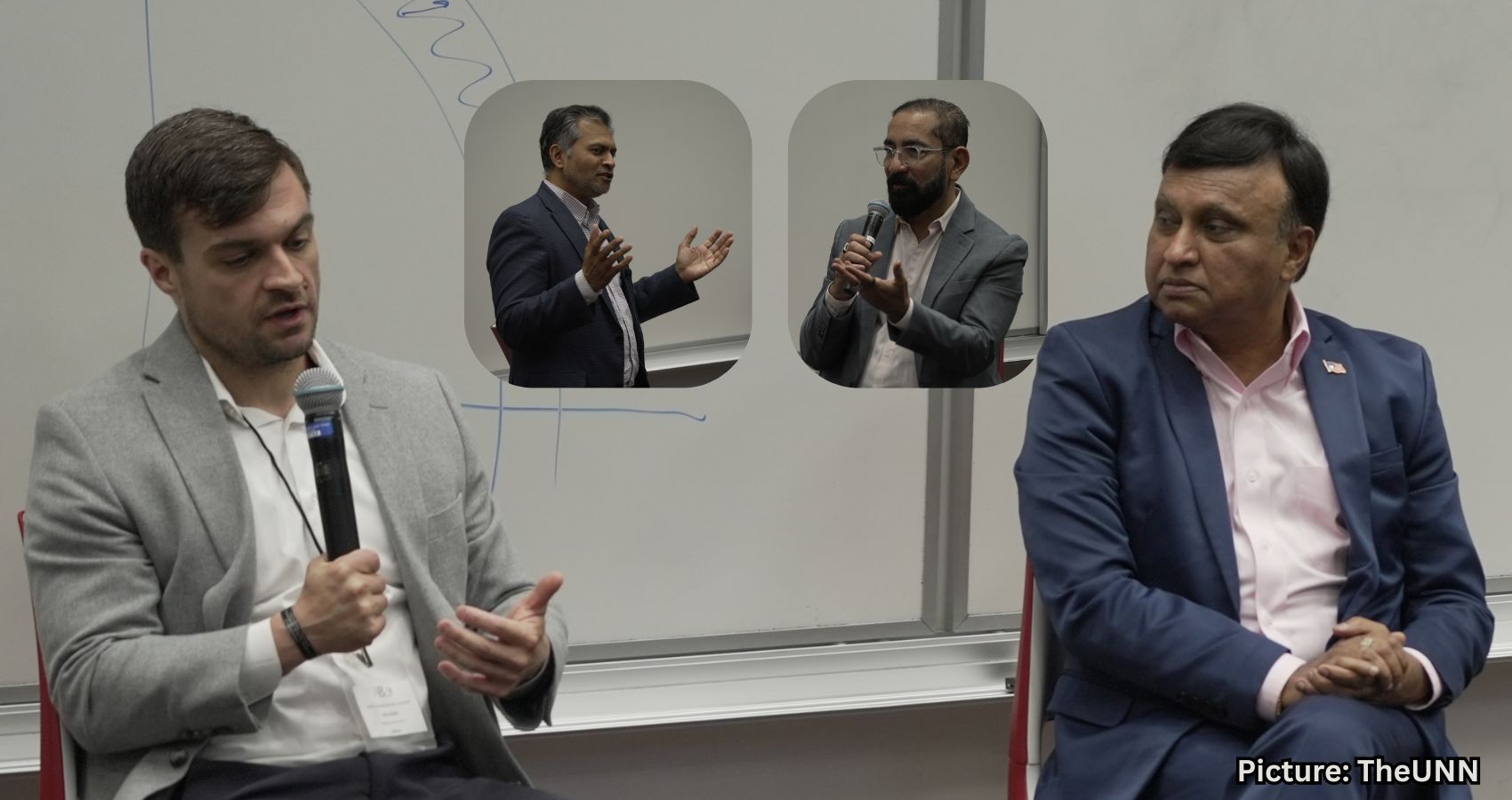
The panel, titled “Winning in GovCon: Opportunities for Businesses of All Sizes,” was moderated by Rohit Tripathi, principal at VU Capital. It featured three leaders whose careers span entrepreneurship, government contracting, innovation, and technology commercialization: Anil Sharma, CEO of 22nd Century Technologies; Dan Lagana, CEO of Building Momentum; and Sanjay Puri, founder of AutoNebula and Regulating AI.
The discussion focused on how businesses can enter the GovCon ecosystem, navigate procurement, build strategic partnerships, and position themselves for long-term growth. However, it quickly evolved into a broader conversation about the future of technology, the changing nature of government contracting, and the opportunities emerging at the intersection of AI, hardware, cybersecurity, and public-sector modernization.
One of the first questions posed by Tripathi addressed a common challenge for entrepreneurs: how much should companies react to opportunities as they arise, and how much should they proactively shape their own futures? Sharma shared insights from his experience building 22nd Century Technologies into one of the nation’s largest government contractors, employing over 6,500 people and serving federal, state, and local government clients across the country.
When his company entered the federal marketplace in 2009, Sharma noted that conventional wisdom suggested success depended on extensive capture management and deep customer relationships before pursuing contracts. “If I would have done that, probably I would have spent two more years doing nothing,” he said.
Instead, the company adopted a largely reactive strategy, identifying opportunities through government procurement platforms and aggressively competing for work. Its first contract was a modest $43,000 project for the U.S. Army at Fort Belvoir, which involved converting Excel files to Microsoft Access databases. While this work may not have generated headlines, it laid the foundation for a long-term relationship. That initial contract eventually led to over $200 million in work from the same agency over the following 15 years.
Sharma emphasized that small companies often cannot afford to wait years building capture pipelines before pursuing opportunities. “You have to balance between that combination of it,” he said. “Don’t give up all the reactive work at the start.” Over time, however, successful firms must transition toward a more proactive model. Today, Sharma estimates that approximately 70 percent of his company’s business development efforts are proactive, although he still sees value in pursuing unexpected opportunities that arise from changing government priorities and budget cycles.
In contrast, Dan Lagana described a markedly different approach with his company, Building Momentum, which develops engineering solutions, prototypes, hardware systems, and innovation programs. Lagana explained that they rarely pursue opportunities without first establishing customer intimacy and understanding the underlying problem. “We evaluate our opportunities internally,” he said. “If we don’t have a high degree of confidence, we just cut it off and move on.”
Rather than focusing on selling labor, Building Momentum emphasizes delivering capabilities. Lagana noted that customers increasingly seek partners who can rapidly translate ideas into tangible solutions. His organization regularly collaborates with companies that have software concepts but require physical products, prototypes, or hardware implementations. The firm’s Alexandria, Virginia-based accelerator enables software entrepreneurs to transform digital ideas into physical form factors in a matter of weeks rather than months.
The panelists agreed that innovation is no longer optional in government contracting. Agencies increasingly expect contractors to bring intellectual property, technology solutions, and creative approaches to the table rather than merely providing personnel. Sharma pointed out that the traditional government contracting model, often described as “people, process, and contracts,” is rapidly evolving into what he termed “IP-enabled services.”
In response to this shift, 22nd Century Technologies established a dedicated innovation lab several years ago. This lab operates as a startup within the company, with its own objectives, governance structure, and investment strategy. Delivery teams identify recurring customer pain points and feed them into the innovation pipeline, where solutions are developed, tested, and commercialized. One notable success emerged from an Internal Revenue Service initiative, where a request for innovative approaches to processing tax returns led to a contract worth hundreds of millions of dollars.
Sanjay Puri, who founded and led the government contracting firm Optimos, Inc. for two decades, offered provocative insights during the session. He argued that the foundational assumption of government contracting—relying on labor—is rapidly disappearing. “The whole method of putting butts in the seats is over,” he stated. As AI tools become more capable, agencies are beginning to focus less on staffing levels and more on measurable outcomes.
Puri explained that companies that continue to rely solely on labor-based business models may struggle, while those that embrace innovation, automation, and outcome-based delivery could thrive. Throughout the discussion, AI emerged as both the biggest opportunity and the most significant disruptor in the industry. Puri emphasized that AI is fundamentally changing how products are built, how services are delivered, and how organizations create value.
While much of the public conversation about AI focuses on software, the panelists underscored the growing importance of hardware and physical systems. Lagana highlighted a project involving drones designed to transport medical supplies between hospitals, addressing the practical problem of traffic congestion that can delay the movement of critical materials.
As the conversation shifted toward entrepreneurship, the panelists identified several sectors experiencing rapid growth, including defense, healthcare, and cloud modernization. Defense remains a major driver, with demand for innovative solutions in autonomous systems, drones, and AI-enabled decision-making. Healthcare is attracting significant investment as federal agencies explore how AI can improve diagnostics and accelerate research. Cloud modernization presents another major opportunity, as many federal agencies continue to operate legacy data centers.
The traditional startup model—building a software application, raising capital, and scaling rapidly—is becoming less effective. Competitive advantage must now come from a deeper understanding of customer problems, stronger execution, and unique capabilities. “Innovation will still be the key to entrepreneurship,” Sharma concluded.
The panelists shared a belief that society is entering a period of profound transformation driven by AI, automation, cybersecurity, advanced manufacturing, and digital infrastructure. They viewed the current changes not as incremental but as structural shifts that could redefine entire industries.
For entrepreneurs, government contractors, and innovators, the landscape may seem daunting. However, the panelists emphasized that the government continues to spend billions of dollars addressing complex challenges, and new technologies are creating entirely new markets. Agencies are seeking partners capable of delivering outcomes rather than simply supplying labor, presenting opportunities for businesses of all sizes.
As attendees of Startup Bazaar learned, winning in government contracting increasingly requires a nuanced understanding of technology, innovation, customer problems, and the rapidly changing landscape in which these elements intersect. For those willing to adapt, the opportunities may be larger than ever, marking a new era in government contracting.
The event was the third annual Startup Bazaar, building on the success of previous gatherings and featuring a keynote address by Atif Chaudhry, Maryland’s Secretary of General Services.
According to The American Bazaar, the insights shared during this event underscore the critical need for innovation and adaptability in the evolving GovCon landscape.