
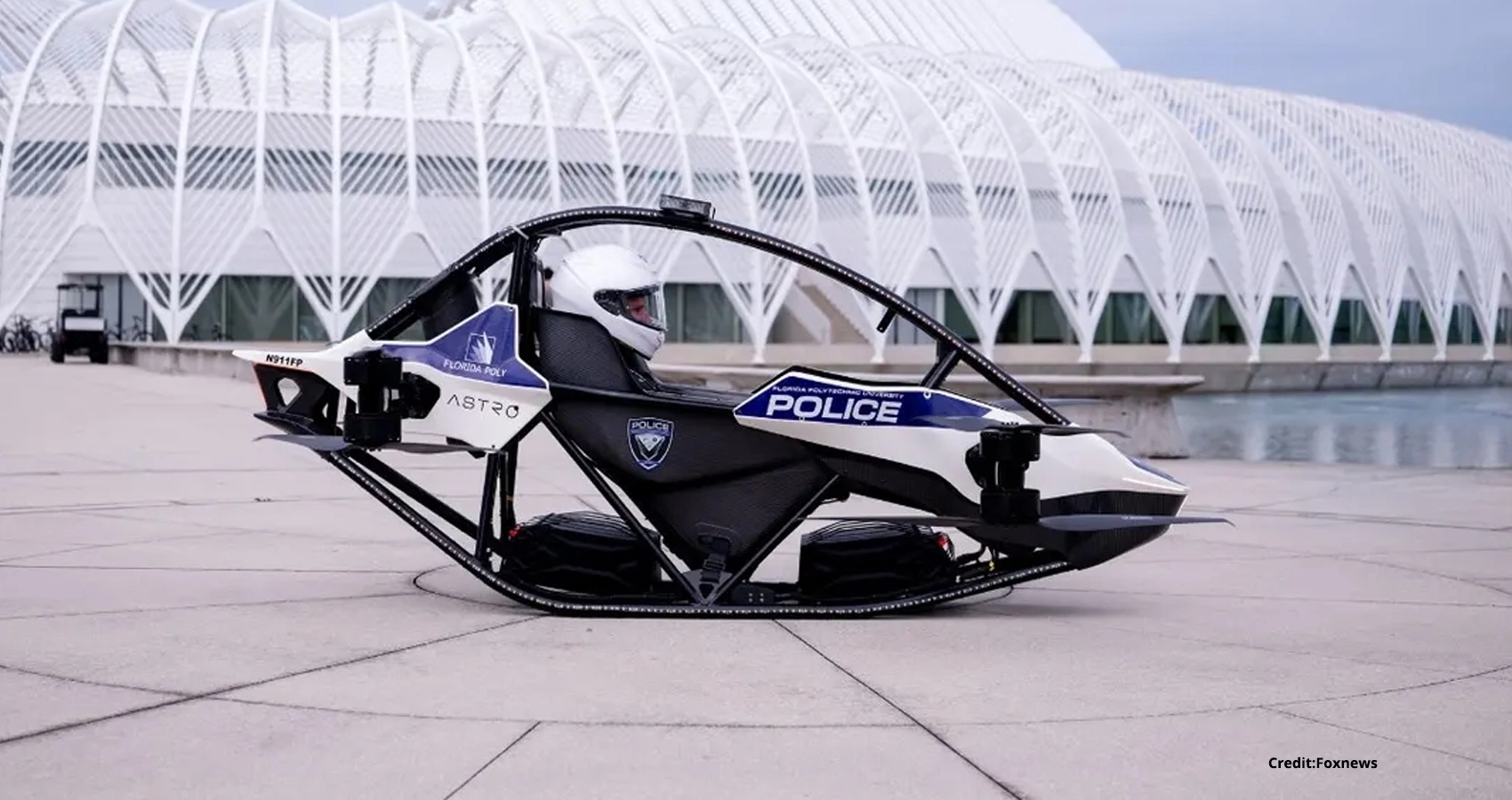
Florida Polytechnic University has introduced Astro, a $148,000 flying patrol vehicle, marking a potential shift in law enforcement response capabilities, pending FAA authorization.
In a groundbreaking development for law enforcement, the Florida Polytechnic University Police Department in Lakeland has unveiled Astro, a flying patrol vehicle designed to enhance emergency response capabilities. This innovative aircraft, known as the Jetson ONE, is a single-seat electric vertical takeoff and landing (eVTOL) vehicle that resembles a large drone.
Astro is being hailed as a potential first for U.S. law enforcement, as it represents the first instance of a police department integrating a piloted electric aircraft into its fleet. However, before officers can utilize Astro for operational patrols, it must receive authorization from the Federal Aviation Administration (FAA).
The Jetson ONE, manufactured by Jetson, is designed to take off and land vertically, eliminating the need for a traditional runway. Its compact frame can be folded for easier transport and storage, making it a versatile option for police operations. The aircraft features an open cockpit surrounded by a lightweight frame, powered by eight electric motors that drive its propellers.
Control of the aircraft is managed through a four-axis joystick, allowing for precise maneuvering. Florida Polytechnic University chose the Jetson ONE to explore its potential applications in law enforcement, with police personnel, including Police Chief Aaron Murray, having completed flight training. The aircraft is registered under the number N911FP, a nod to emergency services and the university itself.
Astro is equipped with police lights and has provisions for a handheld radio and action cameras, with plans for a pilot-controlled searchlight in the future. Despite its compact design, the aircraft boasts impressive performance specifications, capable of reaching speeds of up to 63 mph. This speed allows officers to cover short distances quickly, bypassing road traffic.
However, the aircraft’s battery life limits its operational capacity, with an estimated flight time of approximately 20 minutes per charge. Jetson indicates that the aircraft takes around 90 minutes to recharge using a 240-volt connection, while charging through a standard household outlet may take up to three hours. Officers can swap batteries between flights, enabling quicker turnaround times if fully charged replacements are available.
Astro has a maximum weight limit of 210 pounds, which includes the pilot, police gear, and any emergency supplies. This limitation may restrict the amount of equipment an officer can carry during a flight. Jetson has also incorporated several safety features into Astro, including the ability to continue flying even if one motor fails, an automatic landing system, and a ballistic parachute for emergencies.
With a price tag of $148,000 before taxes and additional fees, Astro represents a significant investment for the police department. The Florida Polytechnic University aims to determine whether this aircraft can assist officers in navigating challenging conditions, such as those that arise after severe storms that may block roads and hinder emergency response efforts.
Police Chief Aaron Murray believes that Astro could enhance the department’s ability to monitor the campus and access areas that traditional vehicles cannot easily reach. The department is also exploring the potential for using the aircraft to deliver emergency supplies. “Advanced air mobility is a technology on the rise, and we can either choose to be proactive or reactive as it develops,” Murray stated.
In addition to its law enforcement applications, Astro will serve as a research platform for students enrolled in the university’s aerospace engineering program, which launched in the fall of 2026. Students will have the opportunity to study electric aircraft technology and the challenges associated with its operation. Faculty and students plan to utilize flight data from Astro for research and engineering projects, and there are indications that the university is considering virtual training simulations for police officers to better understand the aircraft’s performance during specialized missions.
Florida is actively expanding its involvement in advanced air mobility, with the nearby SunTrax transportation testing facility in Auburndale featuring a dedicated aerial test track for emerging aircraft technologies. Testing under Florida’s participation in a federal advanced air mobility pilot program is expected to commence by the end of 2026, although this effort is separate from Astro’s pending authorization for police operations.
Astro presents an intriguing possibility for law enforcement agencies seeking alternatives to traditional helicopters. Police helicopters require substantial resources for acquisition and maintenance, and a smaller electric aircraft could provide a viable option for specific missions, particularly when rapid aerial assessments are necessary.
However, Astro’s limitations must be acknowledged. Its short flight duration necessitates careful mission planning, and while swappable batteries could facilitate repeated flights, officers would still need to land to replace them. Weather conditions and airspace restrictions may further complicate operations. Additionally, the question arises as to whether a single-seat piloted aircraft offers sufficient advantages over drones, which can conduct aerial surveillance without placing an officer in the cockpit.
Jetson views the Florida Polytechnic University Police Department’s acquisition of Astro as a pivotal step toward integrating personal electric aircraft into professional use. The company reports that its entire production for 2026 and 2027 is sold out, and it is now accepting orders for 2028, with the listed price remaining at $148,000. Astro is expected to make an appearance at the public UP.Summit event at Kennedy Space Center in Florida on November 7 and 8.
While flying patrol vehicles may not be commonplace in neighborhoods just yet, Astro offers a glimpse into how public safety agencies might leverage small electric aircraft in the future. In the aftermath of severe storms, an officer flying over inaccessible roads could assess damage and provide critical information to emergency crews. The same technology could eventually aid in searches for missing persons, although the aircraft’s practical utility in real-world police operations remains to be demonstrated.
As law enforcement agencies explore aerial technology, privacy concerns are likely to emerge. Citizens may want clarity on when officers can fly over their properties and whether the aircraft will collect or record information. Addressing these questions will be essential as the potential benefits of such technology are weighed against privacy considerations.
Florida Polytechnic University stands at the forefront of this innovative approach to emergency response, working toward the necessary federal authorization to make Astro a regular part of police operations. The implications of this technology could reshape how law enforcement interacts with communities, particularly in times of crisis.
As the conversation around aerial technology in policing evolves, it raises important questions about safety, privacy, and the future of emergency response. The community’s perspective will be vital in shaping how these advancements are integrated into everyday policing practices.
For further insights on this topic, please refer to CyberGuy.