
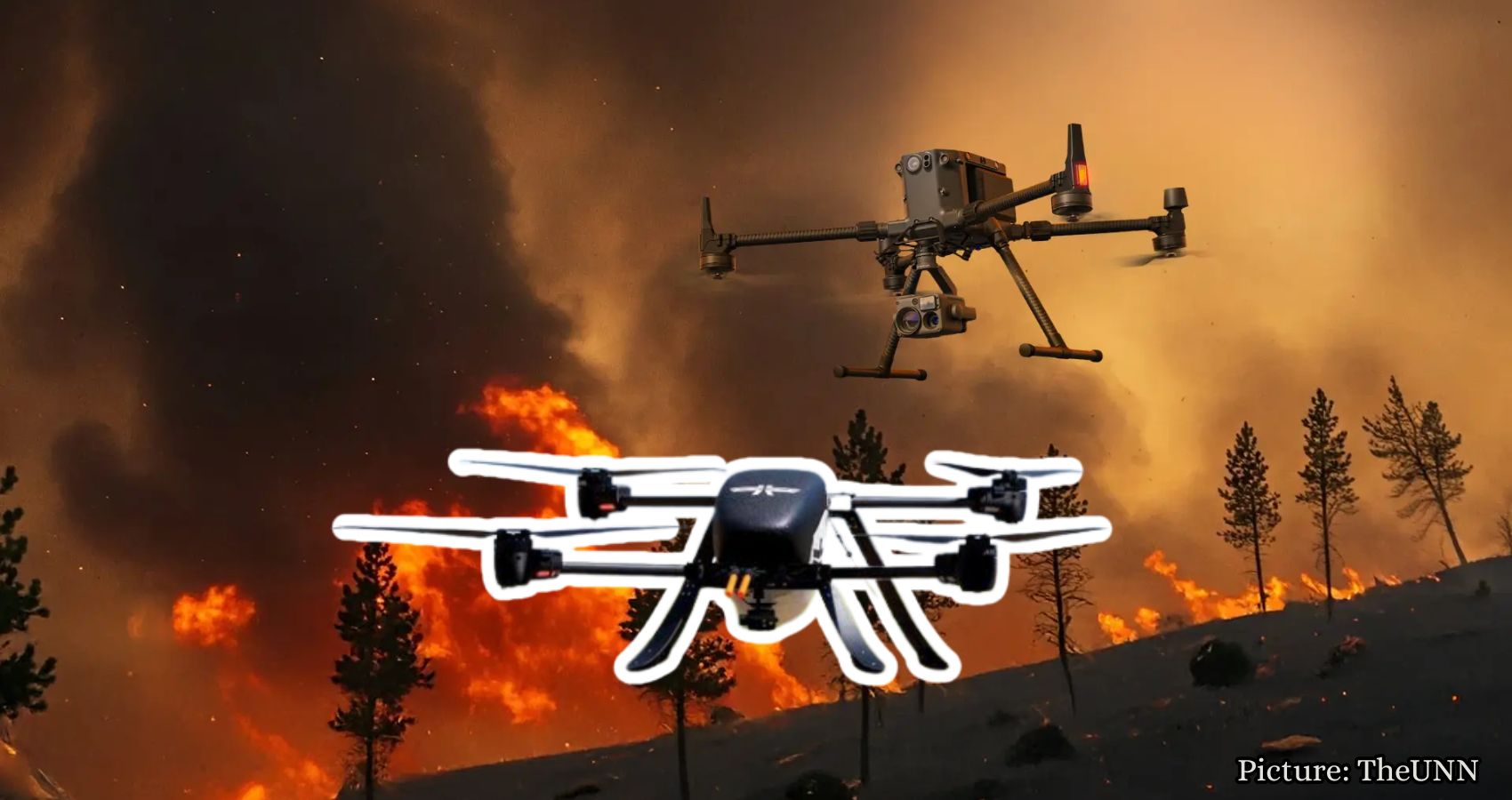
CAL FIRE and XPRIZE are testing AI-powered firefighting drones to enhance wildfire response times and effectiveness amid increasing fire risks in California and the western United States.
Wildfires can escalate rapidly, often outpacing firefighters’ ability to respond. A new generation of AI firefighting drones aims to address this challenge by reducing the response time to small ignitions in remote areas. Recently, CAL FIRE conducted tests of Seneca’s autonomous suppression drones in California, while teams competing in the $11 million XPRIZE Wildfire competition faced field challenges in Alaska.
The urgency of this technology is underscored by research from NOAA, which indicates that human-caused climate change is contributing to larger and more severe wildfires across California and the western United States. This warming trend has also been linked to extended wildfire seasons in the region.
During a field test on July 15, CAL FIRE collaborated with the nonprofit FireWERX and engineers from Seneca to evaluate the capabilities of autonomous firefighting drones. Five aircraft participated in the demonstration, showcasing technology that could assist firefighters who typically combat small vegetation fires using backpack pumps and hand tools.
Seneca’s drones are designed to respond quickly once a potential fire is detected. The drones utilize onboard sensors equipped with AI and computer vision to locate fires and deliver aerated Class A foam directly to the affected area. According to Seneca, their systems can deploy four to six drones, capable of delivering between 500 and 1,000 pounds of suppression material per trip.
It is essential to clarify the payload specifications, as they can be misleading. Reports from the CAL FIRE demonstration focused on the volume of water carried by individual drones and the amount of foam produced after mixing. However, Seneca’s product descriptions emphasize suppression capacity by weight, while their Aspen deployment materials refer to finished foam volume. These metrics should not be considered interchangeable.
While Seneca’s drones do not match the payload capacity of large airtankers, CAL FIRE operates over 70 fixed-wing and rotary-wing aircraft that can reach many remote fires within approximately 20 minutes. The smaller drones serve a distinct purpose; they can be transported by utility vehicles or positioned near high-risk fire areas. This system is being developed for early attack, nighttime operations, and challenging terrains, which is crucial when fires ignite in locations that ground crews cannot access swiftly.
In December 2025, San Bernardino County Fire tested an earlier version of Seneca’s technology, the Argo-1 system. This semi-autonomous aircraft utilized thermal tracking and precision targeting for early wildfire response, highlighting the important distinction in the term “autonomous.” While the drones can perform significant portions of the flight and targeting processes independently, they still operate under human supervision. For the Aspen deployment, a single pilot will oversee multiple aircraft.
In Alaska, a different firefighting system faced challenges during the XPRIZE finals testing in June 2026. Three finalist teams were tasked with using autonomous technology to detect and suppress early-stage fires without human intervention. Judges evaluated the teams based on speed, accuracy, and effectiveness in suppression.
One of the finalists, German company Dryad Networks, integrates its Silvanet detection network with a drone system called Silvaguard. Silvanet employs solar-powered environmental sensors placed in forests to monitor combustion gases and particulates associated with the initial stages of a fire. These sensors communicate through Dryad’s network, enabling a rapid response to potential ignitions.
Once Silvanet identifies a possible fire, a Silvaguard observation drone can launch automatically. This drone uses infrared and optical imaging to locate the source and confirm whether a fire exists. A separate suppression drone can then respond to the verified location. Dryad’s suppression drone has the capacity to carry up to 100 liters of fire suppressant, equivalent to about 26 gallons. In a demonstration in November 2025, Dryad successfully detected a controlled fire and extinguished it in under 12 minutes without human involvement.
During the XPRIZE finals in Alaska, Dryad’s sensors detected a small fire, triggering an autonomous response. The Silvaguard system successfully located and suppressed the fire. While controlled tests demonstrate the technology’s potential, real-world fire operations will present more complex challenges.
In Colorado, the Aspen Fire Protection District has signed a five-year, multimillion-dollar agreement with Seneca for a five-aircraft Seneca Strike Team and a mobile operations base. This system is expected to have a capacity of about 500 gallons of finished foam per sortie, and one pilot will be able to oversee multiple aircraft due to the system’s autonomous features. Seneca plans to deliver the system during the summer of 2026, marking a significant step toward real-world deployment. Aspen firefighters will receive training on the aircraft before integrating them into operations.
Firefighting drones may eventually complement existing technologies used in California for early detection. CAL FIRE collaborates with UC San Diego’s ALERTCalifornia program, which operated over 1,200 cameras and sensor arrays as of February 2026. This program claims its AI wildfire system detected more than 1,200 fires during its inaugural season, often outpacing initial 911 reports by over 30%.
Additionally, Google’s FireSat project, which utilizes specialized satellites and AI to identify wildfires earlier, has made significant progress. Earth Fire Alliance launched its first three operational FireSat satellites on July 7, 2026, with operational data expected to reach early adopters at least twice daily by the fourth quarter of 2026.
Ultimately, systems like FireSat and ALERTCalifornia could help identify ignitions, allowing nearby drones to provide firefighters with a faster response option. However, these technologies still face limitations, including smaller payloads compared to major firefighting aircraft and performance variability based on weather and terrain. Furthermore, the transition from demonstration to real operations for autonomous firefighting technology remains a critical step.
For those living in wildfire-prone areas, these drones may offer local fire agencies an additional tool for responding to fires in their earliest stages. However, it is essential to continue relying on official emergency alerts and evacuation instructions, and to have a plan in place for quick evacuation if conditions worsen.
The promise of these drones lies in their ability to act quickly. If they can reach a remote ignition while it is still small, firefighters may have a better chance of controlling it before it escalates. The focus on those critical first minutes is what makes this technology particularly intriguing. While drones will not replace large airtankers or the expertise of seasoned firefighters, they could provide a crucial advantage by slowing down a new ignition until more resources arrive. The true test will come when these aircraft face unpredictable conditions in real fire scenarios, necessitating clear procedures for coordinating autonomous systems with existing firefighting efforts.
Would you feel safer knowing autonomous firefighting drones were stationed near your community? Share your thoughts with us at Cyberguy.com.
According to Fox News.