
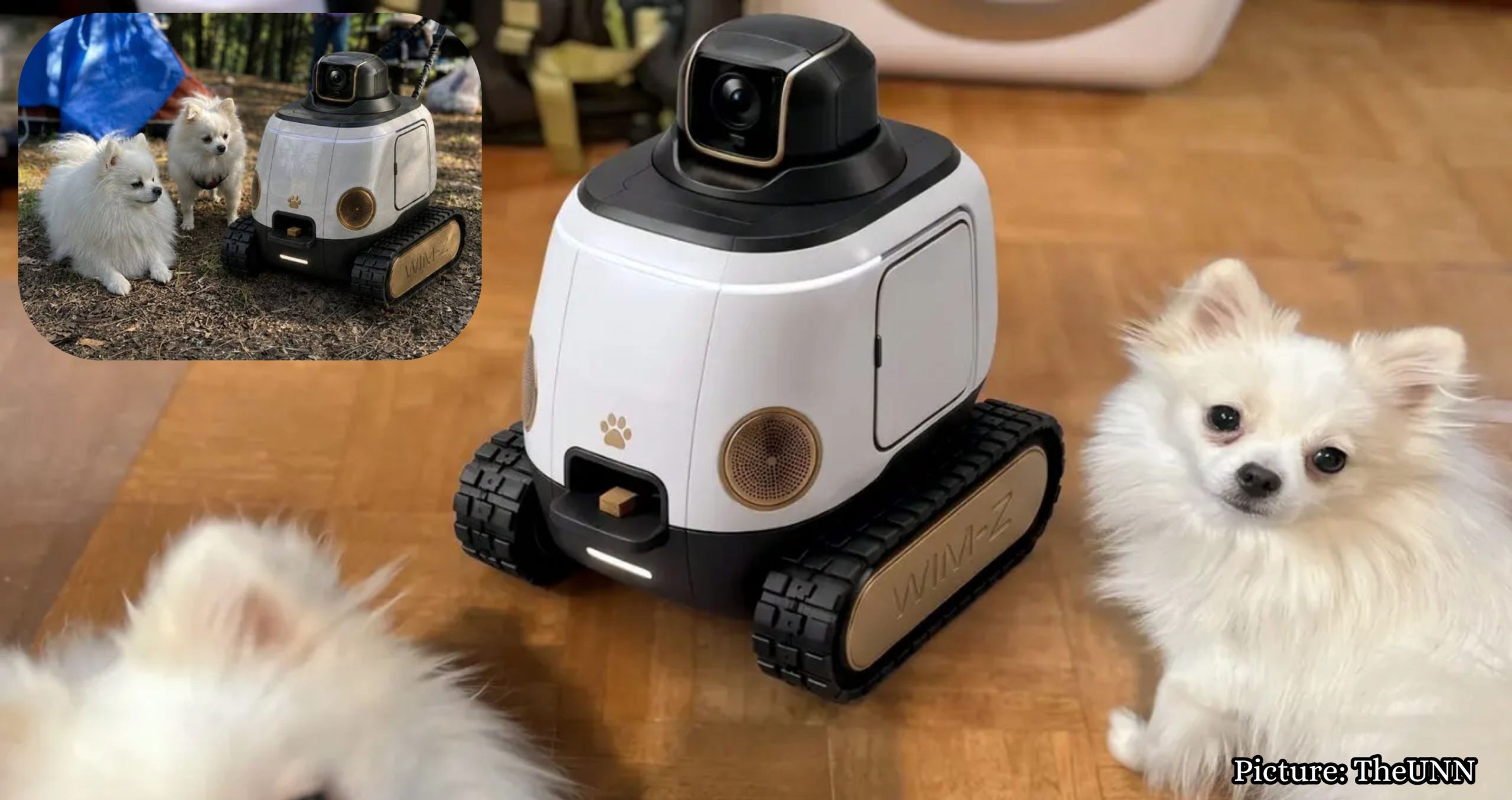
WIM-Z’s AI dog training robot aims to reduce barking in dogs while their owners are away, showing promising early results with an up to 83% reduction in barking during trials.
Leaving home can be a source of guilt for dog owners, especially when their pets start barking the moment they walk out the door. This scenario is common in both apartments and houses, where pet cameras may provide a view of the situation but offer little in terms of intervention. WIM-Z seeks to change this dynamic with an innovative solution.
The WIM-Z robot is a small, tracked device equipped with on-device artificial intelligence designed to monitor dogs and respond to their behaviors. Once positioned, the robot can identify individual dogs, detect barking, and autonomously dispense treats to reward calmer behavior. Additionally, owners can communicate through the robot and control its movement from their smartphones.
WIM-Z, which stands for Watchful Intelligent Mobile Zen, measures approximately 11 inches in height and moves on rubber tank-style treads. Its camera turret can pan 270 degrees and tilt over 120 degrees, while a side cartridge can hold up to 44 treats. The robot operates using a Raspberry Pi 5 paired with a Hailo-8 AI accelerator, allowing it to classify barking and track dogs effectively.
When barking is detected, WIM-Z’s behavior system can decide whether to intervene without waiting for owner input. The robot can issue calming cues and dispense treats when appropriate. However, it is important to note that WIM-Z does not currently navigate autonomously around the home; owners must control its movement via an app or leave it in a designated spot.
Equipped with two-way audio, WIM-Z’s app provides insights into behavioral activity and optional highlight clips, allowing owners to monitor their pets while away. The company recently released results from seven field trials conducted between May and September 2026, with six trials taking place in homes around the New York metropolitan area and one at a kennel in Jersey City. During these trials, four hand-built robots logged 50 sessions and approximately 60 hours of use, detecting over 2,100 barks and making 107 autonomous interventions, dispensing around 500 rewards.
The most significant reductions in barking were observed in two homes that conducted repeated autonomous sessions over two to three weeks. In one instance, barking decreased from 161 barks per hour to 40, representing a 75% reduction. In another case, barking dropped from 317 barks per hour to 53, an impressive 83% reduction. WIM-Z also noted that more interventions resulted in dogs becoming quiet as the trials progressed.
WIM-Z adopts a gentle approach to dog training, relying on treats and calming cues rather than aversive methods such as shocks or sprays. This aligns with recommendations from the American Veterinary Society of Animal Behavior, which advocates for reward-based training. However, a critical consideration remains: can the AI accurately interpret different barking scenarios? For instance, a dog barking at a delivery person is distinct from one exhibiting distress due to separation from its owner. WIM-Z must be able to recognize these differences to respond appropriately.
While WIM-Z can autonomously manage behavioral responses, it still requires owner input for navigation. The first customer units will combine autonomous behavior and training capabilities with owner-controlled movement. Full self-navigation, where the robot can map the home and seek out the dog independently, is planned for future updates but will not be included in the initial release.
Privacy is a significant concern for any mobile robot equipped with a camera and microphone. WIM-Z assures users that all AI processing occurs on the robot itself, including behavior detection and bark classification. No video is transmitted to the cloud for analysis. However, some data, such as bark activity and behavior interventions, is stored on an Amazon Web Services relay server to appear in the app’s activity history. Live video and two-way audio streams are encrypted and sent directly to the owner’s phone, ensuring that no recordings are stored on WIM-Z’s servers.
Optional highlight clips can be uploaded for playback in the app, but continuous footage is never uploaded. Owners have the ability to delete clips at any time or disable the feature entirely. WIM-Z also emphasizes that it does not sell customer data, and footage is not used to train AI models unless the owner explicitly opts in. When used solely on local Wi-Fi without remote access, no data leaves the home.
The WIM-Z robot is priced at $799 for the initial production units, with a fully refundable deposit of $99 required to reserve a spot. The company anticipates shipping the first batch between late Q4 2026 and early Q1 2027, although hardware schedules may be subject to delays. If units are not shipped by Q2 2027, deposits will be refunded automatically. Currently, WIM-Z has built five robots, with four in use for field trials and one in production evaluation in Shenzhen, China.
For dog owners dealing with barking or restlessness when they leave home, WIM-Z represents a potential advancement in pet technology. Rather than merely alerting owners to their dog’s behavior, the robot can actively respond by providing calming cues and rewards for settled behavior.
It is essential to note that the first version of WIM-Z will not autonomously roam the house in search of the dog. Owners must position it in areas where their pets typically spend time or control its movement through the app. While WIM-Z may not be a solution for severe separation anxiety, it could serve as a valuable tool for addressing barking or mild restlessness.
As WIM-Z prepares for its market debut, the early results are promising, but further testing with a broader range of dogs in various environments will be necessary to assess its effectiveness. The concept of a robot that can make training decisions and reward calm behavior without waiting for owner intervention is intriguing, and WIM-Z’s approach to privacy and data handling is commendable. At a price point of $799, potential buyers may want to wait for more customer feedback once the first units are shipped.
Would you trust an AI robot to determine when your dog needs a calming cue or treat while you are away? Share your thoughts with us at CyberGuy.com.