
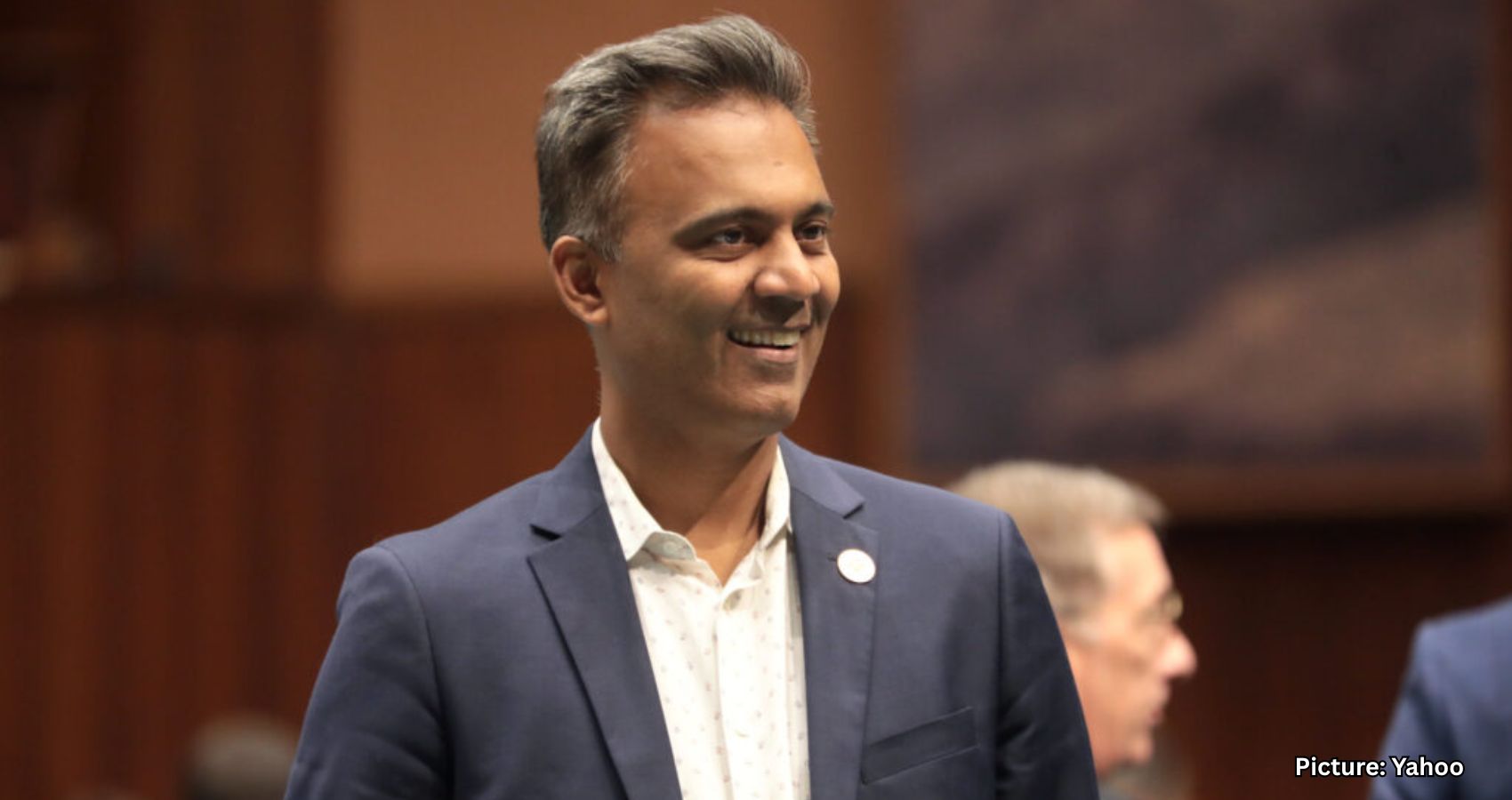
Jain Indian American Amish Shah is poised to make history in Arizona’s congressional race, leading in early election results and aiming to become the first Indian American to represent the state in Congress.
Jain Indian American Democrat Amish Shah is on the verge of a historic victory in Arizona’s 1st Congressional District. Early election results from the November 3, 2026, midterm elections show him leading Republican Jay Feely. According to the Associated Press, Shah has garnered 52.57% of the vote, equating to 163,584 votes, as counting continues. If he secures this win, Shah will become the first Indian American to represent Arizona in the U.S. Congress, marking a significant milestone for the Indian American community.
Shah, an emergency medicine physician and a three-term former Arizona state representative, is challenging Feely, a former NFL kicker and sports broadcaster, for the seat previously held by Republican David Schweikert. The contest has garnered attention as Democrats aim to gain ground in the House of Representatives.
Beyond the electoral stakes, Shah’s candidacy underscores his connection to Jainism, the Indian religious tradition followed by his father, Satish Shah. Born and raised in Chicago to parents who immigrated from Gujarat, India, Shah grew up immersed in a blend of Indian traditions and American influences. His mother is Hindu, and he attended Catholic schools throughout his childhood, which exposed him to a variety of religious and cultural perspectives.
Two key Jain principles, Anekantavada and Ahimsa, are particularly relevant to Shah’s outlook. Anekantavada teaches that truth has multiple dimensions and encourages individuals to consider different perspectives. Shah has integrated this philosophy into his approach to public service, emphasizing the importance of listening to people with opposing views and finding common ground.
Ahimsa, which translates to nonviolence and the avoidance of harm to living beings, is another fundamental principle of Jainism that influences Shah’s lifestyle. His commitment to vegetarianism and animal welfare reflects this principle. Additionally, he founded the Arizona Vegetarian Food Festival to promote plant-based eating.
Shah speaks Gujarati and has maintained strong ties to his Indian heritage while building a career in medicine and politics. He earned his bachelor’s and medical degrees from Northwestern University and a Master of Public Health from the University of California, Berkeley. Notably, he is also a licensed pilot who has utilized his flying skills to assist underserved communities.
Healthcare and the rising cost of living have been central themes in Shah’s campaign. He has advocated for lower health insurance premiums, reduced prescription drug costs, and protections for Medicare, Medicaid, and Social Security. Shah also supports abortion rights and the Deferred Action for Childhood Arrivals (DACA) program, while criticizing Trump-era tariffs for their impact on American families.
Shah has raised concerns about the water and energy demands of data centers in Arizona, incorporating this issue into his broader focus on local economic and environmental priorities.
During the campaign, Feely attempted to portray Shah as too far to the left, citing his past praise for Senator Bernie Sanders and his positions on healthcare. In response, Shah criticized Feely’s association with former President Donald Trump, arguing that a Republican victory would perpetuate federal policies that have increased financial pressure on households.
Shah has positioned himself as a candidate focused on healthcare, affordability, and bipartisan cooperation in a competitive suburban district. His emphasis on finding common ground resonates with the Jain principle of considering diverse viewpoints.
With Shah currently leading in the reported vote count, his race has become a focal point for Indian Americans. A victory would not only mark the first time an Indian American with Jain family roots represents Arizona in Congress but also bring both his political campaign and cultural heritage into the national spotlight.
According to Associated Press, the outcome of this race could have significant implications for the representation of Indian Americans in U.S. politics.