
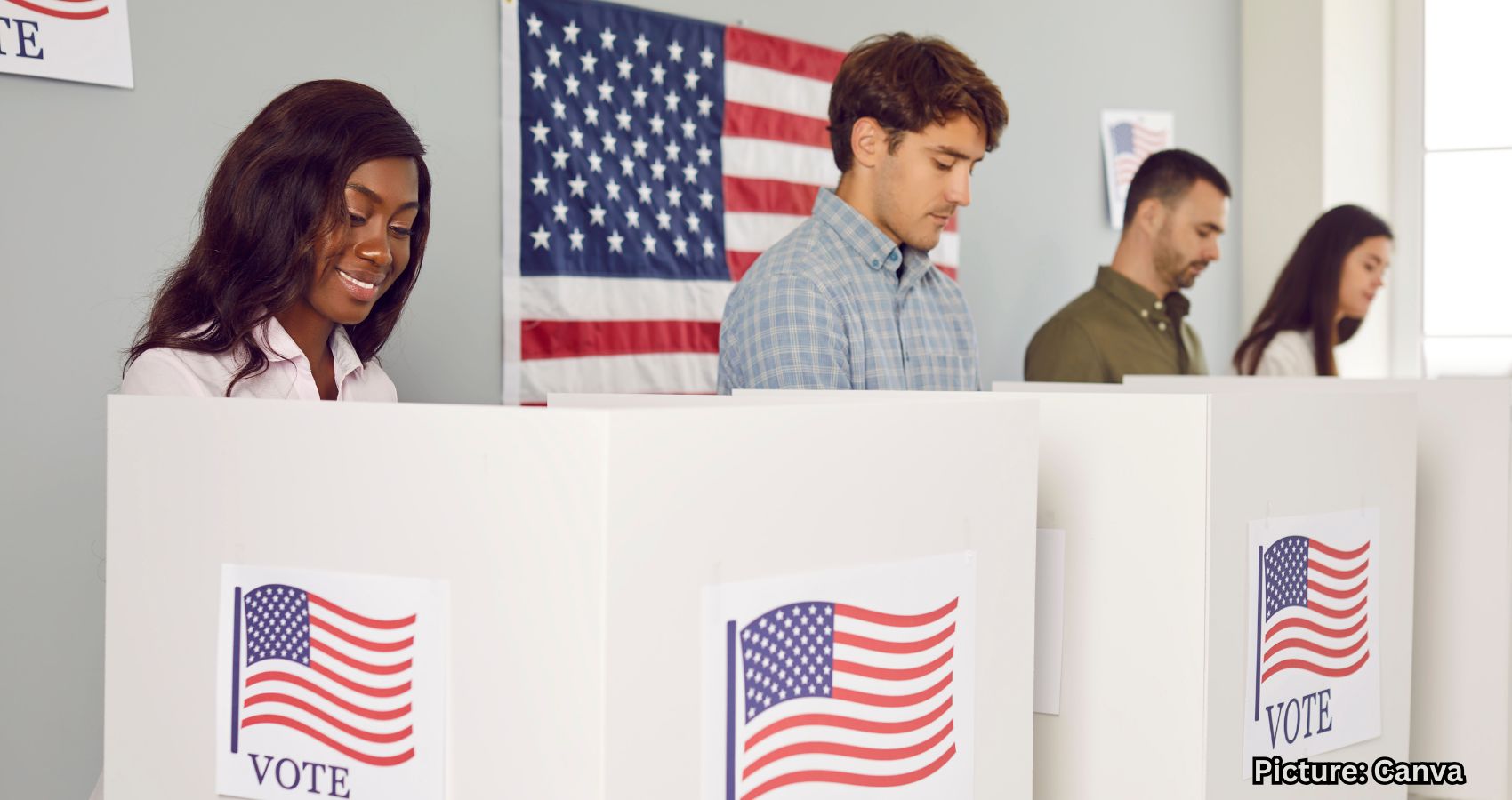
Voters head to the polls on Election Day 2026, with Republicans defending slim congressional majorities amid record early voting and a challenging political landscape.
Election Day 2026 has arrived, and voters across the United States are casting their ballots to determine control of the U.S. House and Senate for the next two years. Republicans are tasked with defending their narrow majorities, while former President Donald Trump expresses confidence that the GOP will maintain both chambers during the final two years of his presidency. “We’re going to win, and let’s make the next two years bigger and better and stronger than ever before,” Trump told supporters at a rally in Kansas on the eve of the election.
However, the GOP faces significant challenges, as historical trends indicate that the party in power typically loses seats during midterm elections. Additionally, the current political climate is marked by persistent inflation, which many attribute to an unpopular war with Iran, alongside Trump’s declining approval ratings.
Public opinion polls suggest that Democrats may be more energized to vote than their Republican counterparts, raising concerns about potential turnout deficits for the GOP. Early voting has already set records, with over 54 million ballots cast nationwide—nearly nine million more than during the 2022 midterms, according to the Associated Press. Republican National Committee Chair Joe Gruters emphasized the importance of turnout, stating, “If our voters turn out, we win.”
As Election Day unfolds, the GOP is on the defensive, with Trump making efforts to rally the party base. His rally in Kansas, which marked his 30th event in the past month, came shortly after the Fox News Power Rankings shifted the state’s Senate race from Lean Republican to Toss-up. Democratic candidate Adam Hamilton is vying to become the first Democrat in nearly a century to secure a Senate seat in Kansas, challenging incumbent Republican Senator Roger Marshall.
According to the Fox News Power Rankings and other nonpartisan political analysts, Democrats have a viable path to retake control of the House, while the Senate majority remains uncertain. “Think of what is possible tomorrow: Democrats can flip the House, take back the Senate, and stop Trump’s harmful agenda,” Democratic National Committee Chair Ken Martin highlighted in a social media post on the eve of the election.
This year’s elections also include governorships in 36 of the 50 states, with legislative elections taking place in all but four states. Voters will also weigh in on 145 statewide ballot measures across the country. A key question remains: have public opinion polls underestimated Republican voter turnout?
As the results begin to roll in, it is crucial to understand the stakes involved. Republicans currently hold a 53-47 majority in the Senate, meaning Democrats need to gain four seats to reclaim control. The GOP must retain at least 50 seats to maintain their majority, as Vice President JD Vance serves as the tie-breaking vote.
In addition to Kansas, Republicans are defending seats in several other states, including Alaska, Iowa, Maine, Nebraska, Ohio, South Carolina, and Texas, all rated as toss-ups in the Power Rankings. Democrats, meanwhile, are on the defensive in Michigan, Minnesota, and New Hampshire.
The House of Representatives presents a similarly tight race, with Republicans holding a slender majority. Democrats need to gain just three seats to reach the 218 required for control. A successful night for Democrats could result in as many as 240 seats, while a strong performance by Republicans could leave them with 212 seats—six short of a majority but sufficient to complicate the next Democratic House speaker’s agenda.
As the evening progresses, early poll closings will provide initial insights into the House’s future. Notably, Kentucky’s 6th District, which encompasses Lexington and surrounding areas, is one to watch. Trump won this district by 15 points in the last presidential election, but changing demographics, including left-leaning college voters and farmers affected by rising costs, could make this race competitive.
Currently, there are 26 Republican and 24 Democratic governors. The Power Rankings identify three states—Alaska, Nevada, and Georgia—where the GOP governorship is considered a toss-up. In contrast, gubernatorial races in Florida, Kansas, and Texas are rated Lean Republican, while contests in Arizona, Iowa, Michigan, Ohio, and Oregon lean Democratic.
Voters will also decide on various referendums, including measures requiring identification at polling places and bans on noncitizen voting in 11 states. In Alaska, voters will consider repealing the state’s ranked-choice voting system, while Virginia residents will vote on restoring voting rights to convicted felons upon their release.
California’s Proposition 40 is drawing national attention, proposing a one-time 5% tax on wealth for individuals worth over $1 billion, with most of the revenue earmarked for healthcare. Meanwhile, Washington state voters will weigh in on a measure to repeal a recently approved 9.9% tax on income exceeding $1 million.
In addition to these measures, voters in Maryland, Missouri, and Colorado will address congressional redistricting, while states like Arizona, Colorado, Nebraska, and Washington will consider referendums regarding transgender students’ participation in sports. Colorado will also vote on a measure to block gender transition surgeries for minors.
As the polls close throughout the evening, the first results will begin to emerge, with the earliest poll closings at 6 p.m. ET and the final polls closing at 1 a.m. ET. The outcome of Election Day 2026 will have significant implications for the political landscape in the United States, shaping the direction of governance for the next two years.
For ongoing updates and analysis, stay tuned to TheUNN.com.
According to Fox News.