
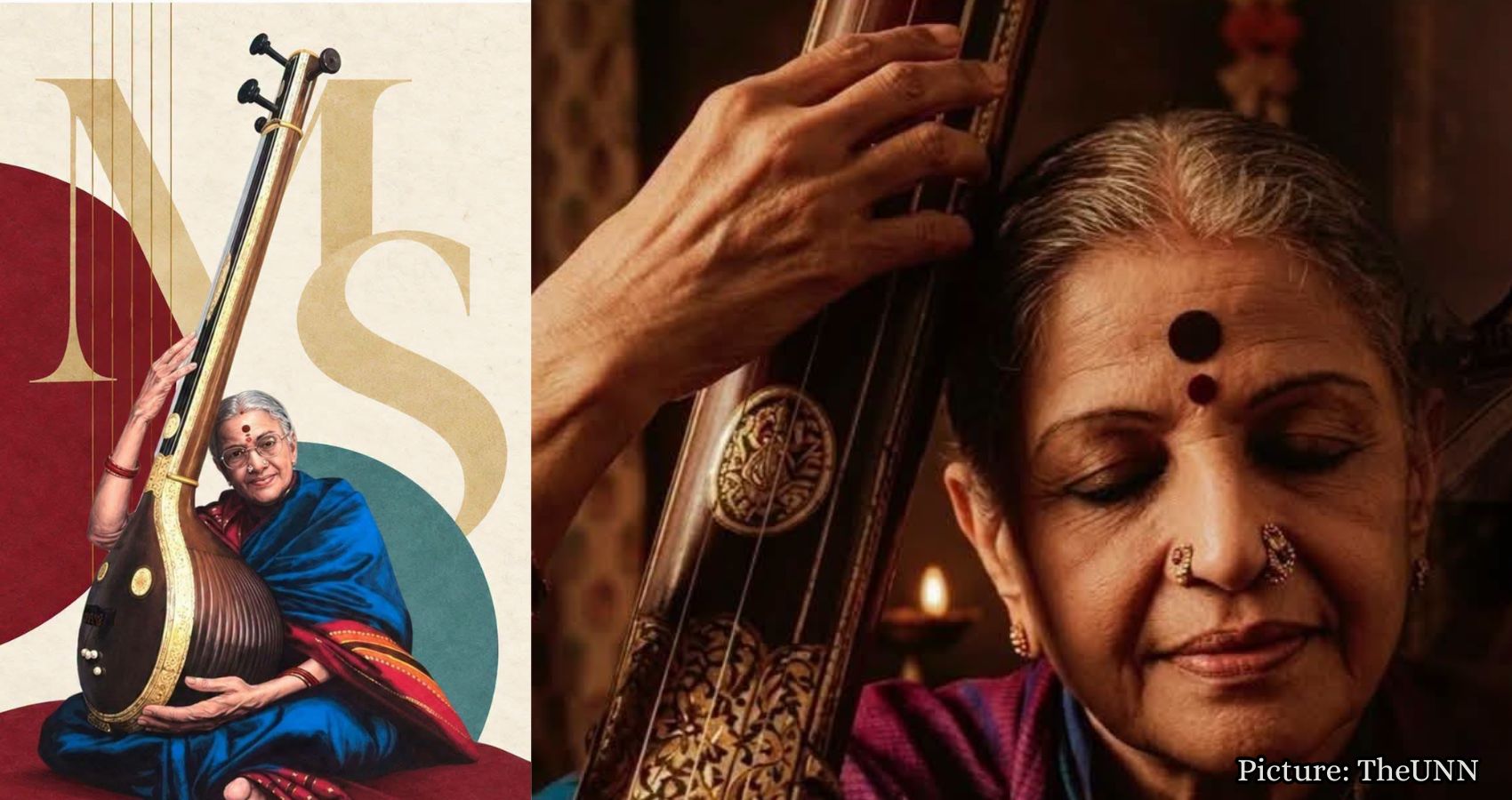
As we celebrate the 110th birth anniversary of M.S. Subbulakshmi, we reflect on her profound impact on music and spirituality, transcending generations and cultures.
On the eve of M.S. Subbulakshmi’s 110th birth anniversary, we remember the legendary Indian classical singer and her enduring musical legacy. Her contributions to music and spirituality continue to resonate deeply with audiences around the world.
Certain childhood experiences remain etched in our memories, shaping who we are. For me, one such experience began at the tender age of 10 when the music of M.S. Subbulakshmi first touched my soul in a way I could not articulate. Even then, I sensed that her voice transcended ordinary music, reaching deep within me.
I vividly recall attending her performance at Carnegie Hall when I was just 11 years old. At that moment, I could not fully grasp the significance of the experience, nor could I have imagined that decades later, the memory would remain so vivid. Few childhood experiences linger in our consciousness, but hearing M.S. Amma at Carnegie Hall was one of those rare moments that left an indelible mark on my soul.
What is it about her music that defies description? We can discuss her extraordinary voice, her mastery of Carnatic music, her command of rhythm and melody, and her ability to convey emotion and devotion. Yet, none of these descriptions fully encapsulate the transformative effect her music has on listeners. It exists in a realm beyond words, where the lines between music and prayer begin to blur.
In Sanskrit, the Gandharvas are celestial beings associated with music. Whenever I think of M.S. Subbulakshmi, I am reminded of this ancient concept of music as a divine gift from a realm beyond human experience. Her voice possessed an almost ethereal quality, enhanced by the humility and devotion with which she wielded her gift. She did not simply sing to showcase her talent; she offered her voice as an instrument of devotion.
Every day begins for me with M.S. Amma chanting the “Venkateswara Suprabhatam” and the “Vishnu Sahasranamam.” Before the day fills with responsibilities and distractions, her voice creates a moment of stillness and remembrance. It is a beautiful way to start the day, reminding us that there is something larger than ourselves.
Perhaps that is why I have always felt that M.S. Subbulakshmi transcended music. She embodied the essence of Goddess Saraswati, who represents music, knowledge, and learning in Hindu tradition. M.S. Amma exemplified the union of artistic excellence and spiritual surrender. Her greatness lay not only in her vocal prowess but also in the devotion that flowed through every note she sang.
Years later, I had the privilege of visiting her home in Chennai after the passing of her beloved husband, Sri T. Sadasivam. By then, my childhood memory of the woman whose voice had moved me at Carnegie Hall had intertwined with an understanding of her extraordinary life and the spiritual legacy she carried to generations of listeners. What I remember most vividly from that visit was not a discussion of her career or accomplishments, but a conversation about bhakti—devotion—and the poetry and music of Annamacharya.
During our conversation, something remarkable happened. M.S. Amma reached for her books and, almost spontaneously, began to sing. There was no concert hall, no formal performance, and no expectation to entertain. She was simply at home, discussing bhakti, and allowing the music to emerge naturally. For someone who had first heard her voice as a child at Carnegie Hall, to hear it again in the intimacy of her home was an experience for which I will always be grateful.
There are few greater blessings in life than encountering something that profoundly moved you as a child and then experiencing it again years later, enriched by age and perspective. As a child, I appreciated the beauty of her voice; as an adult, I began to grasp the devotion behind it. Yet, I realized that some things cannot be fully understood through intellect; they must be experienced.
The true measure of a soul’s divinity may not lie in their accomplishments during their lifetime, but in the echoes and ripples that continue long after they are gone. Achievements can be quantified through awards, honors, recordings, and performances, but these metrics tell only part of the story. The deeper measure of a life is found in the lives touched, the memories cherished, and the values carried forward—emotions that awaken in people who may never have met that person.
A stone dropped into still water creates ripples that travel outward, eventually obscuring the point of impact while the movement continues. Great souls are much the same; their physical presence may be temporary, but the ripples they create can traverse generations, reaching those who were not even alive during their time.
In Hindu scripture, the divine is described as infinite and eternal—concepts the human mind can acknowledge but never fully comprehend. Perhaps the closest we can come to understanding these ideas is through rare individuals whose influence transcends their lifetime. Their presence becomes larger than their physical existence, and their gifts continue to resonate in ways that defy measurement.
For me, M.S. Subbulakshmi is one of those immeasurable souls. She was not merely a great musician whose recordings have survived her; she was a bridge between music and devotion, artistic expression and spiritual surrender, and the ancient traditions of India and a modern world that embraced her voice in concert halls far beyond her homeland. Her music could be appreciated by those who understood every word, yet it could also move those who spoke none of the language, as the emotion carried by her voice required no translation.
This may be the ultimate power of music and perhaps the reason M.S. Amma remains so deeply present in my life. At 10 years old, I lacked the vocabulary to explain why her music moved me. At 11, sitting with my parents in Carnegie Hall, I could not foresee that the experience would remain with me for a lifetime. Decades later, in her home in Chennai, listening to her sing about bhakti and Annamacharya, I still struggled to articulate my feelings.
Perhaps I was never meant to explain it. Some experiences are too profound to be reduced to words, and some individuals bestow gifts that cannot be adequately measured by ordinary language. M.S. Subbulakshmi offered generations a way to experience devotion through sound, stillness through song, and, for fleeting moments, a glimpse of the infinite through the human voice.
In that sense, to be immeasurable is to leave this world yet continue to touch lives long after one’s departure. Somewhere, in a quiet home at the dawn of another day, the music begins anew, and for a brief moment, the distance between the human and the divine seems to vanish.
As we celebrate M.S. Subbulakshmi’s legacy, we honor not just her music but the profound impact she has had on countless lives, reminding us of the power of art to transcend time and space, connecting us to something greater.
According to The American Bazaar, M.S. Subbulakshmi’s influence continues to inspire and uplift, making her an everlasting figure in the world of music and spirituality.