
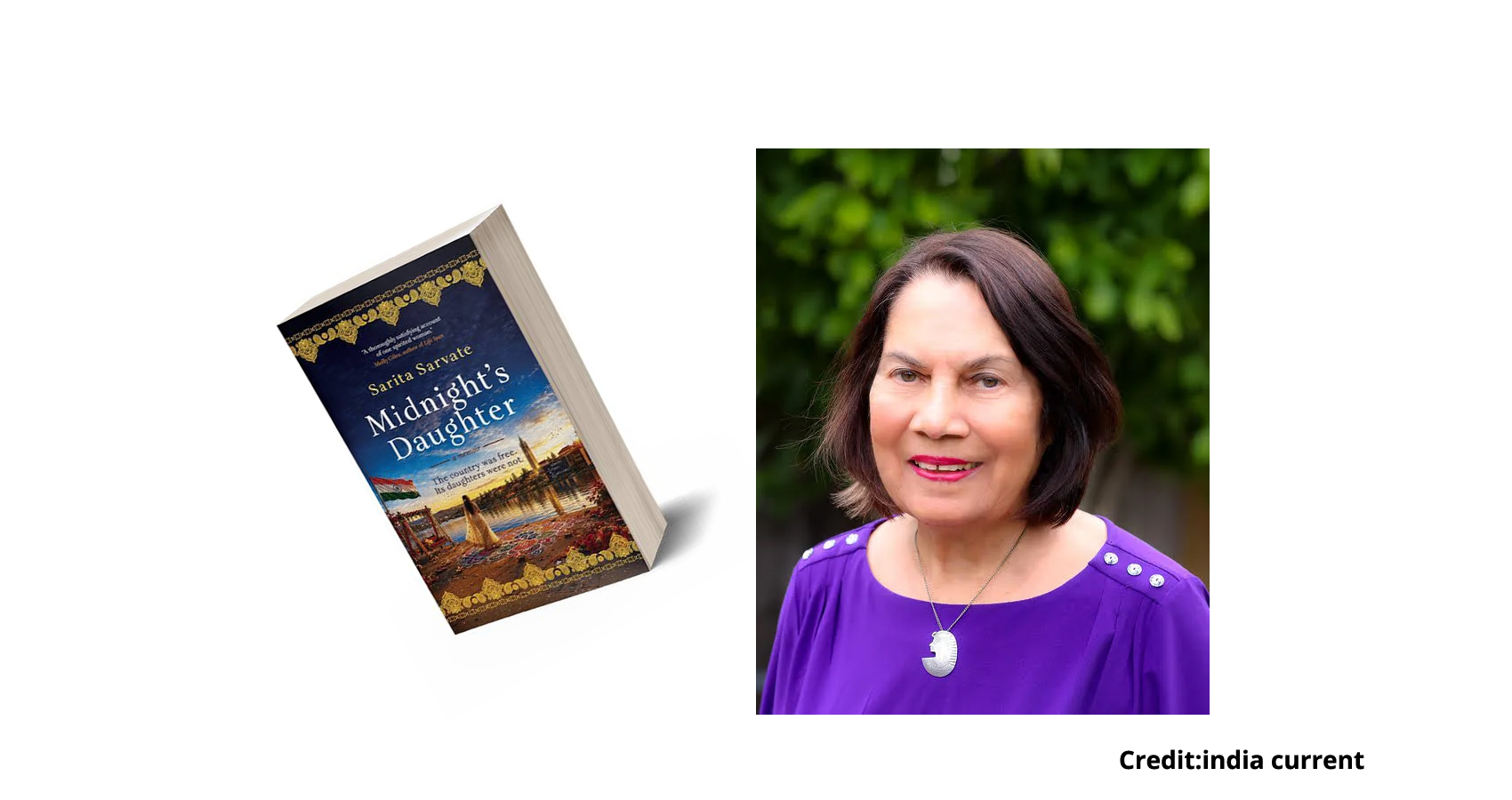
In her memoir *Midnight’s Daughter*, Sarita Sarvate shares a fearless journey of self-discovery that transcends cultural boundaries and personal struggles.
*Midnight’s Daughter* is a powerful and poignant memoir by Sarita Sarvate, a longtime columnist at *India Currents*. For over two decades, she authored “The Last Word,” a sharp and incisive column that provided insights beyond the typical narratives of the perfect Indian family with high-achieving children.
The memoir chronicles Sarvate’s intrepid journey from her childhood in Nagpur, a mid-sized city in India, where she grew up in a family of modest means and faced the challenges of her mother’s mental health issues. Despite excelling academically and earning a master’s degree in Physics, Sarvate succumbed to family pressure to enter an arranged marriage.
In 1976, she moved to UC Berkeley to pursue a master’s in Energy and Resources, where she ultimately decided to end her loveless marriage. This decision led her to Hawaii, where she worked as a researcher studying alternative energy systems and promoting rural development in Asia and the Pacific. Her journey continued as she followed a lover to New Zealand, where she took her first writing class.
*Midnight’s Daughter* is a hero’s journey that chronicles one woman’s remarkable adventure across continents and eras. Sarvate escapes poverty, patriarchy, and mental illness, shaping her identity through various cultures and traditions. The book intertwines her grit with vulnerability, self-doubt, and brutal honesty, addressing topics such as her sexual relationships and her mother’s mental health challenges.
In a particularly fearless moment, Sarvate writes about her decision to check into a mental health facility while grappling with clinical depression following a devastating miscarriage. Her candor is a rarity in South Asian memoirs, allowing readers to recognize their own messy, imperfect lives and embrace the duality of achievement and anxiety.
The title, *Midnight’s Daughter*, is derived from the name Aruna, given to her by her father. It pays homage to Aruna Asaf Ali, the Indian freedom fighter who famously hoisted the Indian flag during the Quit India movement in 1942. This connection reflects a parallel in Sarvate’s own life, as she took on household responsibilities at the age of twelve after her mother suffered a nervous breakdown.
While the title alludes to Salman Rushdie’s *Midnight’s Children*, Sarvate’s narrative is uniquely told from the perspective of a woman born on India’s Republic Day. The memoir highlights various milestones in her life, beginning with a chapter titled “A Vacation at the Insane Asylum,” which details her experiences in a mental health facility. The structure of the book weaves between past events and pivotal moments, such as when she calls an adoption agency from a phone booth in 1988, leading to the unexpected opportunity to adopt an Indian baby.
Throughout the memoir, Sarvate employs a narrative style that immerses readers in her experiences, making it feel akin to a suspense novel. The twists and turns of her life keep readers engaged, eager to discover what happens next.
Additionally, Sarvate artfully interlaces references to books, newspaper articles, and songs from both modern America and ancient India, reflecting or contrasting with the themes in her story. For instance, she quotes Jawaharlal Nehru’s speech on India’s independence, concluding with the acknowledgment that she is *Midnight’s Daughter* and desires her soul to find expression.
Evocative passages throughout the memoir paint vivid pictures of her experiences. One particularly striking moment occurs when her father discovers her name on the Merit List, a moment that elevates his status in their community. Another passage captures her first encounter with the British Council Library, where she learns about a new graduate program that piques her interest.
As she navigates her relationships, Sarvate draws parallels to literary figures such as Mr. Rochester from *Jane Eyre*, exploring the complexities of love and identity. Her reflections on her mother’s life as a widow and the societal pressures she faced provide deeper insights into her own struggles.
In a poignant moment, Sarvate recounts the story of Krishna’s adoption from Hindu mythology, likening it to her own journey of finding love and belonging. She examines her love triangles through a feminist lens, questioning her choices and the implications of marrying a white man.
Her evocative language transports readers to the locations and emotions of her experiences. Descriptions of Tibetan refugees in Nagpur and her impressions of Berkeley in the 1970s create a rich tapestry of her life’s journey.
At its core, *Midnight’s Daughter* is a memoir that resonates deeply, leaving readers mesmerized and reflecting on their own lives long after turning the final page. Sarvate’s story is not just her own; it is a universal exploration of identity, resilience, and the pursuit of happiness.
Published by Vine Leaves Press on September 22, 2026, *Midnight’s Daughter* spans 316 pages and is available in English. The ISBN-13 for the book is 978-3988322821, and it can be found in various formats, including eBook.
According to *India Currents*, Sarvate’s memoir is a testament to the power of storytelling in bridging cultural divides and fostering understanding.