
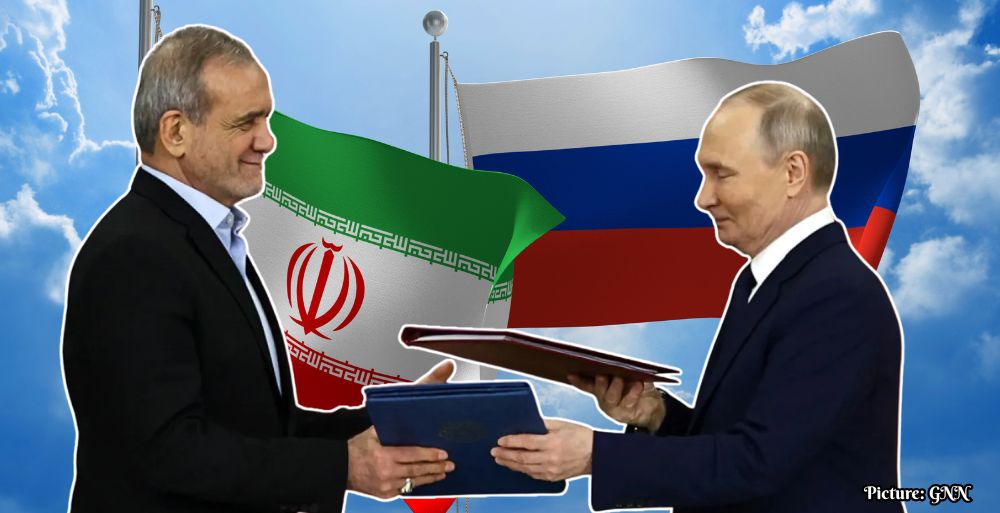
Vladimir Putin expressed strong support for Iran during a recent meeting, highlighting the deepening ties between the two nations amid ongoing U.S.-Iran tensions, according to experts.
Russian President Vladimir Putin has reaffirmed his support for Iran, emphasizing the growing interdependence between the two nations amid escalating tensions with the United States. During a meeting on the sidelines of the Shanghai Cooperation Organization (SCO) Summit in Kyrgyzstan, Putin was photographed shaking hands with Iranian President Masoud Pezeshkian. He stated, “Russia is standing in full solidarity with the people of Iran,” as reported by the Kremlin.
Putin praised Iran’s “courage and resilience in your fight for your national interests” and conveyed his regards to Iran’s Supreme Leader, Mojtaba Hosseini Khamenei. This display of solidarity comes as both countries face significant economic challenges and increasing pressure from the U.S.
Retired U.S. Air Force General Philip Breedlove, a former NATO commander, commented on the evolving relationship between Iran and Russia, stating that “this relationship is growing” and that both nations “need each other desperately.” He noted that both countries are struggling economically, which has driven them closer together.
“In the grand scheme of things, they are both ‘broke,'” Breedlove explained. “They need each other’s help. Russia desperately needs Iran to produce missiles for them because of Ukraine’s attack on Russia’s ability to build missiles. And Iran desperately needs Russian targeting and intelligence to continue to attack Americans in the Middle East.”
Breedlove further elaborated on the military collaboration between the two nations, indicating that Russia is transferring capabilities and technologies to Iran, which helps sustain the Iranian leadership. This partnership is seen as strategically beneficial for both countries, particularly in the context of their mutual opposition to U.S. interests.
Jason Brodsky, the policy director of United Against Nuclear Iran (UANI), echoed Breedlove’s sentiments, stating that Iran and Russia have maintained a long-standing partnership that serves their strategic interests. “Russia views Iran as a cudgel to use against America, and Iran has, in recent years, especially viewed Russia as a lifeline,” he said. This relationship provides Iran with military advancements, economic support, and political backing at the U.N. Security Council.
As tensions continue to rise, Breedlove noted that the conflict between the U.S. and Iran has shifted into a “test of will.” Recent exchanges of aerial strikes between the U.S. military and Iran have underscored the ongoing hostilities. While the U.S. has established air and sea dominance, Breedlove pointed out that Iran’s Islamic Revolutionary Guard Corps (IRGC) believes it can survive without winning the war outright.
“All they have to do is survive and continue to threaten the Strait of Hormuz,” he said, explaining that such threats could significantly impact global maritime insurance rates and disrupt international shipping.
Brodsky expressed skepticism about the possibility of a diplomatic resolution to the U.S.-Iran conflict, stating, “There is no diplomatic happy ending as long as the Iranian regime is in power.” He emphasized the regime’s fundamentally anti-American stance, which complicates any potential negotiations. Brodsky noted that former President Donald Trump has expressed frustration with diplomatic efforts regarding Iran, a sentiment that reflects broader concerns about the regime’s intentions.
During their meeting, Pezeshkian thanked Putin for his support during the ongoing conflicts and U.S. sanctions, stating, “Our relations are of a strategic nature. This is more than just ‘normal’ relations.” He expressed confidence that their partnership would help them withstand U.S. pressures.
Following the Putin-Pezeshkian meeting, Breedlove remarked on the broader implications of Russia’s actions, stating, “The world has a problem with Russia.” He reflected on past efforts to integrate Russia into the Western fold, which have now been undermined by its support for Iran and its ongoing conflict in Ukraine.
Breedlove concluded by highlighting Putin’s vision of spheres of influence, where Russia manages Western Asia and Europe, while the U.S. remains focused on the Western Hemisphere. He asserted that Putin will not change his behavior until he is met with decisive action, emphasizing that “rhetoric doesn’t do anything with Mr. Putin.” He warned that sanctions have not altered Putin’s military strategies, indicating that the West must reassess its approach to dealing with Russia.
As the geopolitical landscape continues to shift, the alliance between Iran and Russia appears to be solidifying, posing challenges for U.S. foreign policy in the region, according to Fox News Digital.