
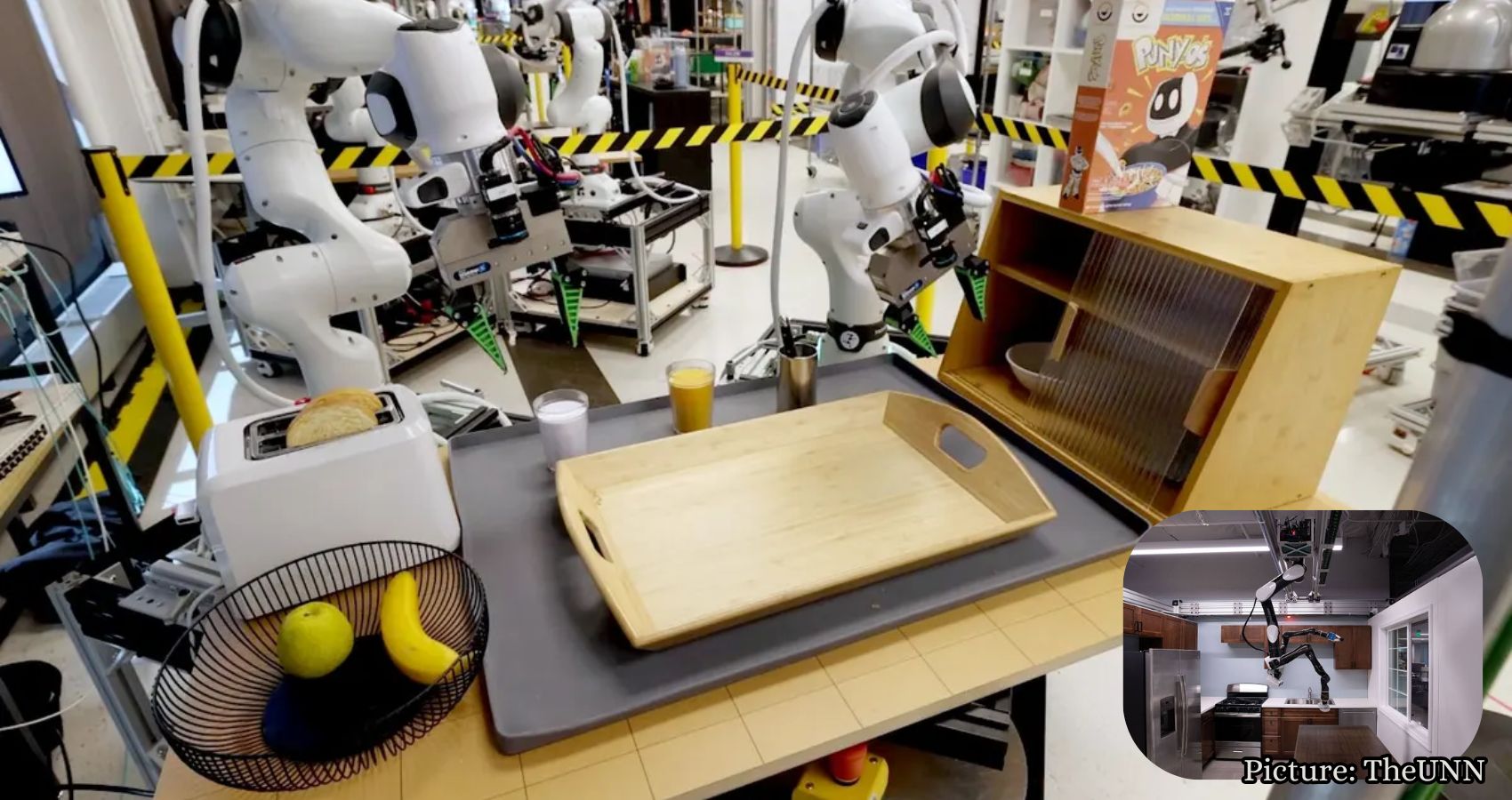
SceneSmith, an innovative AI system, creates realistic virtual environments for robots to practice tasks, allowing them to learn from mistakes before operating in real-world settings.
SceneSmith, a cutting-edge system developed by researchers at MIT’s Computer Science and Artificial Intelligence Laboratory and the Toyota Research Institute, employs AI agents powered by GPT-5.2 to construct intricate 3D environments. These virtual spaces enable robots to practice various tasks and identify faulty plans before they are deployed in actual homes or workplaces.
Consider the simple task of placing a coffee mug in a cabinet. While a human can effortlessly navigate around obstacles and perform this chore without much thought, robots face significant challenges. They must meticulously process each step of the task, which explains why many robots, despite impressive demonstrations, still struggle with basic household or factory jobs. To become reliable, they require extensive experience across diverse environments, making hands-on training both time-consuming and resource-intensive.
SceneSmith aims to address these challenges through virtual training. By generating detailed indoor environments from straightforward text prompts, the system allows robots to practice tasks in a safe and controlled setting. This approach reduces the need for physical testing, which can be complicated by the need to reset scenes after each attempt. A single misplaced object or tipped chair can alter the conditions for subsequent tests, potentially leading to damage or failure.
Simulation offers a safer alternative, allowing robots to repeat tasks without the risk of breaking items or cluttering real workspaces. However, many previous simulation systems produced environments that felt sparse and lacked the realistic details found in everyday spaces. SceneSmith enhances the training experience by creating environments that closely resemble real-world settings.
The process begins with a simple written request. For instance, a researcher might ask for a garage featuring a car and a workbench, with additional items like tires and a ladder. Three AI agents collaborate to build the space: a designer creates the room, a critic assesses its realism, and an orchestrator manages the workflow and determines when the design is complete.
SceneSmith constructs each environment layer by layer, starting with the floor plan and furniture, then adding wall and ceiling objects, and finally incorporating smaller, movable items. The critic plays a crucial role in ensuring that all elements are appropriate for the setting, suggesting adjustments when necessary. For example, it might recommend removing a bathtub from a living room. If any part of the design requires further work, the orchestrator can send the project back for revisions.
Once the agents reach a consensus, SceneSmith integrates physics to control how objects interact within the environment. This results in a functional virtual room where robots can open cabinets and manipulate objects, rather than just a visually appealing 3D scene.
Robots require more than just realistic visuals; they need interactive objects that respond to touch. SceneSmith can create cabinets with operable doors and movable items while estimating physical properties such as mass and friction. These details significantly influence how an object behaves when a robot interacts with it.
For standard objects, the system employs a text-to-image-to-3D process, sourcing articulated items from a curated library. This method ensures that cabinet doors and drawers remain functional within the simulation. Additionally, SceneSmith checks for overlapping objects and allows gravity to settle them into stable positions. Researchers reported that 96% of objects remained stable during simulations, with fewer than 2% of object pairs colliding, underscoring the importance of realistic interactions for effective robot training.
SceneSmith has already generated over 1,300 scenes, including familiar environments like bedrooms and hotels, as well as more unique settings such as a pottery store and a Minecraft-themed gaming room. Some scenes feature up to six times more items than those produced by earlier methods, providing robots with the opportunity to encounter the clutter that complicates real-world tasks.
For example, a robot might be tasked with moving a soda can from a shelf to a table or placing a cup in a sink. Each scene presents different surroundings, preventing the robot from relying on a single, meticulously arranged layout. This variability allows engineers to evaluate whether a robot’s plan is effective across multiple scenarios.
In robotics, a policy dictates how a machine should act based on its observations. SceneSmith enables researchers to test these policies in various environments. The team created 100 evaluation scenes covering four manipulation tasks, with a robot policy attempting each chore in simulation. An AI evaluator then assessed the results, achieving a remarkable 99.7% agreement with human labels. This suggests that the system could facilitate large-scale evaluations of robot performance without the need for manual oversight.
While the phrase “learn from their mistakes” is often associated with this technology, it is essential to clarify that SceneSmith identifies where a policy fails, allowing engineers to refine the robot’s behavior in subsequent iterations. The focus of this study was on scene generation and automatic evaluation rather than continuous self-retraining after every mistake.
To ensure the effectiveness of the virtual environments, researchers tested SceneSmith through physical interactions within the simulator. They placed an independently trained robot policy into generated scenes, demonstrating its ability to follow language instructions, such as moving an apple from a bowl to a cutting board. These tests confirmed that the environments could support more than just visual assessments, providing early evidence that SceneSmith’s rooms are conducive to valuable robotics experiments.
In a comparative study involving 205 participants, SceneSmith outperformed earlier scene-generation methods, achieving an average 92% win rate for realism and a 91% win rate for adherence to the original prompt. Participants consistently found SceneSmith’s rooms to be more believable and closely aligned with their requests. However, the ultimate measure of success lies in robot performance, and SceneSmith’s ability to combine realistic design with functional physics gives it a significant advantage.
Despite its potential, building detailed virtual rooms with SceneSmith is time-consuming, often requiring several hours to produce a single scene due to the extensive object creation and inspection process. Increased computing power could expedite this, but generating a comprehensive training library will still demand considerable resources. Additionally, the current system has limitations in simulating deformable objects, such as sponges, which change shape upon contact. Researchers hope to expand their capabilities by developing larger 3D libraries.
Real-world testing remains crucial, as homes are filled with unpredictable elements, including people and objects that can wear down or break. While simulation can mitigate risky trial-and-error scenarios, engineers must still validate that robots can operate safely in physical environments.
In the future, household robots could practice in hundreds or even thousands of virtual rooms before entering a real kitchen. This extensive preparation allows developers to identify and rectify potential issues while the robot remains in a safe, simulated environment. SceneSmith’s ability to expose robots to diverse furniture, objects, and layouts is vital, as no two kitchens are identical.
Ultimately, SceneSmith addresses a significant challenge for robot developers: preparing machines for homes where furniture shifts, counters accumulate clutter, and nothing remains static. By providing a safe space for robots to learn and make mistakes, engineers can identify and correct errors before the machines interact with real people or objects. The system’s unique feature is that its virtual rooms function like physical spaces, with operable cabinets and movable objects. While the speed of scene generation poses a drawback, the potential benefits of these AI-generated environments could significantly enhance the development of household robots.
Would you feel more comfortable with a household robot that has already navigated thousands of virtual environments and learned from its mistakes? Share your thoughts with us at Cyberguy.com.
According to Fox News, the technology remains in the research phase, but its implications for the future of robotics are substantial.