
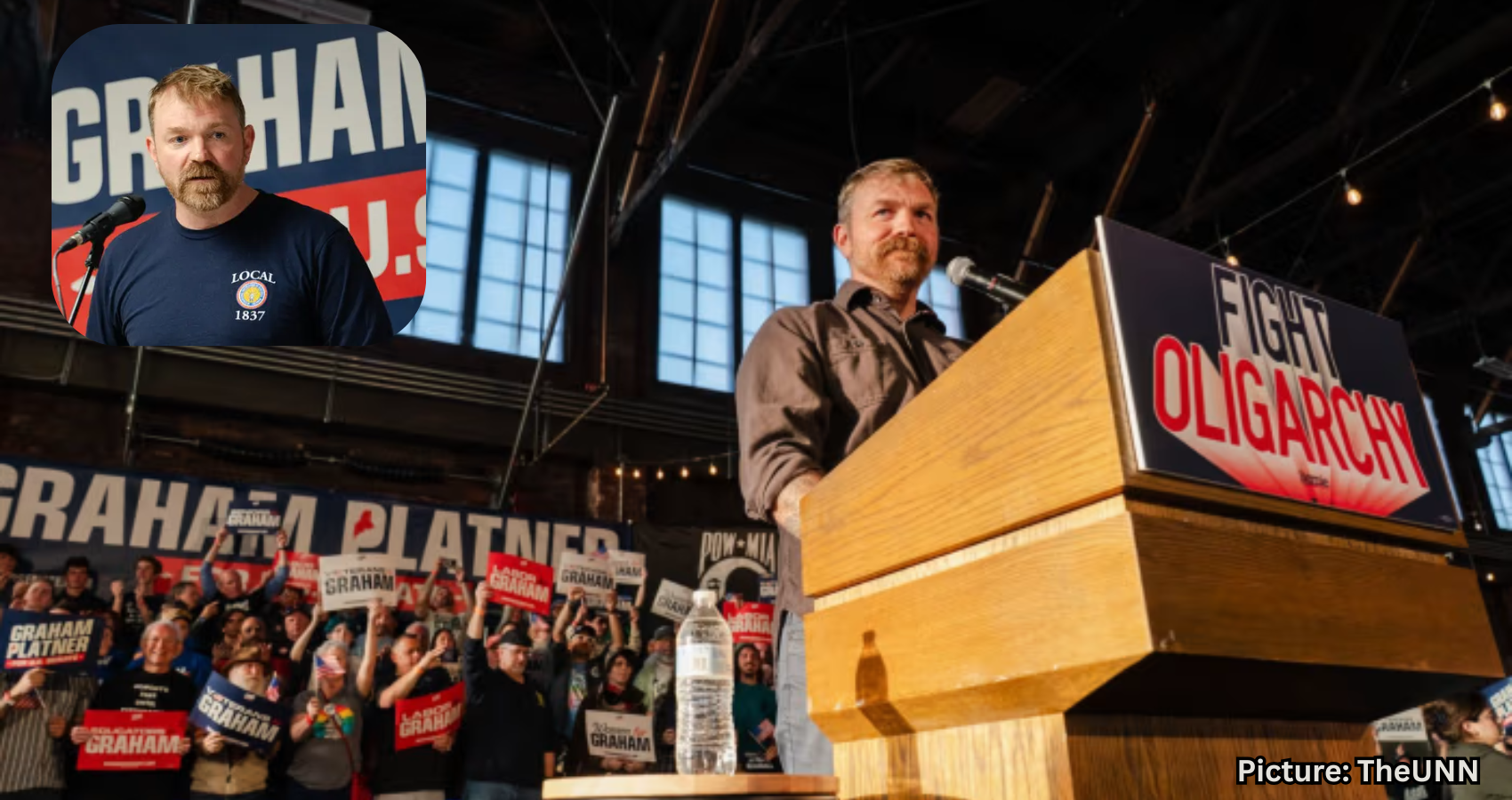
Maine Senate candidate Graham Platner faces a series of controversies that could impact his campaign as he seeks to challenge incumbent Senator Susan Collins.
Maine Democratic Senate candidate Graham Platner has garnered national attention as one of the party’s rising stars, known for his populist message and outsider image. However, as his profile has increased, so has scrutiny of his past conduct, leading to a series of controversies that have raised questions about his candidacy.
Platner’s campaign has been marred by allegations ranging from sexually explicit messages and offensive social media posts to a tattoo linked to Nazi symbolism and internal staff issues. In an effort to address these controversies, Platner traveled to Washington, D.C., to meet with party leaders at the Democratic Senatorial Campaign Committee headquarters just a week before the primary election.
The Marine veteran and oyster farmer has defended himself against the criticisms and retains the backing of prominent Democrats, including Senate Minority Leader Chuck Schumer, D-N.Y., and Senators Bernie Sanders, I-Vt., and Elizabeth Warren, D-Mass. Nonetheless, some party members are concerned that these allegations could hinder efforts to unseat Senator Susan Collins, R-Maine, in what is considered one of the most closely watched Senate races in the country.
One of the most significant controversies surrounding Platner involves reports that he exchanged sexually explicit messages with multiple women during his marriage. According to a report by The Wall Street Journal, Platner’s wife, Amy Gertner, informed a campaign aide about these text exchanges shortly after he launched his Senate bid. Gertner discovered the messages months after their marriage in 2024 and disclosed their existence before Platner held a campaign rally alongside Senator Sanders. The campaign later confirmed the existence of the text exchanges, stating that the aide viewed the matter as a private issue between the couple.
In a statement, Platner acknowledged the difficulties in his marriage, expressing gratitude for Gertner’s support. “Amy and I went through something hard — because of me. We did the work, and I’m grateful for her every hour of every day,” he said. He emphasized that voters are more concerned with substantive issues than personal gossip, stating, “Our opponents want politics to be empty of content and empty of actual change — and beating that is exactly what our movement is about.”
Gertner also criticized the public disclosure of their private issues, stating that she had shared “deeply personal details” with someone she considered a friend. She revealed that they attended couples counseling and have since emerged stronger. “I know who Graham is. I know the man I married and the husband he has been to me on the best and the worst days of my life,” she said. “That hasn’t changed, and it won’t.”
Another controversy arose when it was revealed that Platner had once sported a skull-and-crossbones tattoo resembling the “Totenkopf” symbol associated with Hitler’s SS paramilitary forces. Platner stated that he got the tattoo during a “night of drinking” while on leave in Croatia in 2007 and claimed he was unaware of its meaning at the time. In a May Instagram video, he explained that he chose the design from a flash tattoo wall while “carousing” with fellow Marines, downplaying its significance.
After learning of the tattoo’s implications, Platner expressed his dismay, asserting that his life and career have been defined by opposition to fascism, racism, and Nazism. He noted that he was never questioned about the tattoo during his military service. Instead of removing the tattoo, he opted to cover it up due to the lack of tattoo removal services in his rural Maine community. The original design was replaced with a tattoo featuring a Celtic knot and images of dogs, which he said were meant to honor his family pets.
Platner has also faced scrutiny for past social media posts that resurfaced after he announced his Senate candidacy. Under the now-retired username “P-hustle,” Platner made thousands of posts on Reddit, where he referred to himself as a “communist” and “socialist,” and endorsed the slogan “all cops are b—–ds.” In other posts, he suggested that those who expect to fight fascism without a semi-automatic rifle should “do some reading of history,” and argued that “an armed working class is a requirement for economic justice.”
These posts, which included crude comments and controversial opinions, were deleted prior to his campaign launch in August. Platner has since addressed the posts, stating that he was “f—ing around on the internet” during a time when he felt disillusioned with the government. “I made dumb jokes and picked fights,” he said. “But of course I’m not a socialist. I’m a small business owner, a Marine Corps veteran, and a retired s—poster.”
Despite these controversies, Platner’s standing within the Democratic Party remains strong. He continues to attract national attention and grassroots support as he campaigns to challenge Senator Collins. Following the withdrawal of former Democratic Maine Governor Janet Mills from the race in April, much of the party establishment has rallied behind Platner, and national Democrats have maintained their support despite the ongoing scandals.
The controversies surrounding Platner have also highlighted a little-known provision in Maine election law that allows political parties to replace a nominee under certain circumstances after a primary election. According to state law, a candidate who wins a primary and subsequently withdraws by 5 p.m. on July 13 can be replaced by a nominee selected by party officials. Any replacement candidate must be chosen by 5 p.m. on July 27. However, there is currently no indication that Platner plans to withdraw from the race, and he has repeatedly vowed to continue his campaign.
As the primary election approaches, questions remain about whether additional revelations could complicate Platner’s candidacy further. His campaign did not immediately respond to requests for comment.