
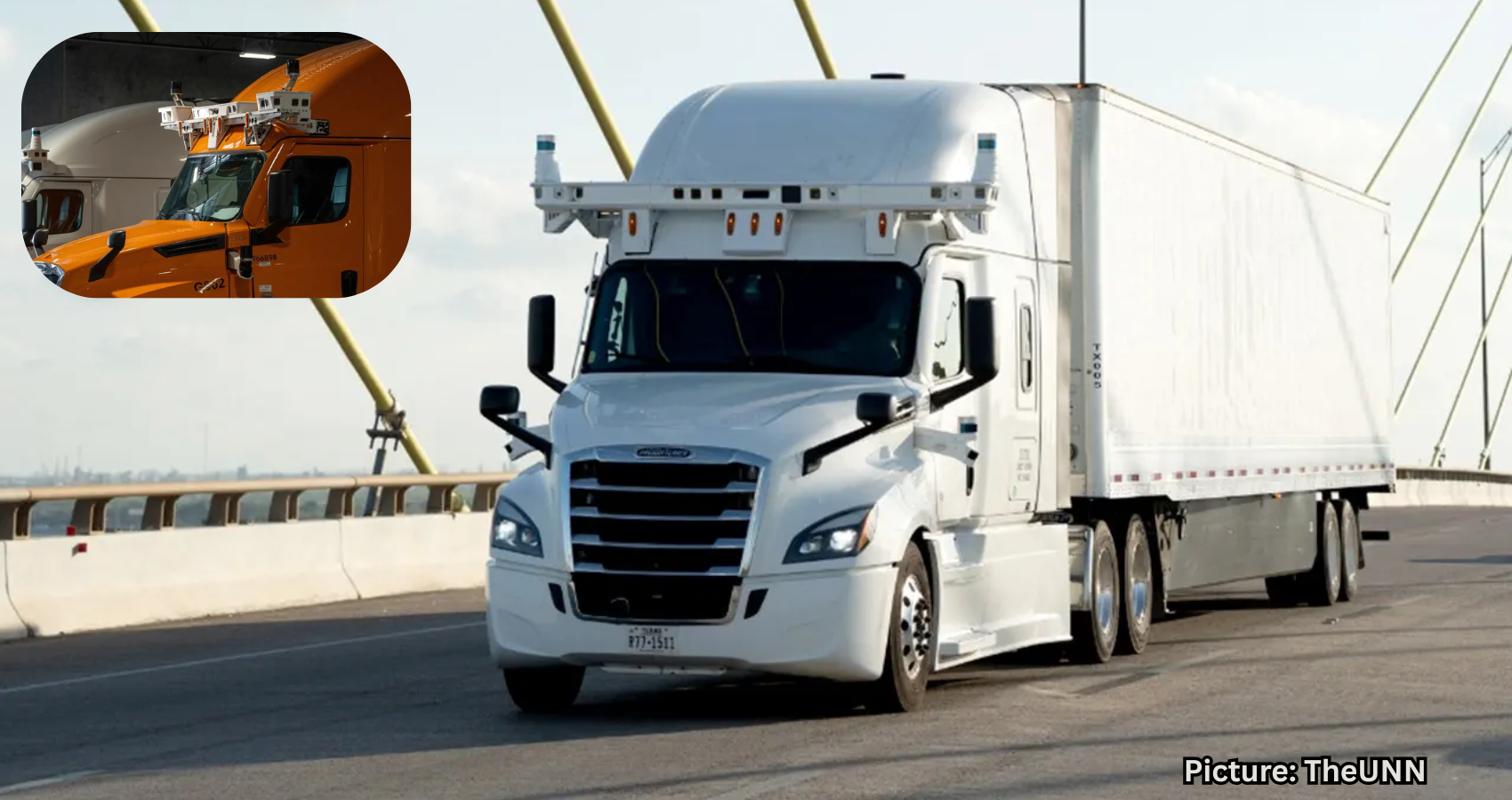
Bot Auto has achieved a significant milestone by completing the first fully humanless commercial freight delivery in the U.S., traveling 230 miles from Houston to Dallas without a driver.
A big rig operated by Bot Auto embarked on a groundbreaking journey from Houston, Texas, in the early hours of the morning, completing a 230-mile delivery to Dallas without any human presence inside the vehicle. This delivery marks what Bot Auto claims to be the first fully humanless, over-the-road commercial truckload in the United States.
According to the company, this run was not a controlled test or staged demonstration; it adhered to a real customer timeline and utilized the same freight network that businesses rely on daily. Xiaodi Hou, CEO and founder of Bot Auto, detailed the journey, stating, “Our autonomous truck departed Riggy’s Truck Parking in northeast Houston, headed to Hutchins, Texas, just south of Dallas. The truck ran 230 miles northbound on I-45, one of the busiest freight corridors in the country, navigating stoplights, side streets, and frontage roads without a safety driver, observer, or remote operator.” The delivery was arranged through Ryan Transportation, a top-20 freight brokerage, emphasizing that this operation was executed like any standard overnight load, just without a driver.
Hou highlighted the significance of this achievement, asserting, “Real freight, real customer, real timeline, delivered safe and on time. We made money on it. This is a commercial business, not a research project.” This statement underscores the operational integrity of the run, which was not staged behind the scenes.
Many companies in the autonomous trucking industry still rely on hidden human support, but Bot Auto differentiates itself by emphasizing a fully humanless operation. “The industry often blurs the line between driverless and human-supervised,” Hou explained. “For Bot Auto, fully humanless means no safety driver, no back-seat monitor, and no low-latency remote human fallback.” The company’s safety design does not require any human intervention within one minute to maintain the truck’s safety, allowing the vehicle to operate independently.
Addressing concerns about how the autonomous system reacts under pressure, Hou assured that the truck is engineered to handle unexpected situations autonomously. “The truck would not wait for a human to save it,” he stated. “If it encounters a condition outside its approved operating boundary, it would enter a mitigated risk condition: slow down, create space, and bring itself to a controlled safe state.” This proactive approach ensures that the vehicle prioritizes safety first, with human support available only after the situation is under control.
Bot Auto’s decision to remove the driver followed extensive validation and rigorous testing. The company conducted millions of miles of simulations and real-world tests with safety drivers, ensuring that the system performed at or above the level of a professional human driver on this route. “Safety isn’t one number; it is a system-level property,” the company stated, emphasizing the thoroughness of their testing protocols.
Economics play a crucial role in the viability of autonomous trucking. Hou noted that the cost of this particular run came in below $2 per mile, which is less than the typical cost associated with human-driven trucks. He cautioned against oversimplified comparisons, asserting that the cost impact of autonomous trucking extends beyond merely replacing driver wages. “The savings go deeper into operations,” he said, indicating that as the network expands, the per-mile cost of technology will continue to decline.
Texas has positioned itself as a leader in facilitating autonomous vehicle deployment. The state passed Senate Bill 2807 in 2025, establishing a formal authorization program for commercial autonomous vehicle operations. Bot Auto successfully applied and met all requirements, including safety compliance and system reliability.
The company is now focused on expanding its operations along high-volume freight lanes in the Texas triangle, which encompasses Houston, Dallas, and San Antonio. “The Houston-to-Dallas lane is repeatable now, and it isn’t a one-time event,” Bot Auto stated, highlighting the strong infrastructure and supportive regulatory environment that makes this route viable.
Despite years of skepticism surrounding autonomous trucking, Hou is confident in the future of the industry. “A truck left Houston with no one in it, ran 230 miles on public roads, and delivered freight to a customer on time. That happened,” he asserted. He acknowledged the previous doubts but emphasized that the focus has shifted from whether autonomous trucking can be done to who can do it safely and economically at scale.
The implications of this technological shift extend beyond the trucking industry. If autonomous freight becomes widespread, it could lead to more predictable deliveries, tighter overnight shipping windows, and potentially lower costs over time. However, there are workforce implications to consider, as long-haul trucking is a significant source of employment. While supporters highlight the benefits of reduced fatigue and fewer human errors, critics call for long-term data to assess the impact on jobs and the economy.
As this Texas run demonstrates, autonomous freight has progressed beyond the prototype stage. The key question now is whether companies can replicate this success across various routes and conditions while maintaining safety. With the potential for humanless semi-trucks to become a common sight on highways, the future of freight transportation is poised for transformation.
For more insights on the implications of autonomous trucking, visit CyberGuy.com.