
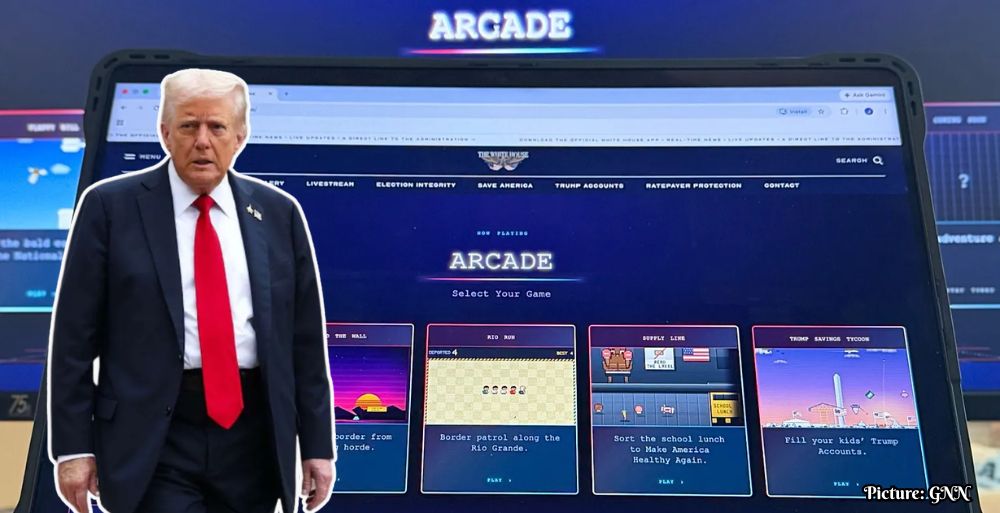
President Donald Trump’s administration has launched a series of MAGA-themed arcade games, drawing both interest and criticism for their portrayal of immigration and border security issues.
The Trump administration has introduced a new online arcade featuring five MAGA-themed games that creatively incorporate elements of President Donald Trump’s political agenda. This initiative, unveiled on September 3, aims to engage a wider audience by transforming traditional political messaging into interactive gameplay.
Among the games, “Rio Run” and “Build the Wall” have garnered significant attention for their direct connections to Trump’s immigration policies. “Rio Run,” inspired by the classic Snake format, allows players to navigate the Rio Grande while collecting individuals attempting to cross the border. Meanwhile, “Build the Wall” adopts a Tetris-like approach, challenging players to construct a border barrier using falling blocks.
The White House’s decision to launch these games appears to be a strategic move to communicate Trump’s policies in a more engaging manner. Rather than relying solely on speeches and social media posts, the administration has packaged several key issues into short, interactive experiences accessible through the White House website.
In a statement, the White House emphasized its goal of presenting the administration’s achievements in a format that resonates with Americans. “This administration is laser focused on ways to innovate and tell the story of the President’s many accomplishments in a way that resonates with every American,” the statement read. It further claimed that the initiative contrasts a culture of fun and winning with what it described as the “dark socialist vision” of the Democrats.
The launch video for the arcade cleverly mimics the visual style of major gaming companies, even transforming the Sega logo into “MAGA,” a nod to Trump’s campaign slogan. The White House promoted the games on social media with messages like, “CAN’T STOP WINNING. Build the wall. Deport. Fill a Trump Account.”
However, the arcade has faced backlash, particularly for its portrayal of immigration issues. Critics argue that games like “Rio Run” trivialize serious matters by reducing complex human experiences to mere scoring systems. Amerika Garcia Grewal, co-director of the Frontera Federation in Eagle Pass, Texas, expressed her dismay, stating, “They’ve been playing games with people’s lives for years; now they’ve made a video game of what they’re doing.” She criticized the lack of empathy in the game’s design, emphasizing that those living in border communities are often treated with suspicion and violence.
The second game, “Build the Wall,” similarly transforms a contentious political proposal into an arcade challenge. Players are tasked with arranging blocks to create a border wall, with instructions urging them to “Protect the border from the coming horde.” This game has also drawn criticism for its insensitivity to the real-life implications of immigration policy.
In addition to the immigration-focused games, the arcade features three others that highlight different aspects of Trump’s political agenda. “Supply Line,” inspired by the classic arcade game Tapper, requires players to manage food products on a conveyor belt, rejecting those that do not meet the game’s standards, reflecting Trump’s Make America Healthy Again initiative.
“Flappy Bill,” a take on the popular Flappy Bird game, allows players to control a bald eagle navigating through obstacles in Washington, D.C., while carrying a piece of legislation. Lastly, “Trump Savings Tycoon” focuses on the administration’s child savings program, where players collect money to fill children’s so-called Trump Accounts, which include a $1,000 deposit for eligible children born during Trump’s second term.
The criticism surrounding the arcade centers on the ethical implications of turning immigration enforcement into a form of entertainment. Rights advocates argue that such games oversimplify the complexities of human experiences and ignore the realities faced by migrants and border communities. As the Trump administration continues to pursue a stringent immigration enforcement agenda, the timing of this arcade launch has raised eyebrows.
While the White House maintains that the initiative is a creative way to communicate its policies, critics contend that it blurs the line between political messaging and entertainment. The arcade exemplifies a broader trend of unconventional digital communication employed by Trump’s administration, which has often utilized social media, memes, and visual stunts to promote its policies.
As the arcade continues to attract attention, it remains to be seen whether it will serve as a lasting tool for political communication or simply another internet stunt from the White House. Regardless, its launch has sparked a significant debate over the appropriateness of using entertainment to address serious political issues involving real people and contentious government policies.
According to AFP, the arcade’s launch has ignited discussions about the intersection of politics and entertainment in contemporary discourse.