
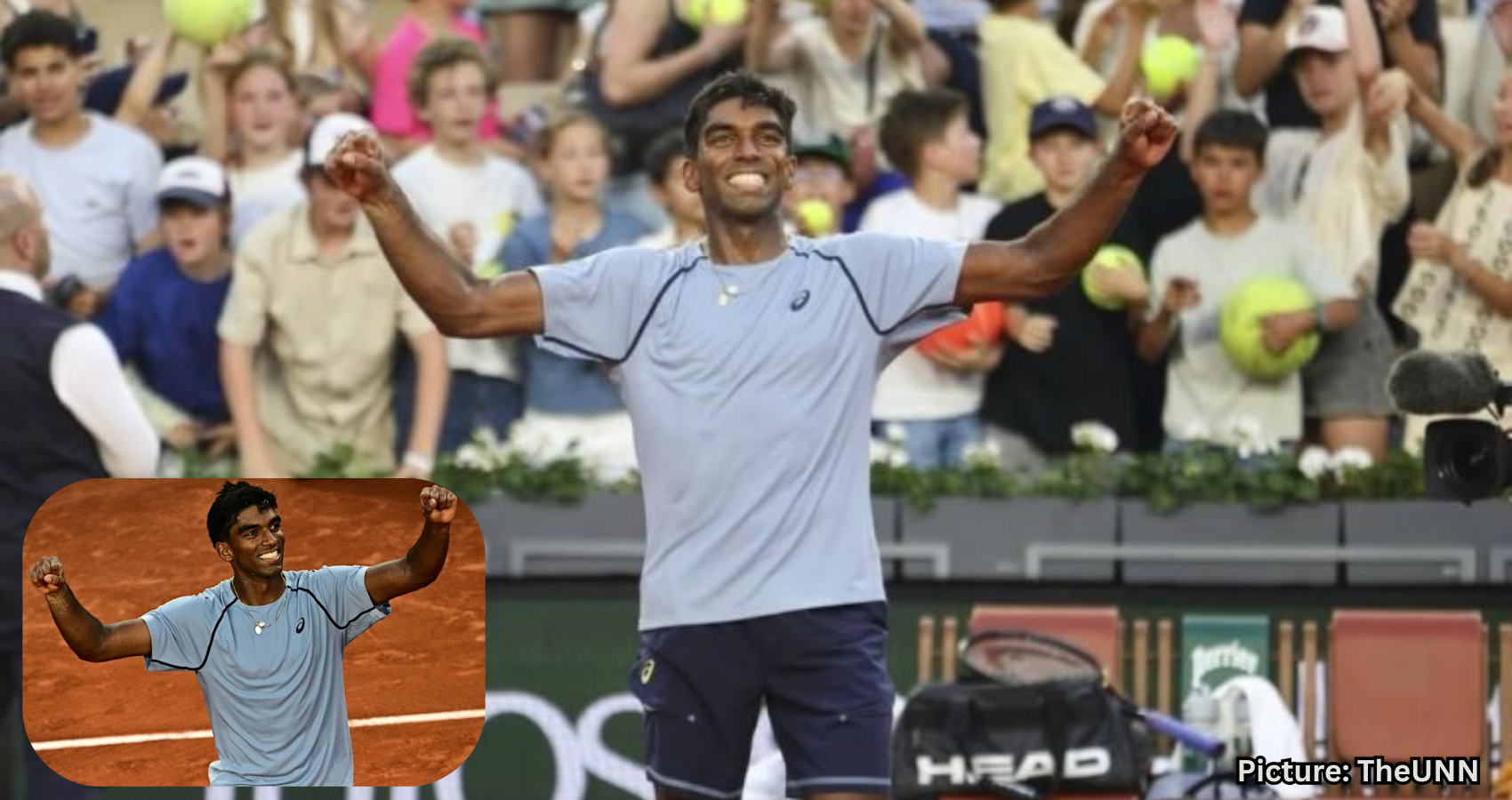
Nishesh Basavareddy achieved a stunning upset over Taylor Fritz in the first round of the French Open, highlighting the challenges faced by American hardcourt specialists on clay.
PARIS — In a surprising turn of events at Roland Garros, 21-year-old American wildcard Nishesh Basavareddy defeated seventh seed and fellow American Taylor Fritz in a grueling four-set match on Court Suzanne Lenglen. This victory marks Basavareddy’s first career win against a top-10 opponent and sheds light on the physical challenges and competitive rust that have affected Fritz following a two-month hiatus due to a chronic knee injury. The match also highlights a broader issue within American men’s tennis: the difficulty of transitioning from hardcourt success to the demanding red clay of Paris.
The opening round of the 2026 French Open delivered an immediate shakeup to the men’s singles draw on Sunday, as world number 148 Basavareddy upset the seventh-seeded Fritz with a score of 7-6(5), 7-6(5), 6-7(9), 6-1. The match, played under the intense afternoon sun, lasted over three hours and effectively concluded Fritz’s highly anticipated but brief European clay-court campaign.
Basavareddy, making his main draw debut at Roland Garros, showcased a level of tactical maturity and physical resilience that belied his ranking. He faced the top-ranked American on the ATP tour and utilized a sophisticated mix of deep baseline groundstrokes and delicate drop shots to exploit Fritz’s compromised lateral movement.
For Fritz, 28, this defeat signifies a second consecutive first-round exit at Roland Garros, a disappointing setback for a player who had previously reached the semi-finals in Madrid and the quarter-finals in Rome. The loss intensifies scrutiny regarding his physical readiness after a competitive layout hampered by injury.
To understand the mechanics of this upset, it is essential to examine Fritz’s recent physical trajectory. He arrived in Paris having played only one competitive match on clay this spring—a first-round loss at the Geneva Open last week. This appearance followed a strict two-month period of inactivity due to a chronic knee issue that has periodically hindered his ability to train at high intensity.
The transition from hardcourts to clay requires unique physical adaptations. Unlike hard surfaces, where movement involves abrupt stopping and starting, clay demands continuous sliding, exceptional core stability, and prolonged baseline rallies. The surface inherently slows ball speed by roughly 20% to 25% compared to faster hard surfaces, meaning players cannot rely solely on raw serve velocity to win free points.
Fritz, whose game is built around a powerful first serve and a heavy baseline forehand, struggled to establish rhythm throughout the match. His first-serve percentage hovered below his season average of 64% during the first two sets, allowing Basavareddy ample opportunities to look for breaks of serve. The lack of match fitness became evident in the long, lateral baseline exchanges, where Fritz appeared hesitant to fully load weight onto his injured leg.
From the outset, Basavareddy demonstrated that he was undaunted by the grand stage or his opponent’s formidable pedigree. The first set progressed strictly with serve, leading to a see-sawing tiebreak. At 5-5 in the tiebreak, Basavareddy forced an error from Fritz with a deep, dipping cross-court backhand, securing the mini-break and ultimately the set.
In the second set, Fritz attempted to change his tactical approach by hitting flatter and closer to the lines. While he generated early break points, his unforced error count began to climb significantly. Basavareddy capitalized on this by varying his depth and frequently drawing Fritz into the net with impeccably disguised drop shots, forcing the taller Fritz into uncomfortable low-volley situations.
The second-set tiebreak mirrored the first. Facing consecutive set deficits, Fritz pushed a forehand wide, allowing Basavareddy to unleash a powerful, unreturnable serve down the T to double his lead.
The third set showcased Fritz’s competitive resolve. Neither player yielded a break point over 12 highly competitive games. In the ensuing tiebreak, Basavareddy earned a match point at 6-5, which Fritz saved with an aggressive inside-out forehand winner. After squandering two set points of his own, Fritz finally converted on his third attempt, taking the tiebreak 11-9 and signaling a potential shift in momentum with a loud scream toward his player box.
However, any expectations of a standard veteran comeback were quickly dispelled in the fourth set. Instead of collapsing after losing a tight third set, Basavareddy broke Fritz’s serve in the opening game of the fourth frame. The physical exertion of the previous sets clearly caught up with the seventh seed, whose movement slowed considerably.
Basavareddy raced to a 5-0 lead, conceding only four points on his own serve during the final set. He closed out the match on his second match point, prompting a standing ovation from the crowd, with portions of the stadium chanting his name.
Reflecting on his performance in the post-match press conference, a composed yet visibly elated Basavareddy detailed his mindset. “I knew I was playing at a high level,” he said, speaking to reporters in a packed interview room. “If I kept going, I’d have more chances, and I was able to come out strong in the beginning of the fourth set. That was the best set I think I’ve ever played.”
When asked about managing his nerves after the disappointment of the third set, he emphasized the significance of his achievement. “I’m super happy to get through that after losing that third set … thank you all,” Basavareddy added, nodding toward his coaching staff. “All the players play their best in these tournaments, and for me to do that today means the world.”
Basavareddy’s breakthrough victory injects a compelling narrative into American men’s tennis, a program that has experienced a renaissance in rankings depth but continues to seek a Grand Slam singles title since 2003. Historically, American players trained almost exclusively on domestic hardcourts, creating a stylistic bias toward big serves and flat groundstrokes. While modern infrastructure, such as the USTA National Campus in Orlando, has incorporated European red clay courts to bridge this developmental gap, success at Roland Garros remains elusive for many top-tier American professionals.
For Basavareddy, who spent his collegiate career developing a versatile, all-court game, this win signifies a significant rise in the live ATP rankings, positioning him to transition from the ATP Challenger Tour into mainstream ATP 250 and 500 events. For Fritz, the focus now pivots entirely to rehabilitation and preparation for the grass-court season, culminating at Wimbledon, where the lower bounce and quicker points are traditionally much friendlier to his baseline-centric style, according to Source Name.