
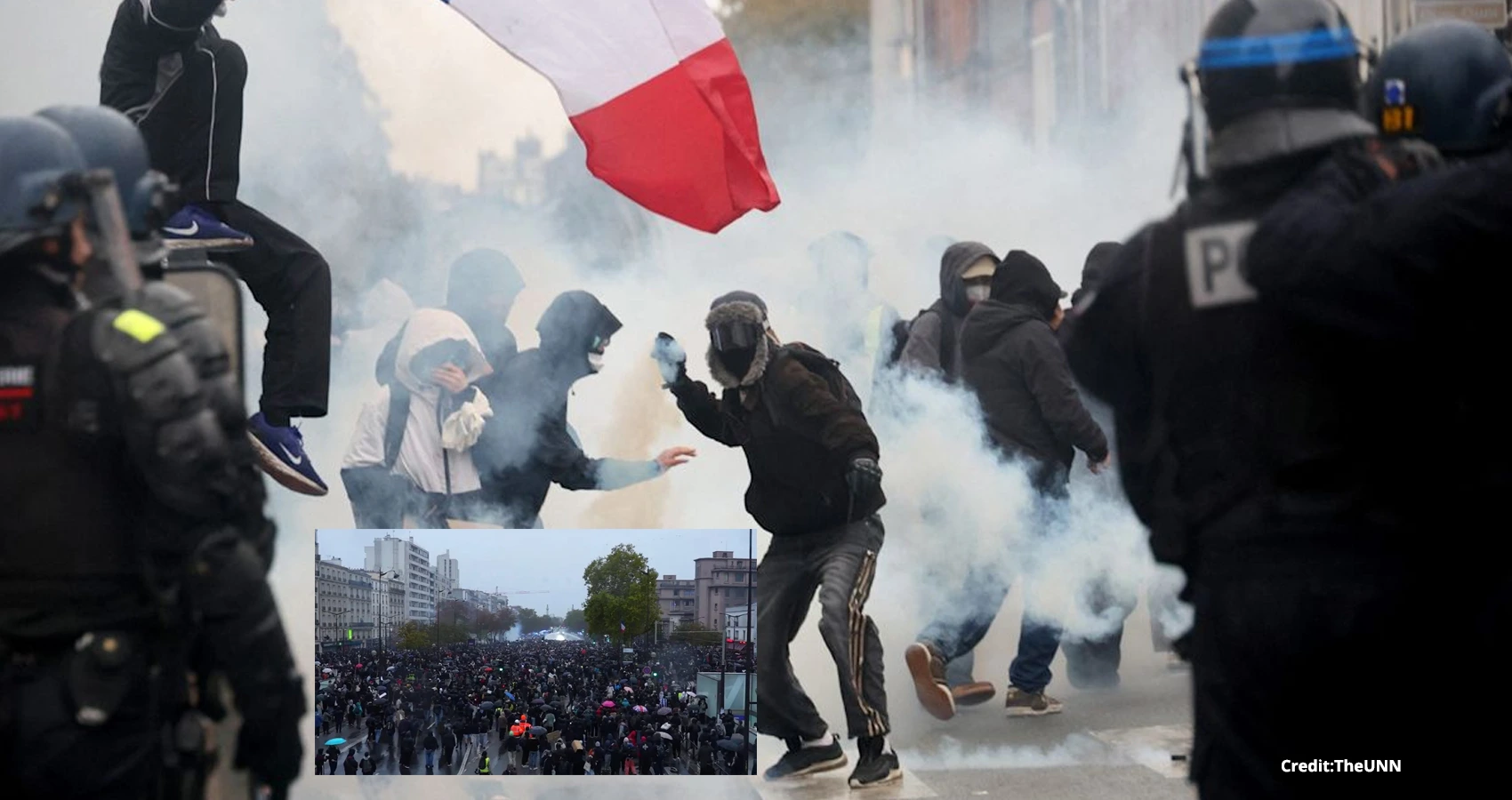
Nearly 1,000 arrests were made across France during nationwide protests, prompting a significant police presence and raising concerns about public safety amid escalating unrest.
French Interior Minister Laurent Nuñez announced that nearly 1,000 individuals were arrested on Saturday as protests erupted across the country. This surge in unrest has not only affected France but has also sparked violent clashes in cities such as Rome and Tirana, Albania, where demonstrators set government buildings ablaze.
As tensions escalated, President Donald Trump commented on the situation, suggesting that the turmoil in France serves as a warning for potential unrest in the United States under left-wing leadership. Earlier in the day, police conducted preemptive searches of protesters and detained individuals suspected of carrying potential weapons, including fireworks and ball bearings, according to reports from Reuters.
In Paris, where police estimated that 110,000 people participated in the march, officers conducted over 3,000 checks and arrested 65 individuals, as reported by the BBC. The French Interior Ministry indicated that approximately 410,000 people took part in protests nationwide, while union organizers claimed attendance figures reached 800,000. In Paris, union leaders estimated turnout at 250,000, contrasting with the police’s lower estimate.
The Paris Police Department issued a statement on social media, asserting that “violent individuals have no place in the marches.” The department emphasized its objective to prevent troublemakers from infiltrating the protests and to ensure the safety of demonstrators.
Central Paris resembled a city under lockdown, with shopkeepers boarding up storefronts, museums closing, and more than 20 metro stations suspending service. In other cities, including Clermont-Ferrand, Grenoble, Lille, and Nice, police resorted to firing tear gas to disperse unruly crowds. In Nice, a water cannon was deployed against demonstrators who refused to retreat, while clashes between police and hooded youths occurred in Marseille and Lyon.
The unrest extended beyond France, reaching Italy, where police used a water cannon against protesters in Rome. Demonstrations over rising living costs and the ongoing war turned violent, with riot police confronting demonstrators. Similar confrontations were reported in Turin and Bologna, although protests in Milan remained largely peaceful. In response to the previous weekend’s widespread rioting and looting, Italian authorities heightened security measures.
In Tirana, Albania, riot police employed water cannons against protesters, some of whom set government buildings on fire and hurled projectiles at officers. Students from high schools and universities have been demanding lower tuition fees, increased investment in education, and an end to corruption within the education system. Some protesters have aligned themselves with a broader anti-government movement calling for the resignation of Socialist Prime Minister Edi Rama. Rama stated that his government is preparing a response to the students’ demands and urged for dialogue, while warning that violent protesters would face consequences, according to The Associated Press.
Trump’s remarks came after he cast his early-voting ballot for the 2026 midterm elections in West Palm Beach, Florida. He criticized previous leadership in the U.S. and argued that similar unrest could manifest in America under left-wing governance. “Just two years ago, we were laughed at. We were a stupid country. We were a country led by idiots and morons and bad people and radical left people. … Just take a look at France because that’s what they’d like to have for our country, and I don’t let that happen,” he stated.
In response to the escalating situation, approximately 70,000 police officers have been deployed across France to manage the protests and prevent the kind of violence seen in recent demonstrations, which included car fires and the burning of a city hall building in Limoges. Last weekend, more than 2,700 individuals were arrested during protests that devolved into riots and looting sprees.
The nationwide marches reflect a growing dissatisfaction with the French government, as protesters voice a range of grievances. The demonstrations began weeks ago, primarily led by high school and university students frustrated with teacher shortages and poor school conditions, including overcrowded classrooms and dilapidated facilities. The movement gained momentum when major labor unions joined the protests, expanding the focus to include opposition to the government’s austerity measures and concerns regarding wages, pensions, and the overall cost of living.
As the situation continues to develop, the French government faces mounting pressure to address the concerns of its citizens and restore order amidst the ongoing unrest.
According to Reuters, the protests are a manifestation of broader societal frustrations that have been simmering for some time.