
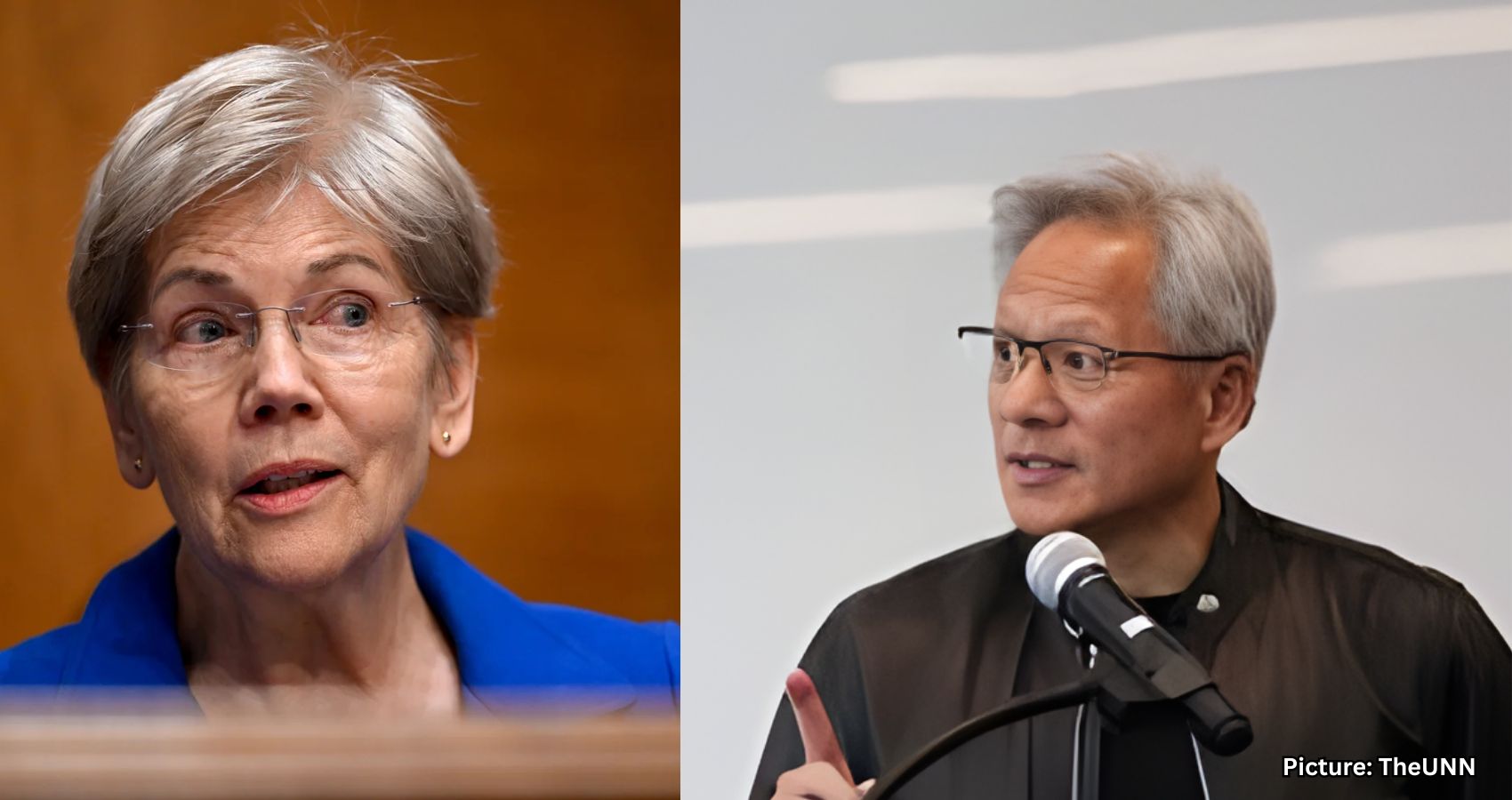
Democratic Senator Elizabeth Warren has summoned Nvidia CEO Jensen Huang to testify regarding President Trump’s approval of AI chip sales to China, raising concerns over national security and technological leadership.
Democratic Senator Elizabeth Warren is taking a stand against President Donald Trump by calling on Nvidia CEO Jensen Huang and Commerce Secretary Howard Lutnick to testify before Congress. This request comes in response to Trump’s recent announcement that he would greenlight the sale of Nvidia’s second-most advanced artificial intelligence (AI) chip to China.
Warren expressed her concerns during a press conference, questioning whether Trump would “muzzle his own Justice Department because he does not want Americans to know that he is selling out our national security?” This statement underscores her apprehension regarding the implications of exporting advanced technology to foreign nations.
The senator’s call for testimony follows a significant policy shift that allows high-performance AI hardware to be sold internationally under U.S. export regulations. Warren emphasized the necessity of Congressional oversight to ensure that these advanced chips are not utilized in ways that could jeopardize U.S. technological leadership or compromise sensitive applications.
In response to these concerns, White House spokesman Kush Desai clarified the administration’s position. He stated, “There’s an obvious difference between chips being illegally smuggled to unknown buyers without regulatory oversight and chips being exported following national security inspections to specifically designated end users.”
The U.S. government recently approved the export of Nvidia’s H200 artificial intelligence chips to China, marking a notable change in long-standing export controls on advanced semiconductor technology. The H200 is a high-performance AI accelerator designed for complex machine learning and data center workloads. This decision allows Nvidia to sell these chips to approved Chinese customers, contingent upon U.S. government licensing and oversight.
Trump’s policy change includes a provision for the U.S. government to collect a 25% share of the revenue generated from these sales as part of the export framework. Nvidia has indicated that China constitutes a relatively small segment of its advanced chip business and that all exports will adhere to licensing requirements.
This move represents a partial reversal of previous export restrictions that prohibited the shipment of H200-class GPUs to China due to national security concerns, although the most advanced chips remain off-limits. Nvidia has reiterated that sales of the H200 to China will still require a U.S. government license and has characterized the overall share of chips sold to China as a minor percentage compared to those sold to U.S. customers.
As companies like Nvidia operate at the cutting edge of innovation, their products can have far-reaching implications beyond commercial markets, affecting global competitiveness, supply chains, and national defense capabilities. Policymakers face the challenge of balancing economic benefits with national security considerations while striving to maintain technological leadership.
Warren’s call for Congressional oversight highlights the critical role lawmakers play in ensuring that commercial interests do not undermine strategic priorities. The potential impact of Congressional hearings, public scrutiny, and future policy changes on subsequent decisions regarding AI hardware exports remains uncertain.
As AI hardware continues to evolve and become more widely distributed, nations must navigate not only domestic regulations but also the broader implications of exports on global security, economic stability, and technological ecosystems. Collaboration among industry leaders, government officials, and international partners is essential to establish safeguards that prevent misuse, promote innovation, and ensure fair competition.
According to The American Bazaar, the unfolding situation emphasizes the need for vigilance in the face of rapidly advancing technology and its potential effects on national security.