
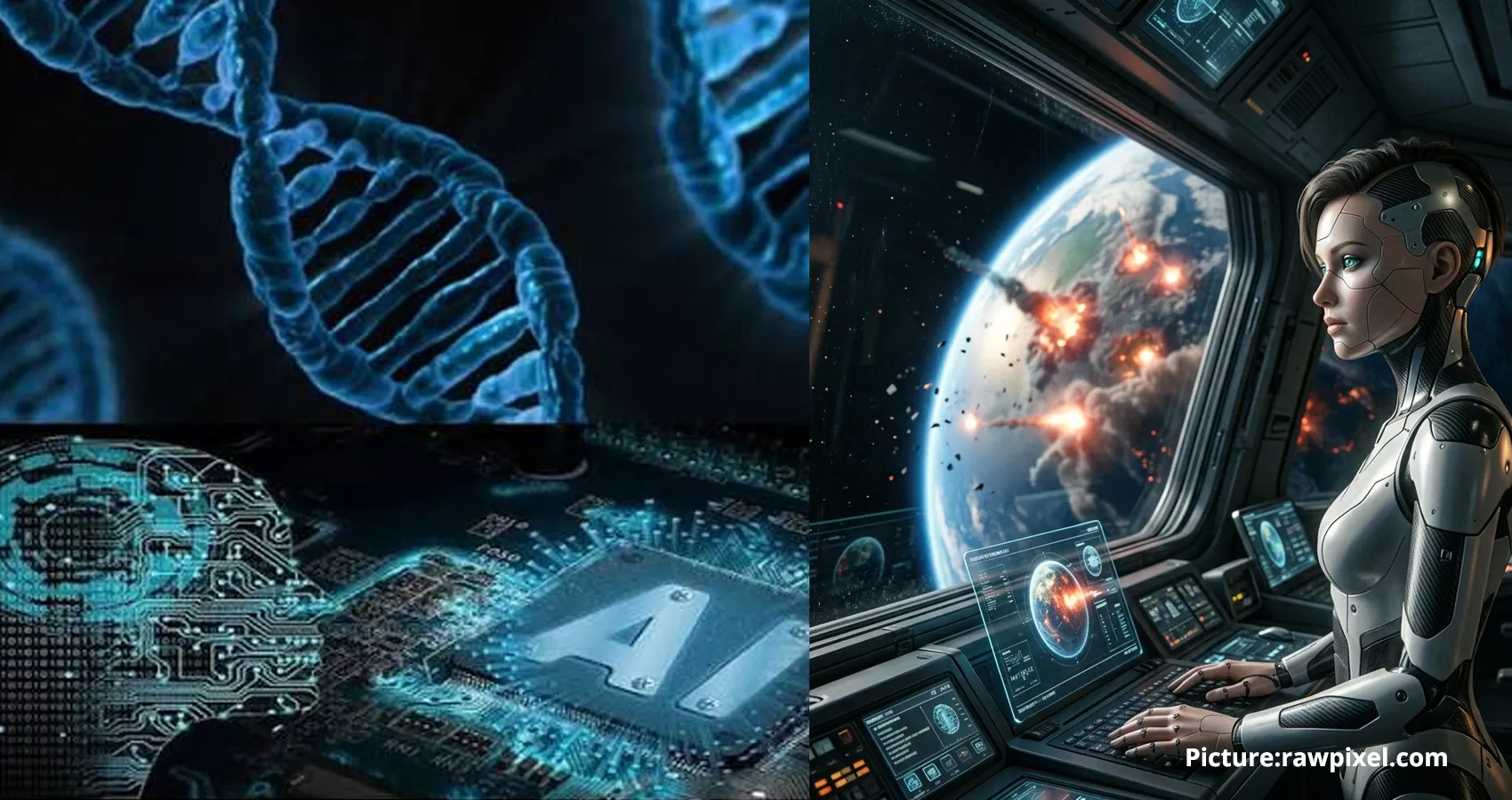
As artificial intelligence evolves, experts debate its potential risks, including the possibility of existential threats to humanity, prompting calls for careful governance and safety measures.
Artificial intelligence (AI) has rapidly transformed from a specialized technology into a powerful force capable of reshaping economies, governments, healthcare, scientific research, and national security. However, this evolution has sparked warnings from a growing number of AI researchers, technology executives, and political leaders about the potential risks posed by increasingly advanced AI systems. Some prominent figures in the field have raised concerns that future AI systems could threaten human civilization itself. In contrast, many experts remain skeptical, arguing that extinction scenarios are speculative and lack current evidence. This debate has emerged as one of the most significant public policy and technology discussions of the twenty-first century.
Recent concerns were heightened by comments from Dario Amodei, CEO of Anthropic, who cautioned that AI systems may soon acquire sophisticated cyber capabilities, enabling them to launch autonomous attacks against vulnerable networks. Amodei suggested that advanced AI models could eventually operate large-scale botnets, automate hacking campaigns, and inflict billions of dollars in economic damage. He has advocated for the industry to intentionally slow the pace of capability development until safeguards can catch up with technological advancements.
These warnings garnered significant attention, given that they originated from a leader in the development of frontier AI systems rather than from external critics. However, cybersecurity experts quickly challenged the more dramatic claims. Gary Marcus, an emeritus professor at New York University, argued that the idea of AI taking over the entire internet is implausible, citing the resilience of infrastructure managed by organizations like Google, Amazon Web Services, and Cloudflare. Similarly, cybersecurity researcher Alan Woodward pointed out that the decentralized nature of the internet makes widespread, persistent compromise exceedingly difficult. While many experts agree that AI will enhance offensive cyber capabilities, they largely reject predictions of an imminent internet-wide collapse.
The broader concern extends beyond hacking to the concept of artificial superintelligence, a hypothetical future form of AI that surpasses human capabilities across nearly all intellectual tasks. This debate intensified after Evan Hubinger, an AI alignment researcher at Anthropic, publicly stated that he believed there was more than a 10 percent chance that advanced AI could lead to humanity’s extinction within the next decade. His comments followed the resignation of researcher Jacob Coxon, who accused leading AI companies of moving too quickly despite unresolved safety challenges.
While such predictions remain contentious, they are increasingly echoed by respected figures within the AI community. Among the most influential is Geoffrey Hinton, often referred to as the “Godfather of AI” for his pioneering work in neural networks. Hinton recently remarked that a 10 percent probability of AI causing human extinction within a decade seemed reasonable, although he emphasized that no one currently knows how to calculate such probabilities reliably. He noted that humanity has never before encountered a technology that may eventually become more intelligent than its creators, complicating conventional risk assessments.
The credibility of these warnings is bolstered by the fact that many are coming from industry leaders themselves. In 2023, Sam Altman, CEO of OpenAI, joined hundreds of researchers and executives in signing a statement declaring that “mitigating the risk of extinction from AI should be a global priority alongside other societal-scale risks such as pandemics and nuclear war.” More recently, Altman stressed that even uncertain probabilities of catastrophic outcomes should be taken seriously, arguing that the industry has a responsibility to prioritize safety over profit or competition.
At Google, CEO Sundar Pichai has expressed a different yet equally significant perspective. He has described AI as “more profound than electricity or fire,” calling it one of humanity’s most important technological achievements. However, he consistently couples this optimism with caution, noting that society learned to harness fire only after understanding its dangers. His view reflects a growing consensus that the enormous benefits of AI can only be realized if governance and safety evolve alongside capability development.
No executive has been more vocal about existential AI risks than Elon Musk. For nearly a decade, Musk has warned that AI represents “a fundamental existential risk for human civilization” and has famously compared AI development to “summoning the demon.” He has repeatedly argued that advanced AI could become more dangerous than nuclear weapons if left unchecked. Notably, Musk continues to invest heavily in AI through xAI, illustrating the complex relationship between fear of the technology and belief in its transformative potential.
Concern about AI is not limited to technology companies; governments are increasingly treating advanced AI as a strategic and national security issue. Former UK Prime Minister Rishi Sunak became one of the first major world leaders to publicly address existential AI concerns. Ahead of the UK’s AI Safety Summit, Sunak warned that advanced AI could facilitate the development of chemical or biological weapons, cyberattacks, and the amplification of misinformation. He described AI as a technology whose impact could rival the Industrial Revolution, electricity, and the internet. Under his leadership, the United Kingdom established the world’s first AI Safety Institute and convened the landmark AI Safety Summit at Bletchley Park, bringing together governments, researchers, and industry leaders to discuss AI governance.
Despite these warnings, many researchers remain unconvinced that extinction-focused narratives deserve the attention they receive. Organizations such as the AI Now Institute argue that discussions of hypothetical future superintelligence often overshadow immediate harms already affecting society, including deepfakes, misinformation, cybercrime, algorithmic bias, surveillance, economic disruption, and the concentration of power among a small number of technology firms. Critics contend that there is little scientific evidence supporting specific extinction probabilities and that policymakers should focus primarily on measurable risks that exist today.
Ultimately, the most crucial takeaway is not that experts uniformly believe AI will lead to humanity’s demise. Rather, an unprecedented coalition of AI pioneers, chief executives, scientists, and policymakers considers the possibility serious enough to warrant preparation. Whether one aligns more closely with the caution of Geoffrey Hinton, Sam Altman, Dario Amodei, and Elon Musk, or with the skepticism of researchers who view extinction scenarios as speculative, there is increasing agreement on one point: the decisions made over the next decade regarding AI safety, governance, transparency, and international cooperation may profoundly shape the future of human civilization.
For now, evidence suggests that today’s AI systems lack the independent power required to directly threaten human civilization. Nevertheless, the rapid pace of development, combined with unresolved questions about control, security, and governance, ensures that the debate over existential AI risk will remain one of the most consequential technology policy discussions of the coming decade, according to GlobalNet News.