
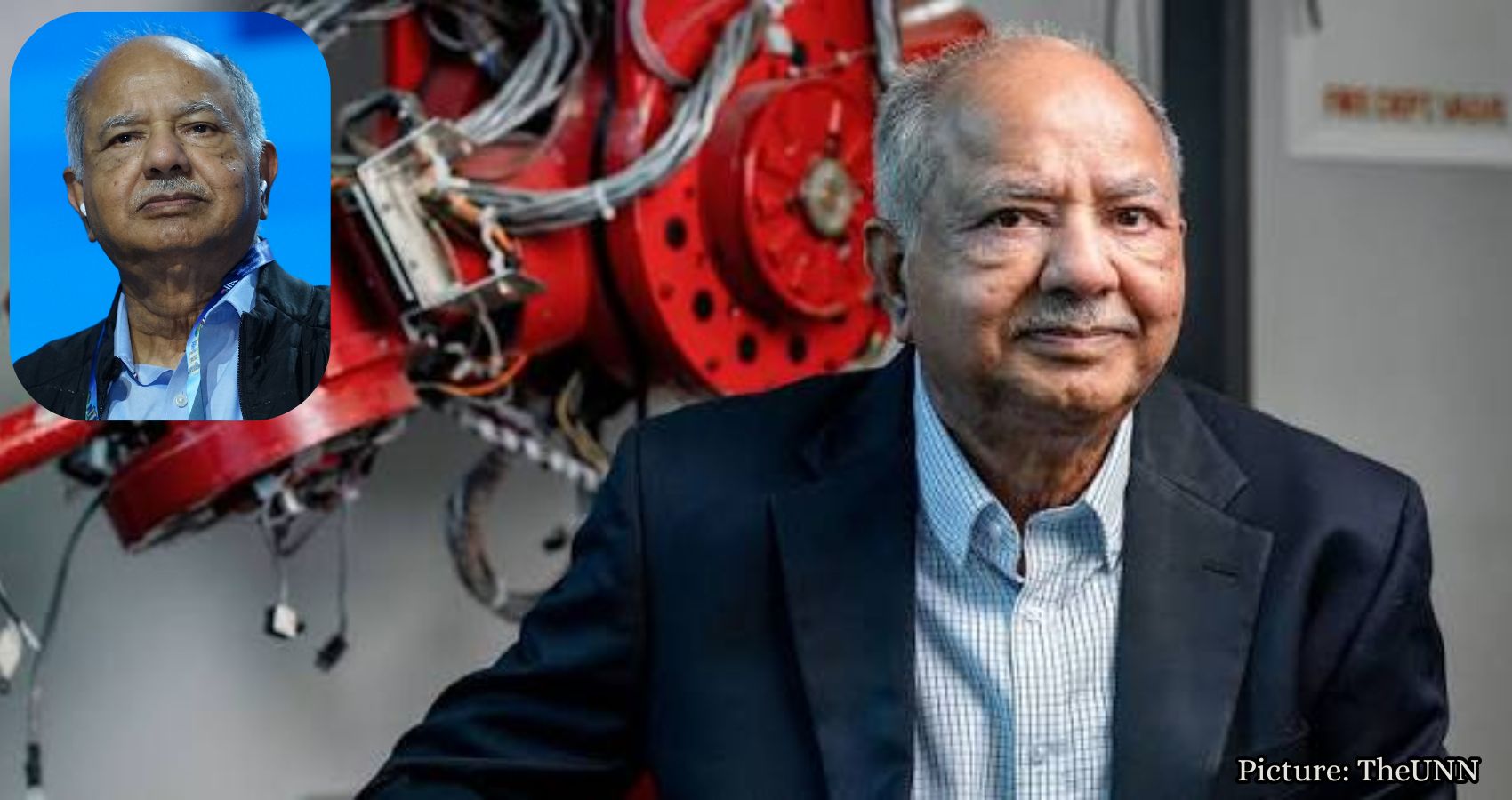
Raj Reddy, an Indian-American computer scientist, has significantly influenced artificial intelligence, becoming the first Asian recipient of the prestigious Turing Award and advocating for technology’s role in education and social equity.
Raj Reddy, an Indian-American computer scientist, has made remarkable contributions to the field of artificial intelligence. His journey from humble beginnings in Andhra Pradesh to becoming the first Asian recipient of the Turing Award, often referred to as the Nobel Prize of computing, is both inspiring and noteworthy.
Born on June 13, 1937, in Katur village of Chittoor district, Reddy’s early life was shaped by the challenges of growing up in a rural environment with limited access to educational resources. His formative experiences instilled in him a resilience and determination to succeed. Reddy began his education in a one-room schoolhouse, where he and his classmates learned to write by tracing letters in sand, as paper was a scarce commodity.
Reddy’s father, Sreenivasulu Reddy, was a farmer and landowner, while his mother, Pitchamma, was a homemaker. Despite the obstacles he faced, Reddy became the first person in his family to attend college, earning a bachelor’s degree in civil engineering from the College of Engineering, Guindy, in Madras in 1958. His academic journey continued with a move to Australia, where he completed a Master of Technology (MTech) at the University of New South Wales in 1960.
It was during his time in Australia that Reddy first encountered computing technology, specifically the English Electric DEUCE computer, which utilized vacuum tubes and mercury delay-line memory. This experience ignited his interest in artificial intelligence. In 1963, Reddy made a pivotal decision to pursue a PhD at Stanford University under the mentorship of John McCarthy, a pioneer in the field who is credited with coining the term “artificial intelligence” at the Dartmouth Conference in 1956.
At Stanford, Reddy joined the Stanford Artificial Intelligence Laboratory during a crucial period for AI, where researchers were actively exploring questions about machine reasoning. His doctoral dissertation, titled “A Computer Program for Playing Black Jack,” completed in 1966, examined how machines could make decisions based on uncertain outcomes. This work laid the groundwork for his future contributions to the field.
Reddy’s research significantly advanced the domains of speech recognition, language processing, and robotics. Alongside his colleagues, he developed Hearsay I, one of the early systems capable of recognizing continuous speech. This groundbreaking work paved the way for subsequent systems, including Hearsay II and Harpy. One of Reddy’s students, James K. Baker, co-founded Dragon Systems, which played a crucial role in commercializing speech recognition technology.
By the late 1960s, Reddy joined the faculty at Carnegie Mellon University (CMU), where he would spend much of his career. In 1979, he became the founding director of the Robotics Institute, helping to establish it as a leading center for robotics and artificial intelligence research. The institute became affectionately known as the “Raj Mahal” in recognition of his contributions and leadership. Reddy later served as dean of CMU’s School of Computer Science.
In 1994, Reddy and Edward Feigenbaum received the prestigious ACM Turing Award for their pioneering work in the design and construction of large-scale AI systems. This accolade marked a significant moment not only in Reddy’s career but also in the history of computing, as he became the first person of Asian descent to receive the award. His achievements underscored the importance and potential of AI technologies.
Beyond his technical contributions, Reddy has been actively involved in initiatives aimed at leveraging technology for educational advancement in rural communities. He played a pivotal role in establishing the Rajiv Gandhi University of Knowledge Technologies, designed for gifted students from rural backgrounds, and served as the founding chairman of the International Institute of Information Technology (IIIT) in Hyderabad.
Reddy’s vision extends beyond merely developing advanced technologies; he seeks to harness AI, speech recognition, translation, and digital education to empower marginalized communities. His efforts aim to bridge the digital divide and ensure that the benefits of technological advancements reach those at the bottom of the economic pyramid.
In recognition of his contributions to science and society, Reddy was awarded the Padma Bhushan in 2001, one of India’s highest civilian honors. Despite receiving numerous accolades, including the French Legion of Honour, Reddy’s legacy remains relatively unknown to many in India. This silence is perhaps the most intriguing aspect of his story, as it reflects the broader challenges of recognizing and celebrating the contributions of individuals who have profoundly influenced technological advancement.
As the field of artificial intelligence continues to evolve, Raj Reddy’s pioneering work and commitment to social impact serve as a testament to the transformative power of education and technology. His journey from a small village in Andhra Pradesh to becoming a leader in AI illustrates the potential for individuals to overcome obstacles and drive change in the world, according to Source Name.