
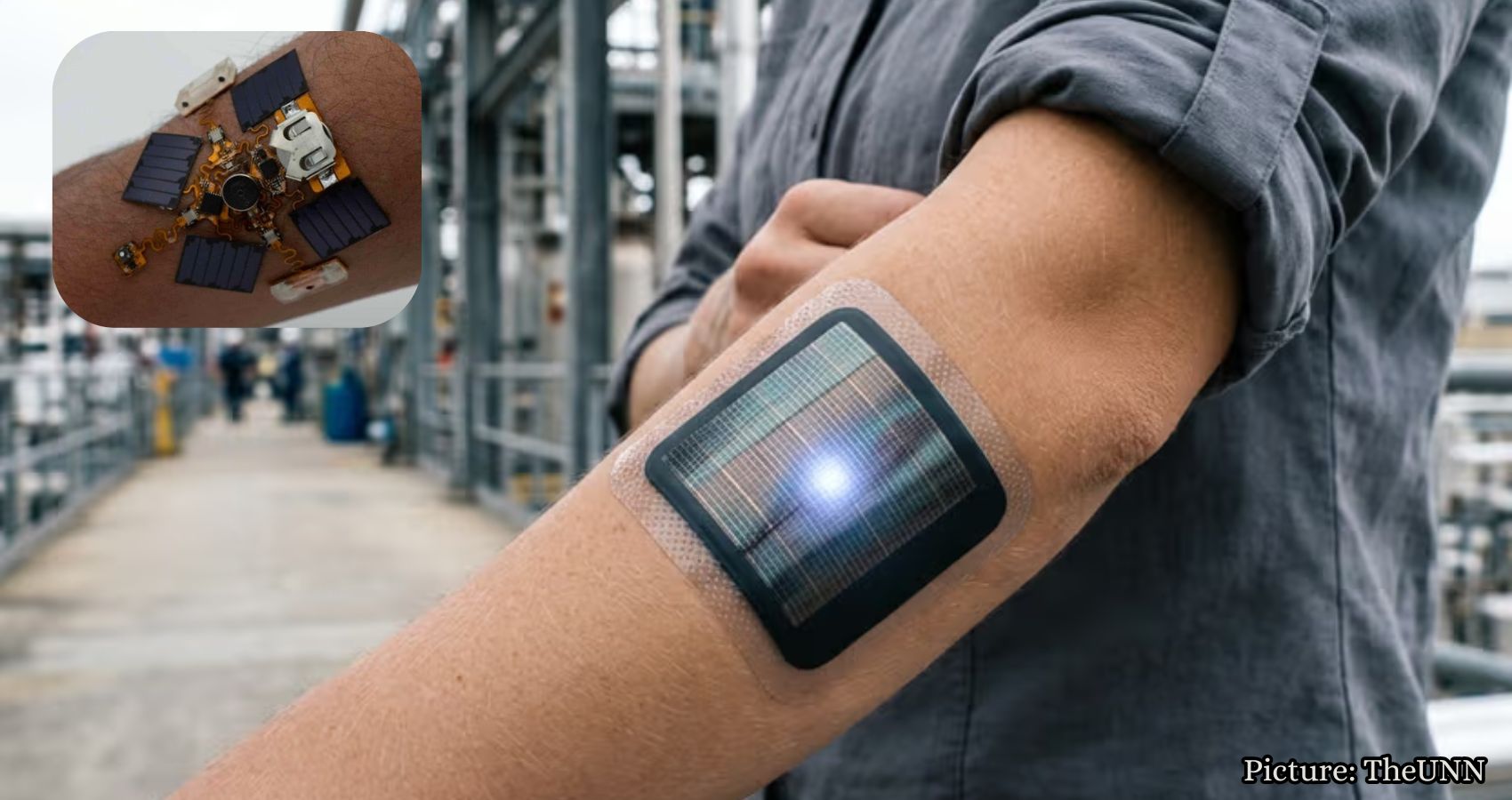
A team of researchers at North Carolina State University has developed a solar-powered wearable patch that vibrates against the skin to alert users of nearby environmental hazards.
Researchers at North Carolina State University have created an innovative wearable patch designed to provide immediate alerts about environmental hazards. This solar-powered device vibrates against the skin, delivering distinct haptic signals for various dangers, eliminating the need for users to check their phones for notifications.
While smartphones can notify users about severe weather or heavy traffic, some threats require instant awareness. For instance, hazardous gases can surround individuals without warning, and contaminated water may appear safe to drink. By the time someone unlocks their phone to check an alert, they could already be in harm’s way. The new patch addresses this issue by detecting environmental hazards and providing a direct tactile alert.
The compact patch is slightly smaller than a driver’s license, making it easy to attach to clothing or wear directly against the skin. Inside, a microcontroller serves as the device’s brain, powered by a small battery. Six sensors continuously monitor the environment for potential threats, including dangerous gases and heavy metals in water.
Once a hazard is detected, a tiny actuator generates a vibration against the skin. This physical alert is designed to be more noticeable than a phone notification, which can easily be overlooked, especially if the phone is in a pocket or silenced.
“If you’re coming into contact with a hazardous substance, you need to know as quickly as possible,” said Erim Uzunoğlu, the first author of the research paper and a Ph.D. student at NC State. The findings were published in the scientific journal Device.
While environmental sensors that send alerts to smartphones already exist, they rely on users noticing the notifications. The wearable patch eliminates this dependency by delivering immediate feedback through vibrations. However, the researchers faced challenges in ensuring that the vibrations were strong and distinct enough to be effective without causing discomfort.
To enhance the tactile feedback, the team developed tiny textured surfaces between the motor and the skin. These surfaces feature miniature patterns of raised bumps, allowing the researchers to customize the size and spacing of the bumps to create distinct vibration sensations. This design is particularly beneficial in noisy environments, where audible alarms may go unnoticed.
The patch does not use a uniform buzzing sensation for all alerts; instead, it generates unique haptic sequences for different hazards. For example, one vibration pattern may indicate the presence of a dangerous gas, while another may signal water contamination. This creates a tactile language between the patch and the wearer, enabling them to understand the type of threat without needing to check a display.
In initial testing, the patch successfully detected targeted substances and triggered the appropriate vibrations. However, users would need time to learn the meanings of each pattern, making clear training essential, especially in workplaces with multiple hazards.
To address concerns about battery life, the researchers incorporated thin-film photovoltaic cells on the patch’s exterior. These solar cells collect energy while the device is worn, supplementing the internal battery. The sensors are designed to consume minimal power, allowing the device to operate for approximately 24 hours during testing. However, real-world performance may vary based on sunlight exposure and sensor activity.
As the team developed the wearable patch, they also explored the possibility of applying the same tactile warning system to robots. This led to the creation of an electronic skin, or e-skin, which places the sensor patch over a piezoelectric layer. When the patch vibrates, it generates an electrical signal that the robot can interpret, allowing it to respond to detected hazards without waiting for wireless communication.
In tests, researchers equipped quadrupedal robots with the e-skin. When these robots detected chemical hazards, they changed direction to follow a safer route. This technology could enable robots to explore areas that may be unsafe for humans, providing an alternative means of sensing risks where traditional cameras and digital instructions fall short.
While the e-skin technology remains in the proof-of-concept stage, it holds promise for enhancing robotic safety in hazardous environments. By converting chemical warnings into physical signals, robots can make quicker decisions without needing to transmit data to a remote computer.
Most robots currently rely on cameras and digital instructions to navigate their surroundings, which can be inadequate for identifying invisible threats. The e-skin offers a new method for robots to sense danger, potentially keeping humans further away from hazardous areas.
Despite the advancements, the wearable hazard detection patch is not yet available for purchase. However, the research highlights a significant shift in how safety alerts can be delivered, moving beyond screens and speakers to direct tactile feedback. This innovation could be particularly valuable for individuals working in environments where exposure to chemicals or unsafe water is a concern.
As researchers continue to refine the technology, they will need to address several challenges, including the patch’s durability, comfort, and effectiveness in real-world conditions. Ensuring that users can easily recognize each vibration pattern and minimizing false alarms will also be crucial for the patch’s success.
In summary, this wearable patch represents a significant advancement in personal safety technology, providing immediate alerts through vibrations rather than relying on smartphone notifications. The potential applications for this technology are vast, particularly in industries where rapid response to hazards is essential. As research progresses, the hope is that this innovation will help protect individuals in dangerous environments.
According to NC State University, the development of this wearable patch could revolutionize how we perceive and respond to environmental hazards.