
The 250th anniversary of American independence prompts a reflection on the enduring quest for equality, drawing parallels between the U.S. Declaration of Independence and the teachings of the Bhagavad Gita.
The 250th anniversary of American independence is an ideal moment to reflect on the words that give moral meaning to the most famous sentence framing the American experiment: “We hold these truths to be self-evident, that all men are created equal…”
Adopted on July 4, 1776, the U.S. Declaration of Independence, primarily drafted by Thomas Jefferson, asserts that all individuals are born with equal rights that cannot be taken away. This foundational document has served as a guiding principle for the nation’s pursuit of equality.
Anniversaries are more than occasions for fireworks, parades, and patriotic songs; they are opportunities for introspection. After 250 years of independence and the ongoing pursuit of equality, where does America stand? What promises have been made, where have we faltered, and what remains to be achieved?
In his book, *The Greatest Sentence Ever Written*, historian Walter Isaacson treats this sentence as a sacred civic mantra, urging readers to contemplate the significance of its key words: “we,” “truths,” “self-evident,” “created,” “equal,” “rights,” “liberty,” and “happiness.” He reminds us that democracy is not merely a voting system but a moral discipline.
While the words “We hold these truths to be self-evident, that all men are created equal, that they are endowed by their Creator with certain unalienable Rights…” remain morally inspiring, they were penned during a time when slavery was accepted, women were denied political rights, and Native Americans faced injustice. This historical context adds weight to the enduring nature of these words.
A great sentence often transcends its time, becoming a call to greatness. It gains significance when subsequent generations respond to its call for equality, striving to build a society that reflects the ideals it espouses.
But is it truly the greatest sentence ever written? How does it compare to the profound meaning of “Tat Tvam Asi,” a mahāvākya (“great saying”) from the Upanishads that expresses a fundamental philosophical truth of Vedanta: the individual soul is one with the universe’s cosmic reality—‘Thou Art That.’
As an Indian American, examining equality through the lens of Hindu philosophy, the phrase “all men are created equal” takes on deeper significance when expanded to include all beings. Our equality is rooted in a shared spiritual essence.
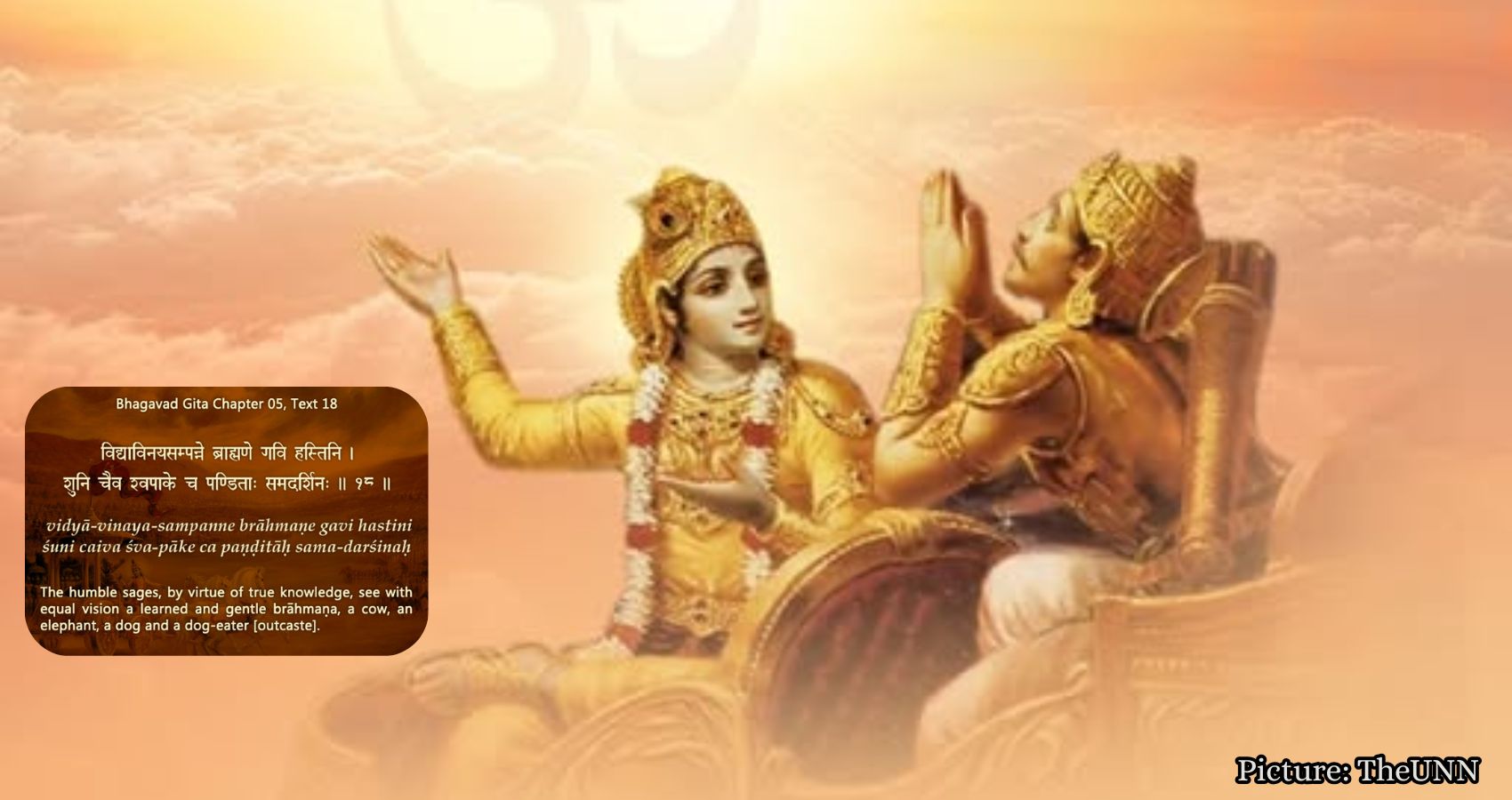
The *Bhagavad Gita* teaches that the truly wise view all beings as equal, regardless of their social status or species. The Sanskrit phrase “paṇḍitāḥ sama-darśinaḥ” translates to “the wise see with equal vision.” This perspective encourages a recognition of the eternal souls within all living beings, transcending superficial differences.
According to the *Bhagavad Gita*, spiritually enlightened individuals perceive all living beings as eternal souls rather than mere bodies or labels. This foundation of equality is not contingent upon our appearances, thoughts, wealth, or achievements. We are equal because the same divine light shines through each of us, even as we navigate different lives and experiences.
For instance, electricity can illuminate a chandelier, a bedside lamp, a streetlight, or a flashlight. Each fixture varies in shape, cost, brightness, and location, yet they are all powered by the same electricity. Similarly, while human beings differ in body, mind, talent, wealth, education, and social status, the divine consciousness within each person originates from the same sacred source.
While American civics lessons emphasize that all individuals possess the same rights, social status, and opportunities, Vedanta offers a spiritual interpretation of equality: one divine essence exists in myriad forms, known by various names.
Nearly 250 years after its founding, America remains a melting pot where individuals from diverse countries, cultures, and backgrounds strive together to fulfill the promise of equality set forth in the Declaration of Independence.
A crucial aspect of this journey is acknowledging that the paths to equality may differ but need not be divisive. This is an essential distinction. Equal does not mean identical.
Human beings are inherently different—psychologically, biologically, and socially. The *Bhagavad Gita* teaches that individuals are not carbon copies of one another. Each person possesses a unique “svabhāva,” or inner nature, which varies in temperament, capacity, motivation, and aptitude. Vedanta explains this through concepts like “samskāras,” “vāsanās,” and “guṇas,” which describe qualities born of nature that manifest in different roles and responsibilities.
For any society to thrive, it must provide a foundation that allows all types of individuals to flourish. This truth is not always self-evident. The *Bhagavad Gita* elucidates that true equality becomes apparent when the mind is liberated from “ahaṃkāra,” or ego.
An enlightened mind transcends prejudices based on race, gender, religion, wealth, appearance, nationality, language, accent, education, or social status. To an ego-driven person, hierarchy may seem natural, while to an enlightened individual, equality is self-evident.
The great sentence of America must be understood both politically and spiritually. The law can ensure legal equality and prevent discrimination, but a spiritual understanding of its words can dissolve contempt and foster compassion. Upholding equality is a societal responsibility that must be maintained through justice, education, opportunity, and respect.
Martin Luther King Jr. referred to the Declaration as a “promissory note” that America has yet to fully honor for Black Americans. As we approach 2026, the most fitting tribute to the Founders would be an honest fulfillment of their highest promise, ensuring that the ideals of equality resonate in every corner of society.
According to Source Name.