
Reflecting on a lifelong journey, the author shares how the Bhagavad Gita became a guiding force in her life, revealing profound insights and wisdom through personal experiences and teachings.
The journey to understanding the Bhagavad Gita began for me at the tender age of five when I first learned to chant the Gita Dhyanam, a meditation on the Gita. My mother, who had learned it from her father, passed it on to me during moments of daily life—bath time, getting dressed, and bedtime. I would echo her chants, memorizing the nine verses in Sanskrit without grasping their meaning. Remarkably, I even won a prize at school for my recitation.
Years later, at twenty-nine, a desire to delve deeper into the Gita emerged within me. I retrieved the copy of the Bhagavad Gita gifted to me by my beloved Guru, Nitya Chaitanya Yati, during my visit to the Narayana Gurukula in Fernhill, near Ooty, India. His handwritten inscription addressed me as Ammu, my pet name among loved ones, and read:
“To Dear Ammu. Feel free to give up. However, you will not be given up. Love, Nitya.”
This book had traveled with me for years, unopened. Yet, as I began to read it, the Gita Dhyanam reemerged in my memory. I was astonished that these verses, which had lain dormant within me, could return so vividly after just a few readings. It felt as if a hidden spring had been tapped, bringing forth memories that had silently flowed beneath the surface for years.
Recognizing the importance of guidance, I sought a qualified teacher to help me navigate the text. Living in Los Angeles, I learned of a Swamiji at the Chinmaya Mission in Anaheim who was teaching the Bhagavad Gita. Every weekend, I drove an hour each way to attend his classes, but I found that the teachings did not resonate with me. I then tried the Hollywood Vedanta Temple, but those classes also fell flat.
In light of Guru Nitya’s words, I decided to give up—more than once. During this time, my friend Shraddha, a fellow disciple of Guru Nitya from the Bainbridge Island Gurukula, began sending me copies of videos from classes he had taught in 1980. These eighteen chapters were recorded on 26 VHS tapes, and she mailed them to me one by one.
Thus, I began my study of the Bhagavad Gita from the comfort of my living room, watching Guru Nitya teach. His clear, precise, and profound insights evoked a deep appreciation within me for their brilliance and relevance to my life. It felt as if he had returned to guide me personally, embodying the promise of his inscription: “you will not be given up.” He had not given up on me, and I sensed that he understood the significance of his words.
The Bhagavad Gita is a revered text found in the Bhishma Parva, the sixth book of the Mahabharata, one of the largest literary works ever composed, comprising over 100,000 verses. This epic weaves tales of families, kingdoms, loyalties, and conflicts, culminating in a pivotal moment of moral and emotional crisis.
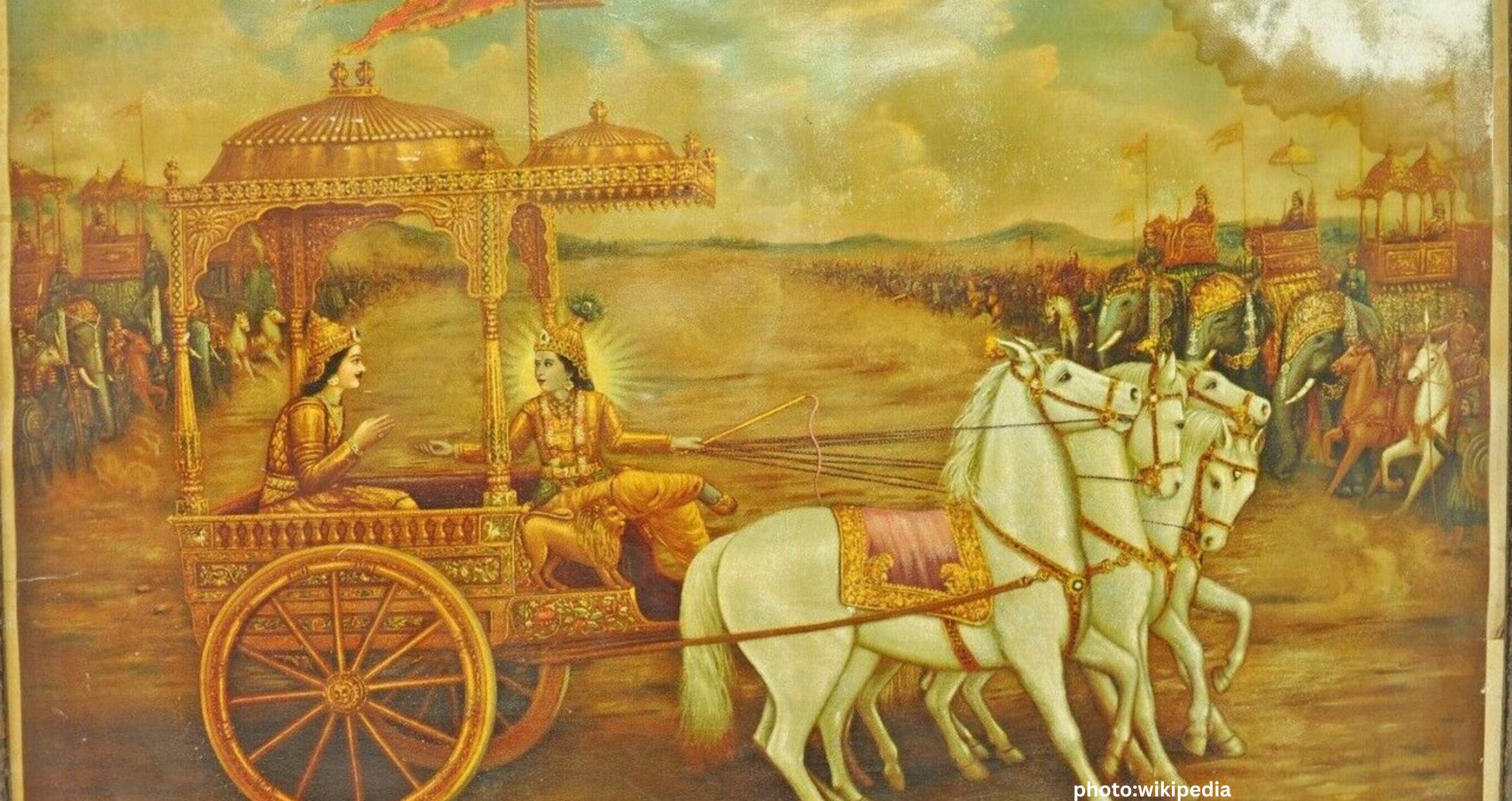
As the Pandavas prepare for battle against their cousins, the Kauravas, Arjuna, the greatest warrior among them, stands in his chariot between the two armies. Beside him is Krishna, his friend and charioteer. In that moment, Arjuna confronts the human cost of the impending conflict, recognizing that he faces not just enemies, but beloved family members and mentors. Overwhelmed, he drops his bow and questions the morality of the battle.
Arjuna’s struggle is universal; it reflects the human condition. His inquiry, “What should I do?” masks a deeper question: “How do I confront my suffering?” This quest for clarity is echoed in the teachings of the Buddha and resonates with anyone grappling with life’s complexities.
To answer these profound questions, we must explore the nature of our existence. Who are we? What is our relationship to the world? These inquiries are not mere philosophical musings; they lie at the heart of our search for purpose, meaning, and fulfillment. Throughout the Gita, Arjuna poses a series of questions to Krishna, who responds with patience and depth.
Krishna embodies the wisdom principle and the Absolute, guiding Arjuna from confusion to clarity. Initially, he is Arjuna’s friend and kinsman, but as the narrative unfolds, he becomes Arjuna’s Guru, illuminating the path from darkness to light. In one of the most profound passages in Sanskrit literature, Krishna reveals his cosmic form to Arjuna, a moment that resonates deeply with the themes of revelation and transformation.
The term “Gita” translates to “song,” while “Bhagavad” means “of the Lord.” Guru Nitya likened it to the “hymn of dialectic” in Plato’s Republic, suggesting that it transports the mind to a sublime state, akin to listening to a hymn. In this sense, the Gita is a song—a divine expression of truth.
Among my favorite verses in the Gita are those that describe the qualities of a devoted person, one who remains equanimous in the face of praise and blame, pleasure and pain. This high standard is articulated in the chapter on Bhakti Yoga, where devotion transcends mere allegiance to a deity. Instead, it invites us to recognize the interconnectedness of all existence, fostering a sense of unity and love for the world.
The Gita’s teachings resonate across cultures and generations, as both Arjuna and Krishna embody universal truths. Arjuna’s dilemmas are timeless, and Krishna’s wisdom is equally applicable to all. While the Gita is cherished as a sacred text, its truths transcend any single tradition. It serves as a lifelong companion, offering guidance to those who find themselves in Arjuna’s position—conflicted and seeking direction.
Ultimately, we all deserve to know that we will not be given up. The Bhagavad Gita stands as a testament to this enduring promise.
According to India Currents.