
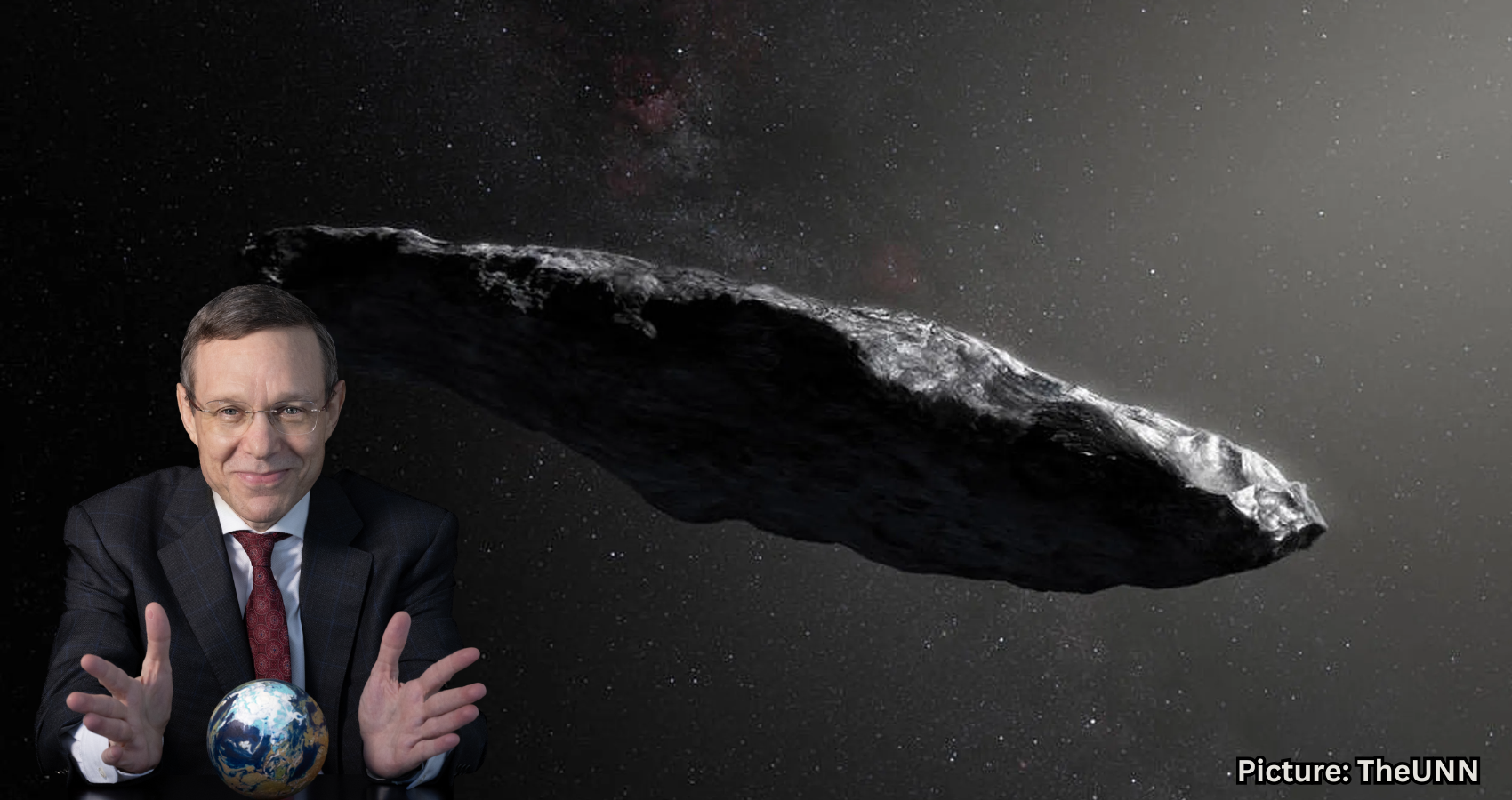
Harvard physicist Dr. Avi Loeb suggests that the interstellar object 3I/ATLAS may be a technological probe, given its unusual characteristics and trajectory as it passes through our solar system.
A recently discovered interstellar object, designated 3I/ATLAS, is raising eyebrows among astronomers and scientists alike. Harvard physicist Dr. Avi Loeb has proposed that the object’s peculiar features might indicate it is more than just a typical comet.
“Maybe the trajectory was designed,” Dr. Loeb explained to Fox News Digital. “If it had an objective to sort of be on a reconnaissance mission, to either send mini probes to those planets or monitor them… It seems quite anomalous.”
3I/ATLAS was first detected in early July by the Asteroid Terrestrial-impact Last Alert System (ATLAS) telescope in Chile. This discovery marks only the third time an interstellar object has been observed entering our solar system, according to NASA.
While NASA has classified 3I/ATLAS as a comet, Dr. Loeb pointed out an intriguing detail: an image of the object shows an unexpected glow in front of it, rather than the typical tail that comets exhibit. “Usually with comets, you have a tail, a cometary tail, where dust and gas are shining, reflecting sunlight, and that’s the signature of a comet,” he noted. “Here, you see a glow in front of it, not behind it.”
Measuring approximately 20 kilometers across, 3I/ATLAS is larger than Manhattan and is unusually bright given its distance from Earth. However, Dr. Loeb emphasizes that its most striking feature is its trajectory.
“If you imagine objects entering the solar system from random directions, just one in 500 of them would be aligned so well with the orbits of the planets,” he stated. The object, which originates from the center of the Milky Way galaxy, is also expected to pass near Mars, Venus, and Jupiter—an occurrence that is statistically improbable, according to Loeb.
<p”It also comes close to each of them, with a probability of one in 20,000,” he added.
NASA has indicated that 3I/ATLAS will reach its closest point to the sun—approximately 130 million miles away—on October 30. Dr. Loeb believes that if the object is indeed technological in nature, it could have significant implications for humanity’s future. “If it turns out to be technological, it would obviously have a big impact on the future of humanity,” he remarked. “We have to decide how to respond to that.”
In January, a separate incident involving a Tesla Roadster launched into orbit by SpaceX CEO Elon Musk led to confusion among astronomers, who mistook it for an asteroid. This highlights the complexities and challenges that come with identifying and understanding objects in our solar system.
A spokesperson for NASA did not immediately respond to requests for comment regarding 3I/ATLAS.
As the scientific community continues to study this enigmatic interstellar visitor, the possibility that it may be a technological probe adds a layer of intrigue to the ongoing exploration of our universe, prompting questions about the existence of life beyond Earth and our place in the cosmos.
According to Fox News Digital, Dr. Loeb’s insights underscore the need for further investigation into the nature of 3I/ATLAS and its potential implications for humanity.