
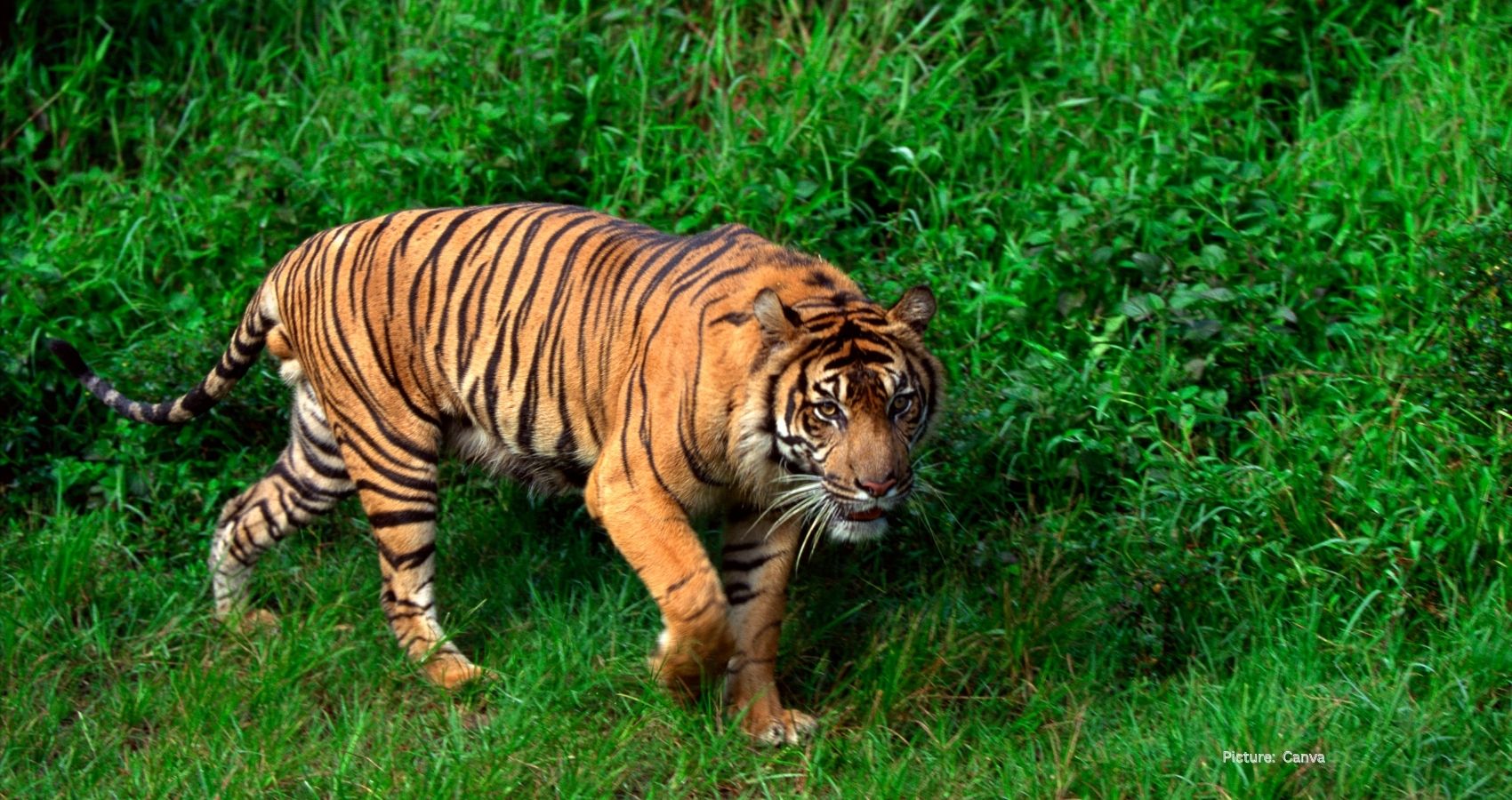
In the heart of India’s Tadoba-Andhari Tiger Reserve, a thrilling safari reveals the delicate balance between wildlife and human interaction, showcasing the majestic tigers and the complexities of conservation.
On the first day of our safari, we woke up at 4 a.m. for a scheduled 5 a.m. departure. Despite our best efforts, we were still 11 minutes late. “That’s okay,” said Swanand Kathale, a naturalist with the resort Trees N Tigers, as he briskly guided us to the car, illuminating our path with a flashlight. His easy laughter and generous sharing of knowledge were infectious, but he had little patience for stragglers. He was right; the animals don’t wait while we sip our coffee. With an hour’s drive to the entrance of the forest followed by a ride in an open jeep, we were eager to begin our search for tigers.
Our primary goal was to find Mama, a robust four-year-old tiger who roamed the buffer zone of the Tadoba-Andhari Tiger Reserve. We parked our jeep near a tiger statue placed under a tree. Swanand shared a haunting story: a man had been killed here, and locals believed his spirit now resided in the tiger. The statue served as a shrine to the man, a plea to the tiger to let one life be enough.
We waited for 45 minutes, and I began to mentally prepare myself for the possibility of not seeing a tiger. Many visitors return without a sighting, yet they still seem satisfied. The forest offers so much more. A trio of wild boars had briefly revealed themselves before darting into the underbrush. Other visitors had spotted a sloth bear and a leopard, while we watched a massive gaur, an Indian wild buffalo, leisurely grazing as a small group of cattle egrets followed, feasting on insects disturbed by his movements. Birds above filled the air with their calls, and our guide and naturalist identified them one by one.
As they “read the forest” in search of Mama, they spotted “pug marks” where most would see only a jumble of gravel, grass, and mud. A sudden cry from a jungle fowl, the snapping of dried bamboo, and the alarmed calls of deer and langurs created a symphony of alerts among the animals. They communicated warnings of impending danger. While Swanand and the local guide exchanged information in Marathi, I strained to catch a Hindi or English word, trying to piece together their conversation.
Then, suddenly, he appeared! Mama emerged from the tall grasses just three car lengths away. He moved silently, threading his lithe body through the vegetation. His grace, agility, and confident demeanor were regal, far too majestic for an audience of bumbling humans. It felt fitting that, despite our long journey for a glimpse of this maharaja, he spared us not a glance.
As Mama sniffed, scratched, and sprayed a tree beneath which sat a crude tiger likeness, Swanand explained that the rain from the previous night had washed away the scents tigers use to mark their territory. Thus, they would be out today to re-spray. Mama delivered on that promise, demonstrating his power and dominance.
We had seen Mama’s name among many others—Shivani, Maya, Junabai, Meera—on the chalkboard in the lounge at Tadoba, indicating every tiger spotted that day. We were told that Mama was big and strong, but we truly understood the meaning of that only upon seeing him in the wild. Recently, he had defeated another tiger to claim his territory, exuding an authority unseen in captive animals.
Yet, this perspective may skew my understanding of the relative danger and safety in Tadoba. Here, we were in tiger territory, seated in an open jeep with only the engine as our protection. We hoped it wouldn’t fail us. The guides assured us they had never lost a tourist, but the thought lingered.
Mama had many trees to mark, and he began walking down the trail toward us. By now, a few more jeeps had arrived, all yielding space for him. Some of us led the tiger, while others followed. Swanand mentioned that Mama had grown accustomed to the presence of jeeps and barely noticed them. Indeed, he seemed focused solely on his mission—to mark and to hunt.
Then, Mama spotted our gaur. A hush of excitement spread through the jeeps. The tiger, who had been moving leisurely, switched to stealth mode, becoming focused, deliberate, and taut. The gaur continued to graze, seemingly unaware of the impending danger.
“How exciting it would be,” my husband whispered, “exciting, bloody, and traumatic.” We both wished for the hunt while dreading it.
Mama disappeared behind some bamboo, but our guide anticipated he would approach his prey from downwind. We drove around to watch from a different angle, as did the other jeeps. More vehicles arrived, creating a cacophony that made me worry about disturbing the hunt. Yet, the tiger remained unfazed, perhaps validating our guides’ confidence.
Suddenly, the gaur sensed something amiss. He jerked his head and began trotting away, taking his entourage of birds with him. Mama lost his nerve and his moment. I breathed a sigh of relief.
For a moment, the tiger returned to scratching and spraying trees. Soon, he stopped to drink from a muddy puddle, despite a lake just 100 feet away offering cleaner water. He paused to catch his breath before vanishing into the forest.
A few hours later, we learned that Mama had crossed the highway and killed a farmer’s calf. A guide showed us a video of Mama dragging his prey across the road, the kill almost too large to fit between his legs, making him waddle awkwardly. I couldn’t help but wonder if our presence had disrupted Mama’s earlier hunt, potentially sparing the calf’s life.
I could only imagine the farmer’s grief. That calf would have grown up to work the land. In India, many farms are only an acre or two—too small to justify tractors, so bulls still perform the labor. The government compensates the farmer with 40,000 rupees (approximately $500), but it hardly suffices. Compensation for a human life is 2.5 lakhs (about $3,300), which is also a mere gesture. What could possibly equate to the loss of a father, mother, or child?
I mentioned to Swanand that in America, we have zero tolerance for animals that harm humans. When a wild animal injures a person, it is often hunted down. “Even if it’s the human’s fault?” he asked. “Yes, even then,” I replied.
In India, responses to such incidents vary by region, influenced by state policies, local culture, and the specifics of each case. Finding a compromise between human and animal interests remains a work in progress.
The complexity of conservation is evident. On average, 45 people are killed by tigers each year in Chandrapur, the district in Maharashtra where Tadoba-Andhari is located. In the first three months of this year alone, 14 fatalities were reported. On the same day as Mama’s calf kill, a villager gathering mahua flowers was also killed. The locals brew these flowers into potent alcohol, which Swanand described as needing only a small amount to achieve its effects.
Villagers are advised to avoid the forest before 10 a.m. when the animals are most active in the early mornings. However, as the heat rises later in the day, they risk encounters with wildlife for their livelihoods.
This situation underscores the intricacies of conservation. Locals rely on the forest for firewood, plants, fruits, medicines, and flowers like mahua. A healthy animal population is essential for a thriving forest, as predators like tigers help control grazing populations, preventing overgrazing and erosion.
Years ago, several villages were located within what is now the core zone of the reserve. As part of tiger conservation efforts, the government relocated these villages in 2013-14. Swanand noted that this move was mutually beneficial, as both tigers and humans were suffering in this territorial conflict.
Moreover, the villagers depend on tiger tourism for their livelihoods. To engage local communities in conservation, the national park employs them as guides and drivers. It’s a synergistic arrangement; they have roamed the forests since childhood and possess intimate knowledge of the land and its creatures, making them excellent guides for visitors like us.
After an action-packed first safari, we found ourselves captivated by the serene sight of Shivani, a recent empty nester who might be pregnant again, backing her overheated body into a pond for a nap. The sight of this sleeping cat was oddly mesmerizing. Perhaps the jungle had already begun to change us. We couldn’t scroll our phones or take selfies; we simply waited for a flick of an ear or a twitch of a muscle. We had come to see tigers, but we might have glimpsed a new side of ourselves.
This afternoon was just the balm we needed after such an exhilarating morning.
According to India Currents.