
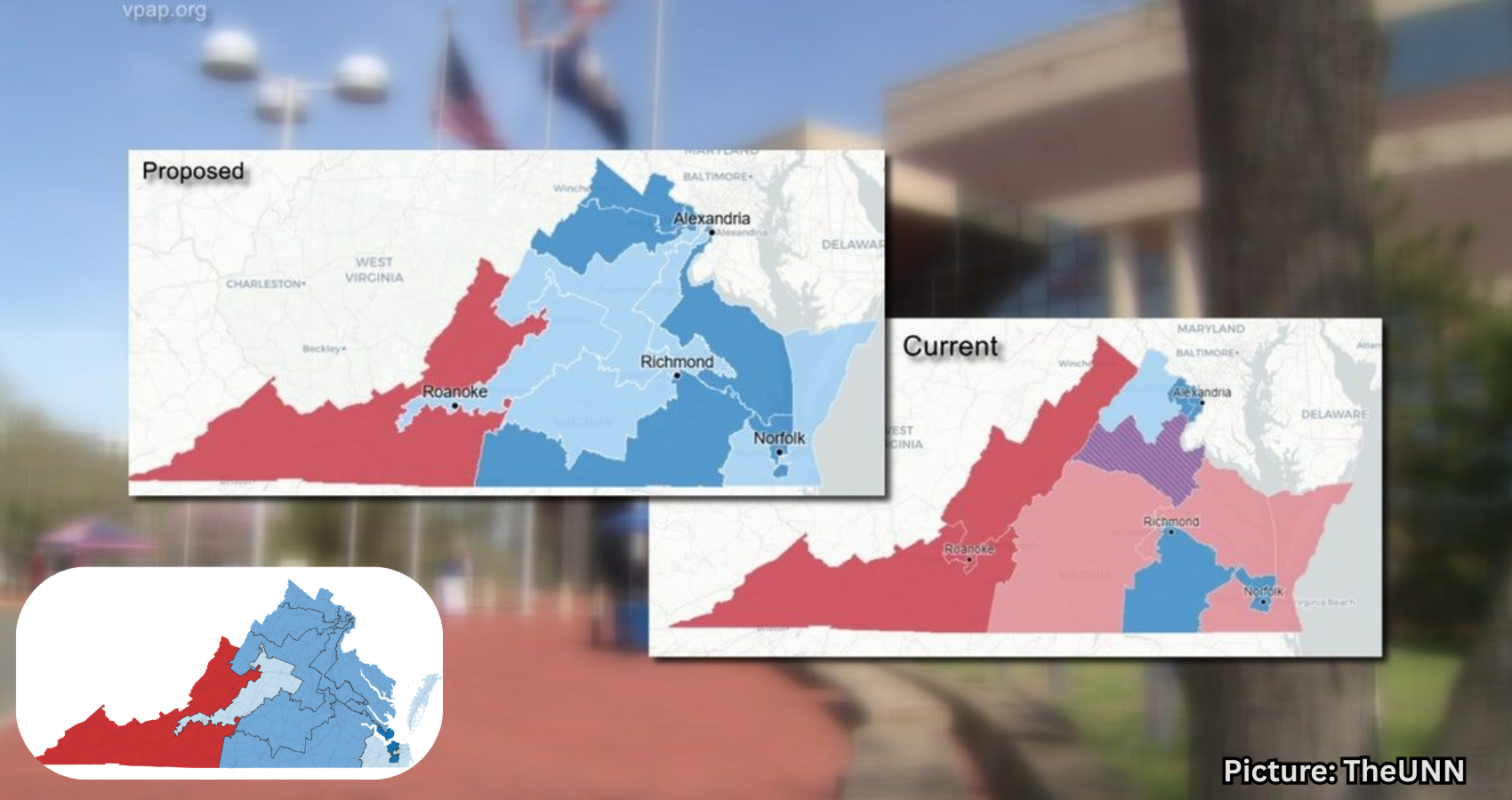
The Richmond Circuit Court has upheld a new congressional map in Virginia, rejecting a Republican challenge that could reshape the state’s political landscape ahead of the upcoming elections.
In a significant ruling for Virginia’s political future, Richmond Circuit Court Judge Tracy Thorne-Begland has dismissed a legal challenge from Republican organizations aimed at blocking the implementation of a newly drawn congressional map. This decision comes on the heels of a narrow victory for a Democratic-backed redistricting referendum during a special election held on April 21, 2026.
Judge Thorne-Begland acknowledged that the new congressional boundaries are “partisan gerrymanders” and less compact than previous maps. However, he concluded that the General Assembly acted within its constitutional authority when it approved the redistricting plan. This ruling sets the stage for a potential shift in Virginia’s congressional representation, transforming a competitive 6-5 Democratic advantage into a nearly insurmountable 10-1 edge for the party in the upcoming November midterms. Ultimately, the final decision will rest with the Virginia Supreme Court.
The case is part of a broader trend of mid-decade redistricting, a practice that has become increasingly common as both major parties seek to gain control of the U.S. House of Representatives. In Virginia, the Democratic-controlled General Assembly initiated a constitutional referendum to bypass the state’s bipartisan redistricting commission temporarily, allowing lawmakers to redraw the congressional lines for the remainder of the decade. Following the narrow victory for the “Yes” campaign, Republicans sought an immediate injunction to prevent the results from being certified or applied to the 2026 election cycle.
In his written opinion, Judge Thorne-Begland emphasized a philosophy of judicial restraint, stating that the court’s role is to verify the legality of power rather than assess the fairness of its application. “This Court knows its role is clear. It is not to assess the wisdom of public policy nor to engage in policy making from the bench,” he wrote.
The Republican plaintiffs contended that the new map was “adopted without legal authority” and violated state constitutional requirements regarding compactness. However, the court found that the General Assembly had the “plenary authority” to submit the amendment to voters, thus validating the process.
Despite ruling in favor of the Democrats, Judge Thorne-Begland did not shy away from criticizing the new map’s aesthetics and partisan nature. He noted that the 2026 congressional maps are “undoubtedly less compact” than their predecessors, describing them as “partisan gerrymanders” that “displace both representatives and voters into new, oddly shaped districts.”
The legal battle over the map’s compactness and credibility hinged on expert testimony regarding how compact a district must be to meet Virginia’s legal standards. Republicans argued that the proposed 10-1 map “rips the Commonwealth into pieces” and disregards communities of interest. However, the court found the testimony of Maxwell Palmer, a political scientist from Boston University, to be more compelling than that of the GOP’s experts. Palmer’s methodology suggested that while the districts may be oddly shaped, they do not violate the broad standards established by Virginia law.
“In short, reasonable and objective persons reached different conclusions on the effects of the 2026 maps. The issue of compactness is fairly debatable,” Thorne-Begland concluded. By labeling the issue as “fairly debatable,” the court opted to defer to the legislative process and the subsequent voter ratification.
The political ramifications of the new map are significant. Currently, Virginia’s congressional delegation is split 6-5 in favor of Democrats. However, under the boundaries established in House Bill 29 and ratified by the April referendum, analysts predict a shift to a 10-1 split. This change is viewed by national Democrats as a crucial counterbalance to Republican-led redistricting efforts in states like Texas and North Carolina, where GOP legislatures have similarly redrawn district lines mid-decade to maximize their electoral advantages.
The referendum saw substantial financial investment, with Democrats spending over $64 million to secure the “Yes” vote, compared to $21 million spent by Republican-aligned groups. This high level of spending underscores the stakes involved: Virginia is one of the few states where a mid-decade shift could significantly influence which party controls the U.S. House this November.
While Sunday’s ruling represents a victory for Democrats, the legal battle is far from over. The Virginia Supreme Court began hearing oral arguments on Monday to address several procedural challenges that could still invalidate the referendum.
The justices are focusing on three primary issues: the legitimacy of the special session used to pass the redistricting amendment, the requirement for an “intervening election” between constitutional amendments, and whether the state provided the necessary 90-day public notice in circuit courts across the Commonwealth.
As the High Court deliberates, candidates and voters remain in a state of uncertainty. With primary elections approaching, the court’s decision will determine whether Virginia proceeds with the newly drawn 10-1 map or reverts to the more competitive lines established by the 2021 bipartisan commission. This ruling will have lasting implications for the state’s political landscape and the balance of power in Congress.
According to Source Name, the outcome of this legal battle could reshape Virginia’s congressional representation for the next decade.