
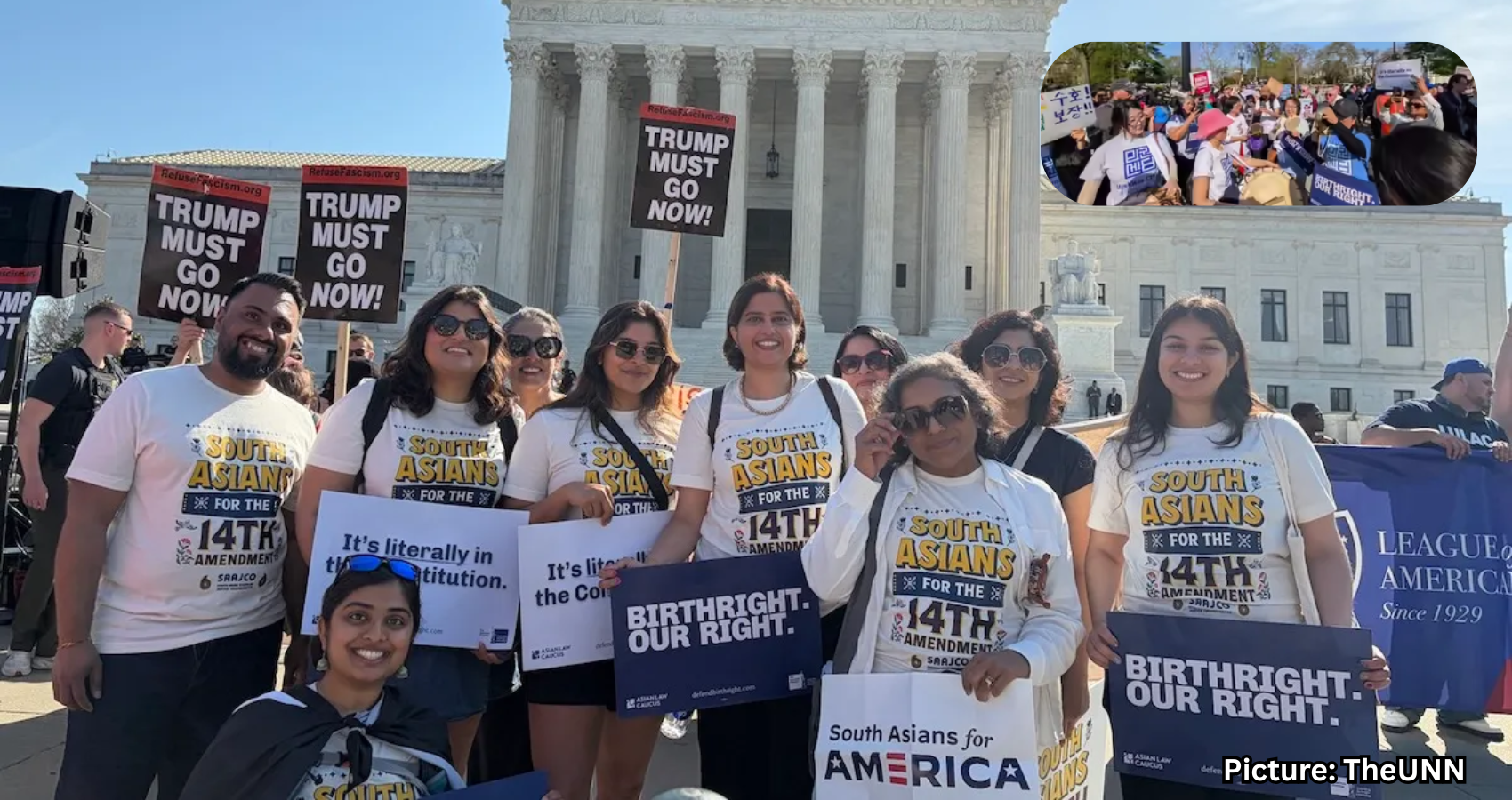
The South Asian American Justice Collaborative rallied outside the U.S. Supreme Court as justices heard oral arguments in a pivotal birthright citizenship case, emphasizing the importance of community solidarity.
The South Asian American Justice Collaborative (SAAJCO) gathered with hundreds of community members, advocates, and partners outside the U.S. Supreme Court on a significant day as justices heard oral arguments in a critical birthright citizenship case.
“The energy today was powerful,” said Chirag Shah, Program Manager at SAAJCO. “People showed up because this is about something fundamental. It’s about recognizing that when one community is impacted, we all are, and that’s why we organize together.”
In addition to the rally, SAAJCO submitted an amicus brief in the case, which underscores the long history of South Asian communities in the United States. The brief challenges the perception that South Asians are “forever foreign” and details the potential harms that communities could face if the executive order regarding birthright citizenship is upheld.
“Two things stood out today. Justice Sotomayor rightly raised the denaturalization of South Asians after Thind and questioned whether changes to birthright citizenship could be applied retroactively,” noted Kalpana V. Peddibhotla, Executive Director of SAAJCO. “Reading new conditions into the Fourteenth Amendment is already deeply concerning. While the government offered assurances about limiting its scope, those limits may not hold over time. This administration has not thought through how far-reaching the implications are.”
Peddibhotla also highlighted that the government’s argument relied on the concept of “temporary visitors” to suggest that birthright citizenship should depend on domicile. This stance directly affects families who have lived in the U.S. for years or decades on H-1B visas, seeking asylum, or navigating green card backlogs.
<p“The Court raised concerns about the administrative burdens that would ensue if this order is upheld,” said Anisa Rahim, Legal Director of SAAJCO. “For South Asians, the second largest growing immigrant demographic, that means many babies would be denied citizenship at birth. Many South Asian countries will not automatically confer citizenship on those babies affected by the order, rendering them stateless.”
SAAJCO led a coalition of South Asian civil rights and community organizations in filing an amicus brief in the United States Supreme Court, defending the Fourteenth Amendment’s guarantee of birthright citizenship. The brief was filed in partnership with Davis Wright Tremaine LLP and was joined by South Asian-focused and allied organizations nationwide.
Drawing on the often-overlooked history of South Asian presence in the United States, the brief articulates how these communities have long sought to assert their rights of citizenship and belonging.
As stated in the brief, “In short, for centuries, South Asian Americans have been woven into the nation’s economic, political, and social fabric. When they have been treated as outsiders, it has been not because of a lack of contribution or commitment, but because of racialized judgments about who belongs.”
The brief warns that conditioning the recognition of citizenship at birth on parental immigration status would undermine established constitutional law and destabilize families who have relied on the guarantee that children born in the U.S. are Americans.
“We are not forever foreign. South Asian children born here are Americans. That is what the Fourteenth Amendment guarantees,” Peddibhotla asserted.
This rally and the accompanying legal efforts reflect a broader movement among South Asian Americans to affirm their rights and challenge narratives that seek to marginalize their contributions to American society.
As the Supreme Court deliberates on this crucial issue, the voices of advocates like those at SAAJCO continue to resonate, emphasizing the importance of community, belonging, and the fundamental rights enshrined in the Constitution.
According to India Currents, the outcome of this case could have lasting implications for countless families and the future of birthright citizenship in the United States.