
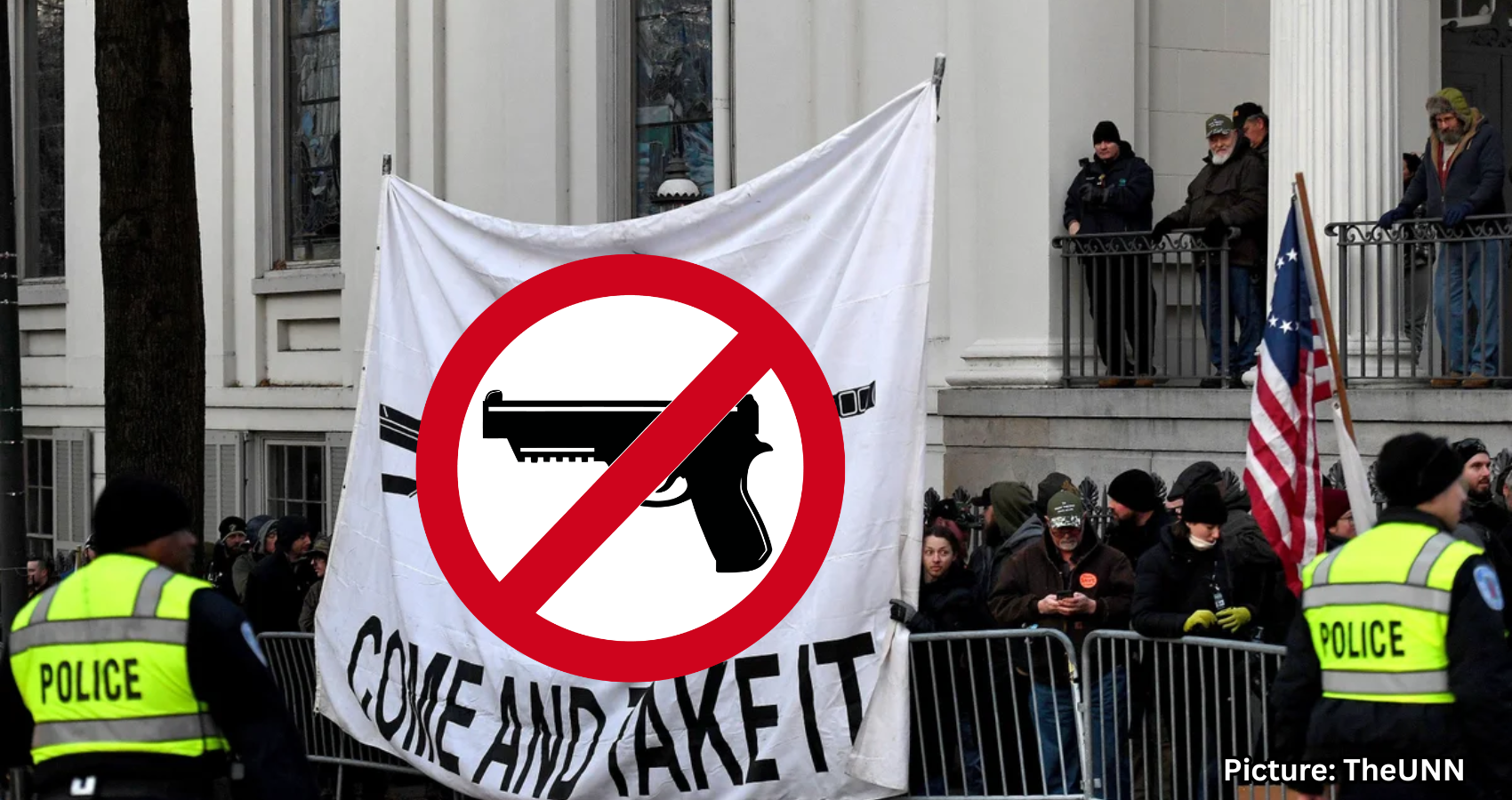
Virginia Democrats have advanced a sweeping gun-control package while West Virginia lawmakers propose expanding access to machine guns, illustrating the stark political divide on gun policy in the two states.
Virginia Democrats have sent a comprehensive gun-control package to Governor Abigail Spanberger’s desk, while West Virginia lawmakers are considering a proposal that would allow residents to legally obtain machine guns. These contrasting legislative efforts underscore the significant divergence in gun policy across the historic Virginia border.
More than 160 years after West Virginia separated from Virginia during the Civil War, the two states are again pursuing very different political paths. In Virginia, Democrats in Richmond are advancing new firearm restrictions, while Republicans in Charleston are exploring ways to expand Second Amendment rights.
Governor Spanberger has expressed her intention to review the sweeping firearms ban proposed by state Senator Saddam Salim, D-Dunn Loring, when it arrives at her desk next week. “As the mother of three daughters in Virginia public schools and a former federal law enforcement officer who carried a gun every day, Governor Spanberger knows how important it is to make sure kids and families are safe,” her office stated in a message to Richmond’s ABC affiliate.
Spanberger’s office did not respond to inquiries about whether she plans to sign Salim’s bill before publication. The push for stricter gun laws comes as the political landscape in Virginia and West Virginia continues to diverge. Republicans hold a commanding majority in West Virginia’s legislature, with supermajorities of 31-2 in the Senate and 91-9 in the House of Delegates. Notably, West Virginia is one of only two states—along with Oklahoma—without any Democrat-majority counties. In contrast, Democrats have strengthened their control over Virginia’s government, capturing the governor’s mansion in 2025.
The assault weapons ban was introduced in January at the onset of the expanded Democratic majority’s rule in Richmond. Salim has stated that there are “so many assault weapons in circulation” and that his bill aims to “gradually” remove them from the streets without retroactively criminalizing possession of any newly categorized “assault weapons.” The Bangladesh-born lawmaker has also raised concerns about how schools can remain safe spaces for children without implementing active-shooter drills.
The proposed legislation would prohibit a wide range of firearms and features, including semi-automatic center-fire pistols with magazines exceeding 15 rounds, rifles with detachable magazines, and weapons with specific characteristics such as collapsible or thumbhole stocks and threaded barrels. The scope of these restrictions has drawn criticism from Republican lawmakers.
State Senator Mark Obenshain, R-Harrisonburg, created a mashup video featuring Virginia Democrats discussing the need for the bill, captioning it: “Clueless Confident Dangerous and still writing the law.” State Senator Bill Stanley Jr., R-Rocky Mount, remarked, “On this list, pretty much everything is a bad firearm. We should stop harming the people who are law-abiding citizens, especially in my region.”
During the floor debate, Senate Majority Leader Scott Surovell, D-Mount Vernon, argued that determining whether a firearm has a threaded barrel requires an inspection of the weapon itself. Stanley countered by reminding lawmakers that “millions of Virginians own firearms” and “billions of pieces of ammunition.” He added, “If we were the problem, you would know about it,” as the debate shifted to light-hearted remarks about “turkey rifles,” a phrase that quickly gained traction on social media.
Meanwhile, in West Virginia, lawmakers are considering how to expand Second Amendment rights for residents. State Senators Chris Rose, R-Monongalia, and Zachary Maynard, R-Chapmanville, have introduced the Public Defense and Provisioning Act, which would permit the transfer of machine guns to residents, among other provisions.
The lawmakers cited the Second Amendment’s language and referenced the favorable decision in D.C. v. Heller, which clarified “unrestricted access” under the militia clause to “resist tyranny.” They also invoked Tench Coxe’s assertion that “Congress has no power to disarm the militia.” Rose stated that the bill aims to address “a longstanding issue in federal firearms law” and to reaffirm the constitutional protections afforded to West Virginians under the Second Amendment and Article III, Section 22 of the West Virginia Constitution.
Rose emphasized his commitment to Second Amendment rights, stating, “I have long been clear that I am a Second Amendment absolutist, and I believe the Constitution means exactly what it says when it states that the right of the people to keep and bear arms shall not be infringed.” However, the bill faced obstacles as West Virginia’s legislative session nears its conclusion, with Senate President Randy Smith, R-Blackwater Falls, deciding not to advance it after it passed through the Judiciary Committee, citing potential legal challenges.
Smith noted, “With an issue as critical as the protection of our Second Amendment rights, we must ensure the legislation we pass will survive legal challenge. This would not have.” The proposal raises questions regarding the federal 1986 Hughes Amendment, which prohibits civilian transfers of machine guns manufactured after that year. A Judiciary Committee attorney indicated that the restriction might not apply if the transfer were conducted through a state agency such as the West Virginia State Police.
During a hearing, Senator Joey Garcia, D-Fairmont, also raised concerns about potential conflicts with federal firearms laws. Gun Owners of America reportedly collaborated with Rose on the legislation and has defended its legal standing. With Smith’s decision and the session nearing its end, lawmakers are expected to revisit the proposal next year. A source within the West Virginia House Republican caucus indicated that discussions are already underway to revive the bill.
Smith expressed openness to a new bill next year but advised proponents to pay closer attention to the legislative calendar to avoid last-minute issues. “For now, [we’re] probably going to have to let this stand,” a West Virginia Senate Republican source told Fox News Digital.
In a related development, Charleston recently approved a bill from Delegate Charles Horst, R-Falling Waters, allowing license-free concealed carry for individuals aged 18 to 20.
As the debate over gun rights and regulations continues, the contrasting approaches of Virginia and West Virginia serve as a reflection of the broader national conversation surrounding firearms and public safety.
According to Fox News.