
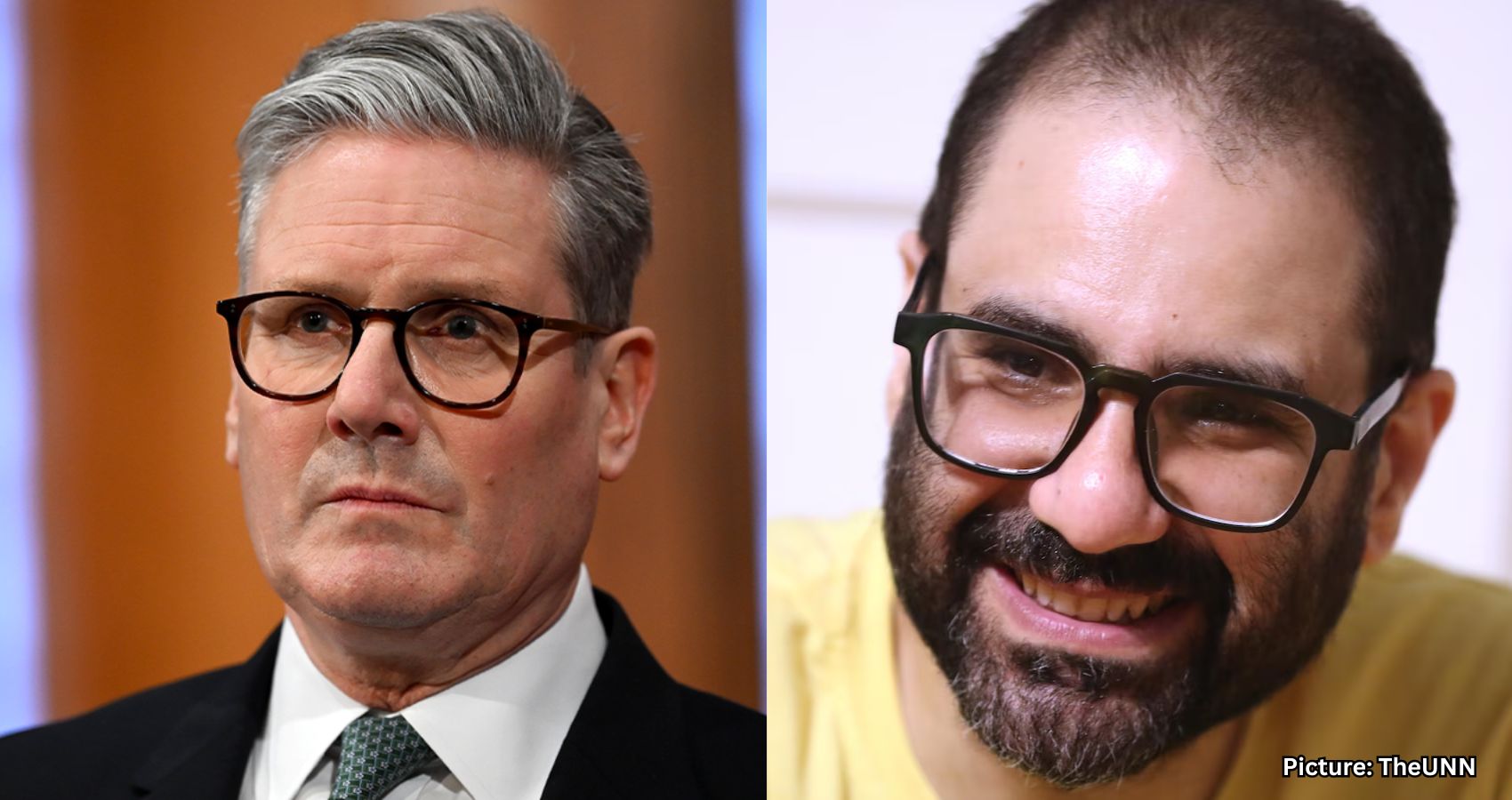
U.K. Prime Minister Keir Starmer faces backlash for welcoming home human rights activist Alaa Abd el-Fattah, following resurfaced social media posts containing violent and antisemitic language.
U.K. Prime Minister Keir Starmer is under fire after celebrating the return of Alaa Abd el-Fattah, a human rights activist recently released from an Egyptian prison. The backlash stems from Abd el-Fattah’s past social media posts, which allegedly contain violent and antisemitic language.
A dual British-Egyptian national, Abd el-Fattah had been imprisoned in Egypt for most of the past 14 years. His release came in September after a pardon from the Egyptian president. However, he remained in Egypt under a travel ban that was only recently lifted, allowing him to return to the U.K. on Friday.
Upon Abd el-Fattah’s return, Starmer expressed his delight at the activist’s reunion with his family in Britain. However, this warm welcome was met with criticism from various political figures.
Robert Jenrick, a senior member of the opposition Conservative Party, condemned Starmer for what he described as a “personal, public endorsement” of Abd el-Fattah. Jenrick questioned whether Starmer was aware of the activist’s controversial past social media posts, which allegedly included endorsements of violence against Zionists and police.
Jenrick urged Starmer to condemn Abd el-Fattah’s remarks and retract his “unalloyed endorsement” of the activist. “Nobody should be imprisoned arbitrarily nor for peaceful dissent,” Jenrick stated. “But neither should the prime minister place the authority of his office behind someone whose own words cross into the language of racism and bloodshed.”
Calls for Abd el-Fattah’s British citizenship to be revoked and for his deportation have also come from Conservative leader Kemi Badenoch and Reform UK leader Nigel Farage.
In response to the growing criticism, the U.K. government clarified that Starmer was unaware of the “abhorrent” social media posts when he issued his welcoming statement. The Foreign, Commonwealth and Development Office emphasized that advocating for Abd el-Fattah’s release does not equate to endorsing his past comments.
The government condemned Abd el-Fattah’s historic tweets, labeling them as “abhorrent.” In a statement, they reiterated that it has been a long-standing priority for both major political parties to secure his release.
Shortly after arriving at London’s Heathrow Airport, Abd el-Fattah issued an “unequivocal apology” for his past comments, describing them as “expressions of a young man’s anger” during times of regional crises and police brutality in Egypt.
Abd el-Fattah’s family has maintained that he spent the majority of the past 14 years in prison due to his opposition to the government of Egyptian President Abdel-Fattah el-Sissi. His mother, Laila Soueif, 69, even undertook a 10-month hunger strike to pressure British authorities to take more action to secure her son’s freedom.
Following the resurfacing of Abd el-Fattah’s controversial posts, he defended his comments, stating they were taken out of context and were part of a “private conversation” during an Israeli offensive in the Gaza Strip, according to The Times of London.
The situation continues to evolve as political leaders and the public respond to the implications of Abd el-Fattah’s past and the government’s stance on his return.
According to The Associated Press, the controversy surrounding Abd el-Fattah’s return highlights the complexities of balancing human rights advocacy with the ramifications of past actions.