
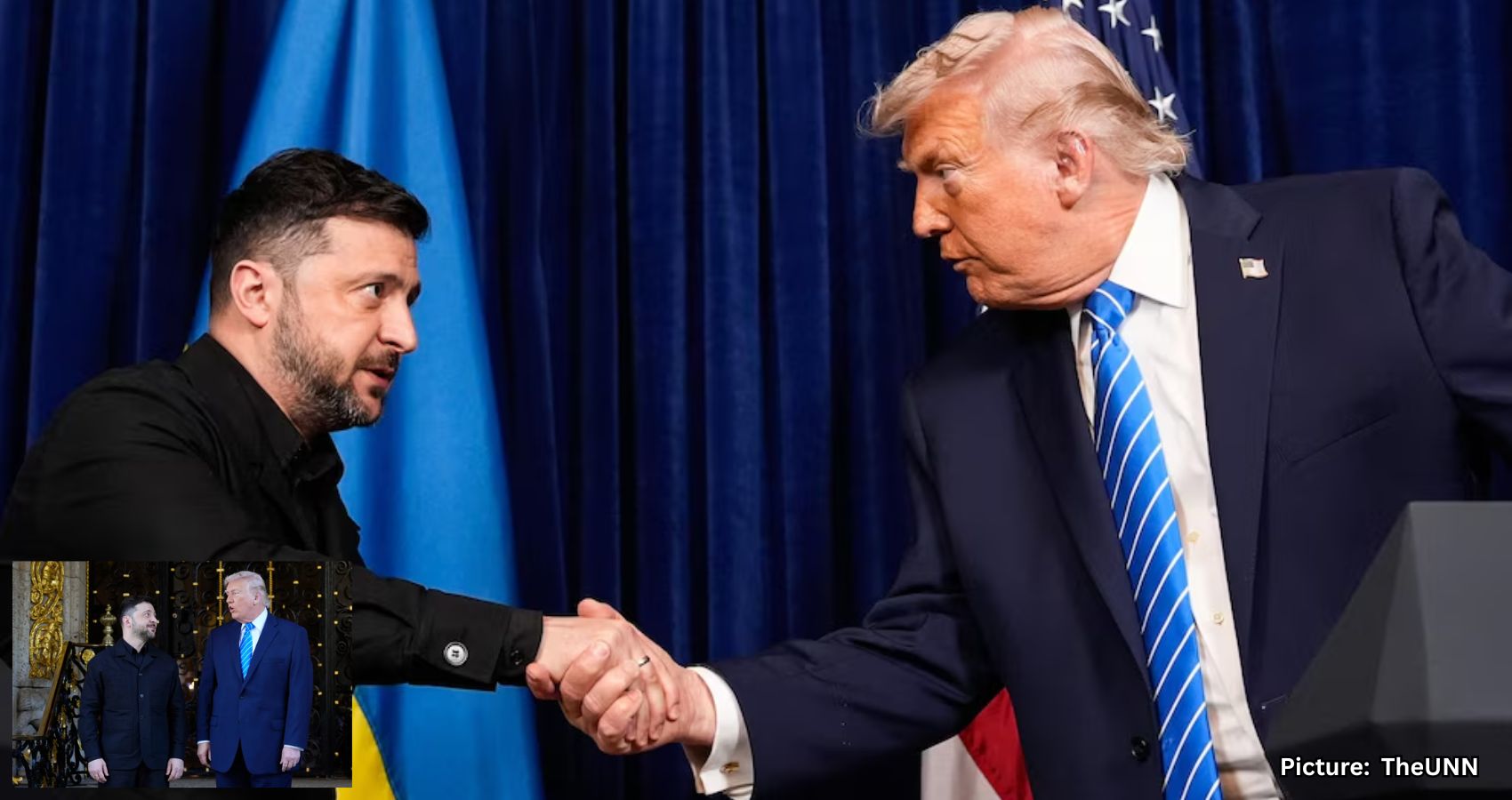
U.S. President Donald Trump and Ukrainian President Volodymyr Zelenskyy expressed optimism about nearing a peace deal for Ukraine following talks in Florida, despite unresolved complex issues.
U.S. President Donald Trump and Ukrainian President Volodymyr Zelenskyy announced on Sunday that negotiations aimed at ending the war in Ukraine are progressing towards a potential breakthrough. This statement followed high-level discussions held at Mar-a-Lago, where both leaders acknowledged that several complex and politically sensitive issues remain unresolved.
After their meeting, Trump and Zelenskyy spoke to reporters about what they described as significant progress on a proposed 20-point peace framework. This framework has emerged from weeks of intensive diplomacy involving the United States, Ukraine, European Union members, and NATO officials. While much of the framework appears to be agreed upon, key disagreements over territorial status, ceasefire guarantees, and the process for Ukrainian domestic approval continue to present major challenges.
“We could be very close,” Trump stated, conveying a sense of cautious optimism. “There are one or two very thorny issues, very tough issues. But I think we’re doing very well. We made a lot of progress today, but really, we’ve made it over the last month. This is not a one-day process. It’s very complicated stuff.”
Zelenskyy echoed Trump’s sentiments, noting that negotiators have largely converged on the structure of a deal following sustained engagement across multiple international venues. He highlighted that discussions have taken place over several weeks in cities such as Geneva, Miami, Berlin, and Palm Beach. American and Ukrainian teams have been working closely together to refine a shared peace framework.
<p“We discussed all the aspects of the peace framework, which includes — and we have great achievements — a 20-point peace plan, 90 percent agreed,” Zelenskyy said. He underscored what he described as unprecedented alignment between Kyiv and Washington at this stage of the conflict.
Both leaders confirmed the involvement of European and NATO officials in the negotiations. Following their meeting in Florida, Trump and Zelenskyy participated in a joint call with senior European leaders and international partners, reinforcing the multilateral nature of the peace effort.
Zelenskyy mentioned that negotiating teams are expected to reconvene in the coming weeks to address the remaining disputes. He also noted that Trump has expressed a willingness to host additional talks in Washington involving European leaders and a Ukrainian delegation, indicating continued U.S. engagement at the highest level.
Despite the progress made, the status of territory—particularly the Donbas region—remains one of the most contentious issues. Both Trump and Zelenskyy acknowledged that Ukraine and Russia hold sharply differing positions, making compromise politically and diplomatically challenging.
Trump cautioned that time could work against Ukraine if fighting continues without a settlement. “Some of that land has been taken,” he said. “Some of that land is maybe up for grabs, but it may be taken over the next period of a number of months. Are you better off making a deal now?” His remarks suggested a sense of urgency in Washington to prevent further battlefield losses from influencing the final terms of any agreement.
In contrast, Zelenskyy emphasized that territorial questions cannot be resolved by executive decision alone. He stated that any final agreement must comply with Ukrainian law and reflect the will of the Ukrainian people, which could require parliamentary approval or even a national referendum.
“Our society, too, has to choose and decide who has to vote, because it’s their land—the land not of one person,” Zelenskyy remarked. “It’s the land of our nation for a lot of generations.”
Trump framed his push for a deal in humanitarian terms, citing what he described as overwhelming public support for ending the conflict and the staggering human toll of the war. “We want to see it ended,” he said. “I want it ended because I don’t want to see so many people dying. We’re losing massive numbers of people—the biggest by far since World War II.”
Analysts suggest that the convergence of diplomatic momentum, public fatigue with the war, and intensifying battlefield pressures may be driving the renewed urgency on all sides. However, they caution that the remaining disputes—particularly over sovereignty, security guarantees, and enforcement mechanisms—are precisely the issues that have derailed past peace efforts.
While neither leader provided a definitive timeline, Sunday’s statements marked one of the most optimistic assessments of peace prospects since the war began. The emphasis on a nearly agreed 20-point plan, coupled with ongoing multilateral involvement, suggests that negotiators believe a framework is within reach—if the final obstacles can be bridged.
For now, the talks remain delicately poised between breakthrough and breakdown. As Trump noted, progress has been substantial, but the final steps will require resolving questions that strike at the heart of Ukraine’s sovereignty and the future security architecture of Europe, according to Global Net News.