
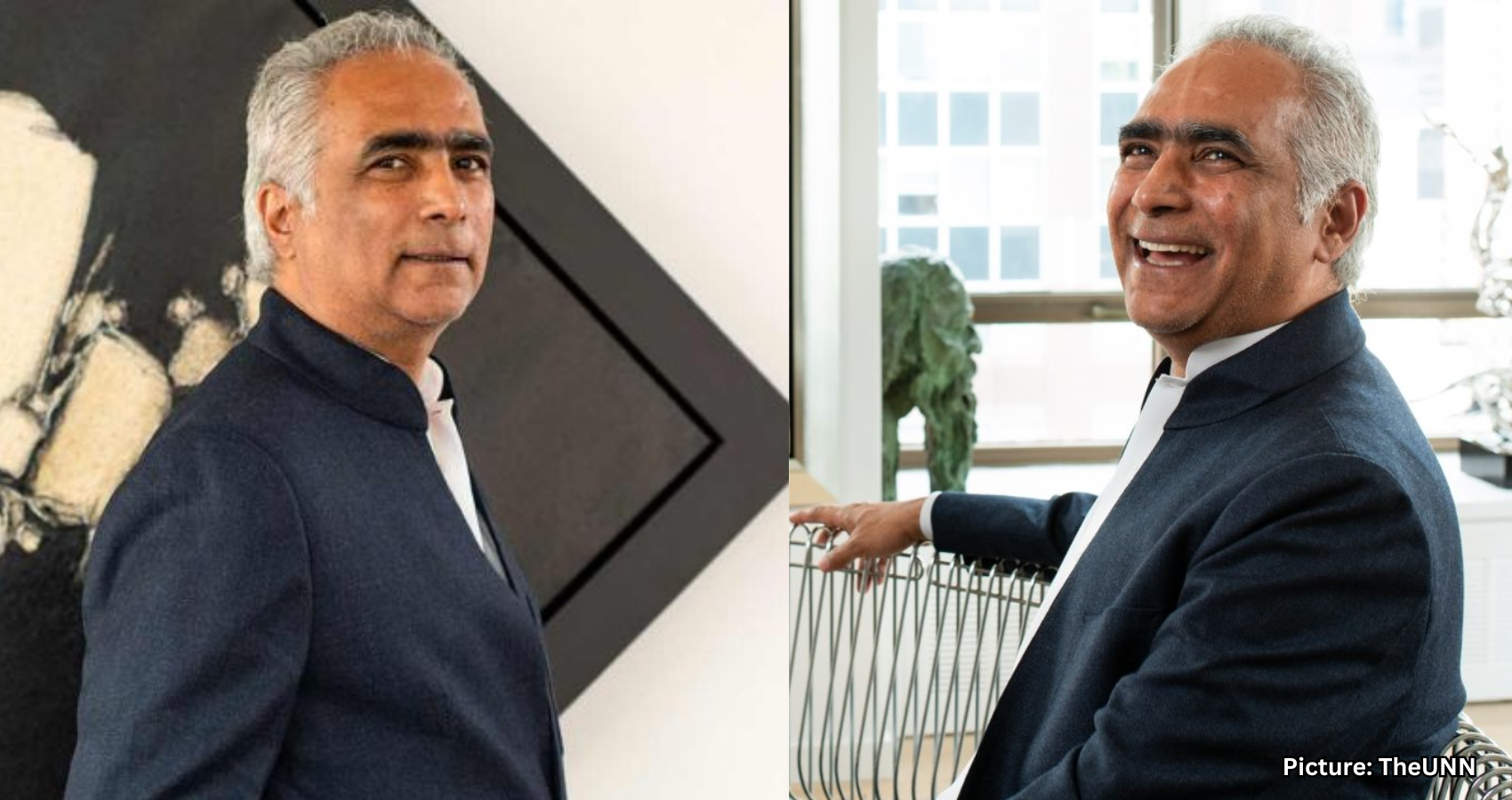
Sundaram Tagore is at the forefront of a global movement that merges India’s cultural confidence with the international art scene, marking a significant milestone in his 25-year journey as a cultural ambassador.
On a crisp fall evening in Chelsea, New York City, the Sundaram Tagore Gallery buzzed with excitement as artists, collectors, curators, and longtime patrons gathered to celebrate a significant milestone in the gallery’s history.
The latest exhibition, part of a year-long anniversary program titled “25 Years: A Global Conversation,” opened its New York chapter with an atmosphere that felt more like a homecoming than a typical art-world event. The gallery showcased a constellation of Hiroshi Senju’s luminous waterfall paintings, inviting attendees to engage with works from artists across continents. These pieces explored themes of identity, migration, technology, and the universal human impulse to create.
Reflecting on the evening, I was reminded of my first encounter with Sundaram Tagore when he established his namesake gallery in SoHo 25 years ago. At that time, few New York spaces focused on artists exploring cross-cultural identity. “We opened with a simple mission,” Tagore stated. “To create a salon where cultures could meet on equal footing through art.” Now, as I stood amidst the vibrant works, I recognized the years of dedication that have contributed to this vision being realized.
Tagore is not your typical art dealer; he eschews spectacle and theatrics in favor of a dignified, soft-spoken demeanor that reflects his lineage in the art world. Trained as a curator and art historian, he entered the gallery scene with a vision shaped by personal experience rather than market trends.
Born in Kolkata to a family rich in artistic and intellectual heritage, Tagore grew up surrounded by painters, poets, and thinkers who viewed art as a means of dialogue. His great-uncle, Rabindranath Tagore, was a renowned poet, philosopher, and Nobel laureate, while his father, Subho Tagore, was a painter and poet who edited art magazines.
While this lineage undoubtedly influenced him, Tagore insists that the gallery’s focus stands on its own merit. After studying art history at Oxford, he began his career at Pace Wildenstein Gallery in New York, curating exhibitions that highlighted connections between Eastern and Western art traditions. In 2000, he brought that vision to life with the opening of the Sundaram Tagore Gallery in SoHo.
As the gallery flourished, so did its reach. A Hong Kong outpost opened in 2005, followed by Beverly Hills in 2008, and later successful expansions in Singapore and London. Rather than expanding for the sake of scale, Tagore positioned each gallery as a cultural hub, fostering its own community of artists, writers, and thinkers. He has also emphasized the work of women artists who have historically been overlooked in the Western art canon.
Tagore has championed notable artists such as Hiroshi Senju (Japan), Natwar Bhavsar (India/US), Golnaz Fathi (Iran), Miya Ando (US/Japan), Sohan Qadri (India/Denmark), and Jane Lee (Singapore). The 25th-anniversary initiative reflects both the gallery’s history and its ongoing momentum. Rather than a retrospective, the exhibition serves as a continuum, showcasing how ideas travel, evolve, and return in new forms.
In addition to his role as a gallerist, Tagore has actively curated and organized exhibitions that promote cross-cultural understanding, including “Frontiers Reimagined” at the 56th Venice Biennale. His contributions have earned him a place on the boards of several esteemed institutions, including The Noguchi Museum and the Asian Cultural Council.
Colleagues describe Tagore as a quiet yet persistent force in the art world. “He helped expand the art world’s mental map, making the case for equivalence — showing that artistic excellence exists everywhere, not only in the West,” one colleague remarked.
In addition to curating, Tagore has ventured into filmmaking. His works include “The Poetics of Color: Natwar Bhavsar,” which illuminated the life of the Indian American painter, and “Louis Kahn’s Tiger City.” His upcoming film, “Art Matters,” featuring Nandita Das and Linus Roache, explores the impact of art on society.
Tagore’s global perspective extends beyond exhibitions and films. New York serves as the flagship, Singapore represents the Asia Pacific presence, and the soon-to-be-opened London gallery at 27 Pall Mall will expand his European reach. Each location acts as a node in Tagore’s network of cross-cultural exchange, with the London gallery set to emphasize his South Asian heritage and promote the best of Indian art.
A quarter-century after its inception, the Sundaram Tagore Gallery remains anchored by a vision that has only grown more urgent: art is most powerful when it brings diverse worlds together. The bridges Tagore has built now feel not only relevant but necessary.
As London prepares to welcome his signature approach to cultural diplomacy, there is a palpable sense of profound change. This shift is not driven by spectacle but rather by the subtle power of artistic resonance. India’s most influential ambassadors are no longer solely from technology or finance; the nation’s cultural voice—rich, confident, and self-assured—is stepping onto the global stage as an equal. In Tagore’s hands, cultural exchange transcends commerce, becoming a calling. In this calling, India finds one of its most compelling ambassadors.
According to Jaswant Lalwani, a global real estate advisor and lifestyle consultant based in New York City, Tagore’s work exemplifies the transformative power of art in fostering cultural connections.