
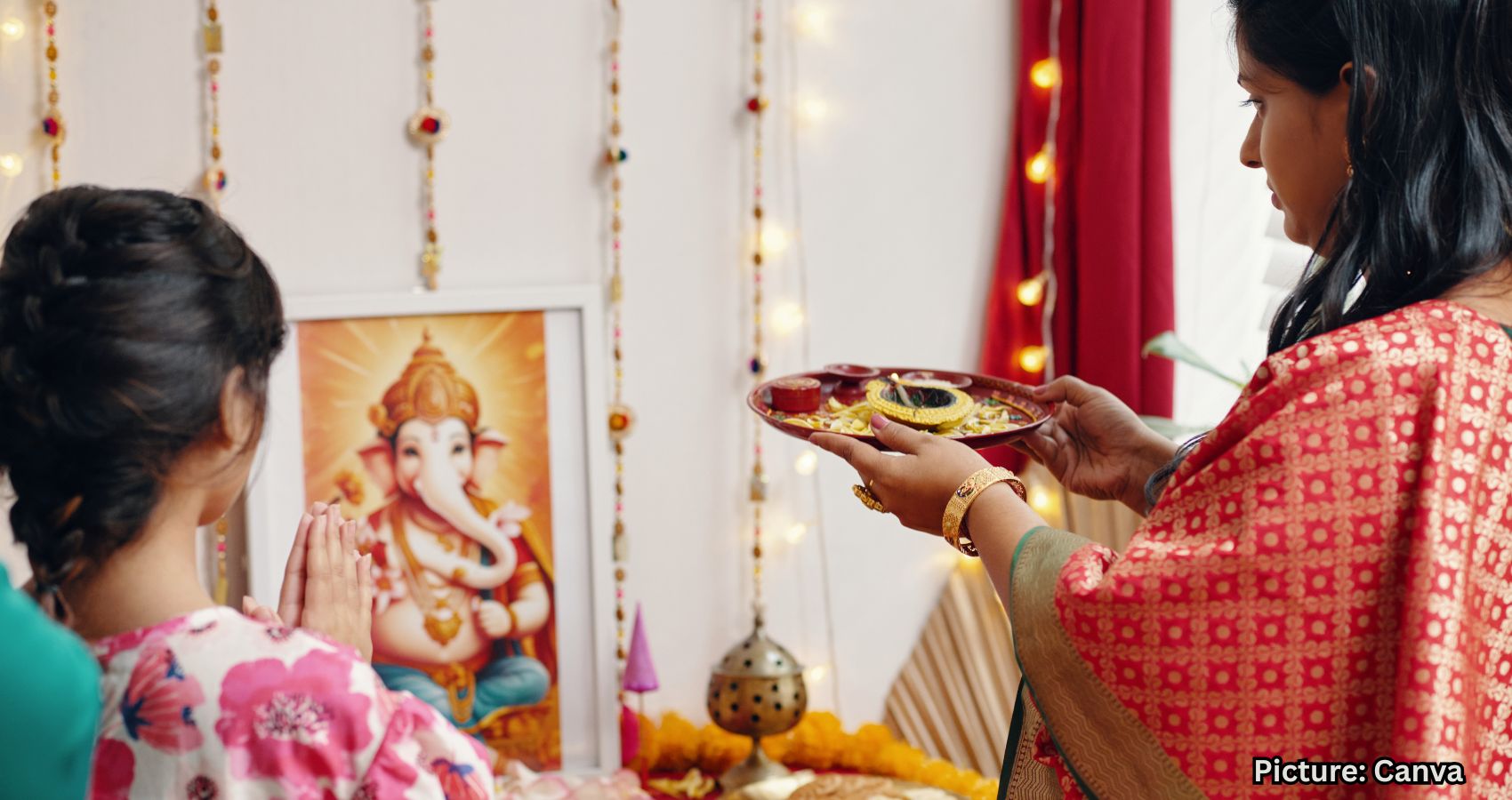
Secular Hindus in India grapple with the complexities of identity, navigating the intersection of faith and politics amid rising polarization and societal expectations.
About four years ago, a former colleague of mine was in the process of hiring interns for his new media business. As part of his evaluation, he reviewed an intern’s social media account before the interview and came across pictures of a clay Ganesh idol she had crafted. “That’s the moment I decided I didn’t want to hire her,” he remarked.
When I inquired about his reasoning, he explained that anyone who publicly showcased their religion was likely to have political affiliations that he found undesirable.
On another occasion, a family member urged me to dismiss the person who washed my car, stating, “He belongs to a certain religion. You can always hire someone who belongs to ours.” After a lengthy argument that extended into the early hours, I stood firm, insisting that I would not terminate someone’s employment based solely on their religious background.
These incidents highlight the deep-seated religious tensions in India, where different faiths often clash politically. In this context, individuals like myself, who identify as secular Hindus, find themselves at a crossroads. There is no guidebook on how to navigate this intricate landscape or why we are compelled to make such choices.
To be fair to my former colleague, it is his business, and he is entitled to make hiring decisions as he sees fit. However, his choice prompted me to reflect on my own practices. I have never publicly posted a religious message, nor can I recall the last time I visited a temple or donned attire that signified my religious identity.
The extreme viewpoints surrounding religion are concerning. Assigned the ‘Hindu’ label at birth, I now feel the weight of secularism pressing down on me more than ever. This is not due to a desire to abandon my identity as a Hindu, but rather as an educated, scientifically-minded individual, I find myself questioning the extremes on both sides of the spectrum.
Why should someone’s religious expression render them unfit for employment, especially if that expression aligns with the ruling party? Why should religion dictate job opportunities? Why must I engage in debates about fairness at family gatherings? Why do I feel compelled to avoid certain community members who may insist on enforcing a religious litmus test for others?
Moreover, I often find myself defending the peaceful and tolerant nature of my religion, arguing that those who resort to aggression are ultimately on a path of self-destruction. The volume of rallies has increased, as individuals strive to assert their beliefs, and there are calls for larger families to outnumber adherents of other faiths.
In the past, celebrating festivals like Diwali and Holi was simply about dressing up, enjoying colors, and bursting firecrackers with friends and family. Today, environmental concerns have diminished the use of firecrackers and colors, yet some individuals ignore the realities of climate change, using religion as a means to ‘other’ those of different faiths, insisting that “we must adhere to our traditions or risk being overpowered.”
This polarization has led to what I term ‘cultural homelessness.’ As a secular Hindu, I am often labeled “anti-Hindu” by right-wing factions or viewed with skepticism by left-wing intellectuals for any minor expression of faith.
Indian politician and author Shashi Tharoor addresses this dilemma in his book, Why I Am Hindu. He asserts that “The Hindu truth is a truth of multiple choice. Hinduism is a civilization, not a dogma,” emphasizing the importance of respecting diverse paths to truth. He cautions against transforming such a “vast, magnificent, and inclusive faith” into a “narrow, intolerant political ideology,” which he views as a betrayal of its essence.
This perspective resonates with me. I appreciate the reverence for nature found in religious texts, yet I lament the degradation of our rivers. I value the principles of aligning body and mind as advocated in religious teachings, yet I am disheartened by the decline in our community’s health. These dualities are part of my daily existence, and I struggle to reconcile them.
Another compelling argument comes from author Devdutt Pattanaik in his essay, “Symbols for the Secular Tribe.” He posits that in India, to validate one’s secular credentials, one must be perceived as perpetually critical of Hinduism. Pattanaik notes that his writings on Hindu mythology are often dismissed as “peddling soft Hindutva.” This selective critique of certain religions, he argues, has become “the modern code of secularism.”
Why can’t I take pride in my heritage while also critiquing how some interpretations of my faith manifest?
Tharoor articulates this sentiment powerfully: “A Hinduism that seeks to dominate and exclude others is no longer Hinduism.” He contends that when a singular, aggressive interpretation of Hinduism is employed to define the nation, it undermines both democracy and the faith itself.
In a country as diverse as India, characterized by multiple religions, languages, and ethnicities, no single ideology or faith can encapsulate the entirety of the population. Yet, the concept of “secularism” carries its own burdens. Why does proving my secularism necessitate distancing myself from my own religion?
Indian liberalism is not a modern or foreign elite concept; it has been the adhesive that has held a diverse civilization together for centuries. Political scientist Pratap Bhanu Mehta has frequently noted that polarized public discourse forces individuals into rigid categories, leaving little room for liberal perspectives. Expressing pride in Hindu pluralism can lead the Left to suspect majoritarianism, while criticizing religious aggression may prompt the Right to label someone as anti-national.
For many secular Hindus today, there is a constant worry that their faith will be mistaken for intolerance, while their secularism may be interpreted as a rejection of their identity.
Currently, secular Hindus often feel ashamed of their faith. But does a genuinely secular society emerge from instilling fear about expressing one’s beliefs publicly? I believe it does not. Such an environment merely creates more opportunities for political parties to claim ownership of religion.
Historian Ramachandra Guha, while critical of Hindutva, also scrutinizes the rigidity of the Indian Left and secular academics. He observes that even a positive expression of Hindu identity is frequently met with deep suspicion.
Can a secular Hindu today confidently declare they are a “proud Hindu” without feeling they have committed a transgression, just as easily as they can affirm their support for a secular state?
The concern for secular Hindus is not about physical safety, but rather about the erosion of nuance. In contemporary India, individuals are often compelled to choose between being an atheist or a bigot, leaving scant room for those who are religious, proud of their heritage, and committed to a pluralistic democracy.
According to India Currents, the struggle for secular Hindus is emblematic of a broader societal challenge, where faith and identity are increasingly politicized, complicating the quest for a harmonious coexistence.