
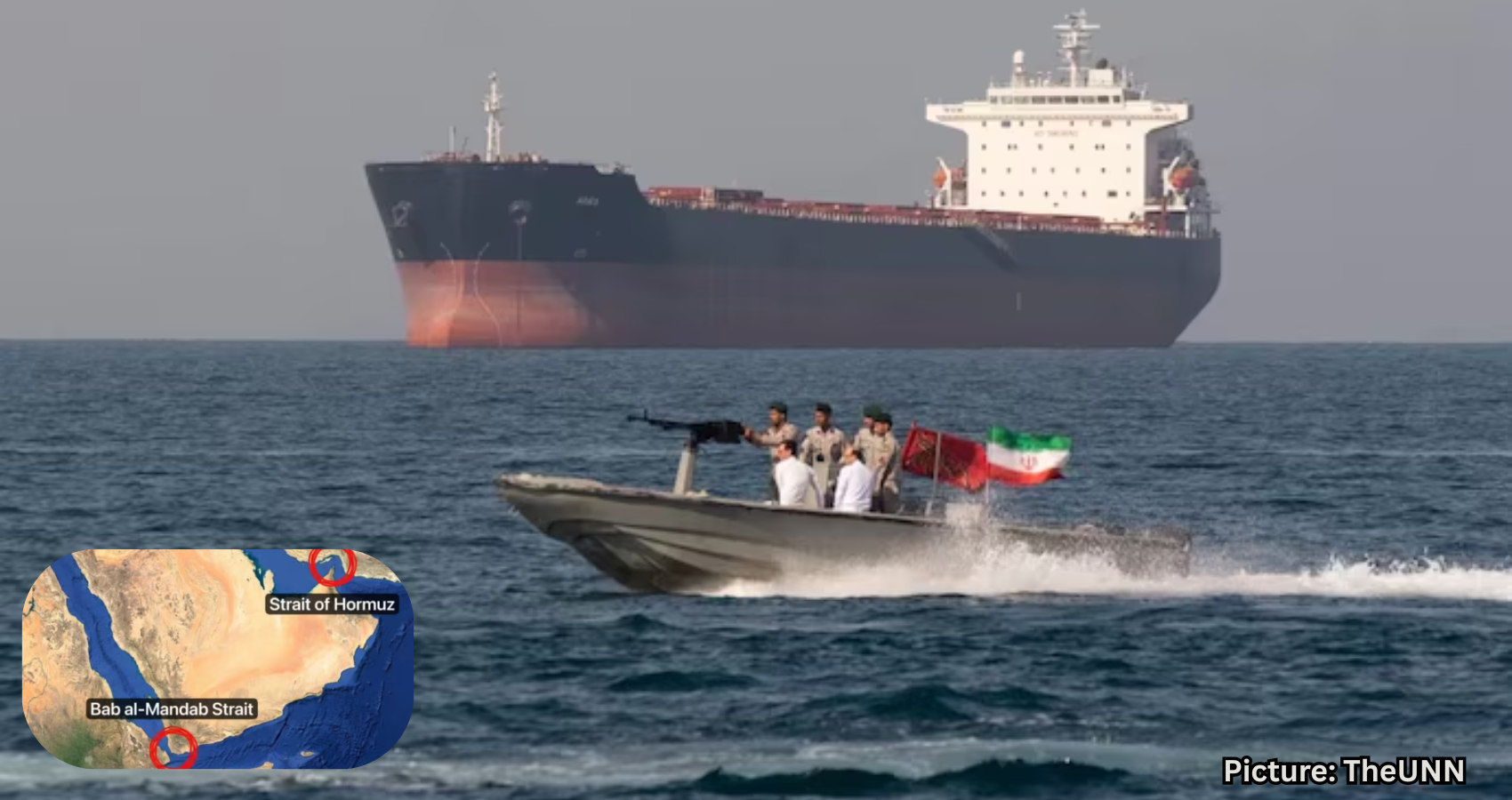
Iran threatens to disrupt global shipping routes, particularly the Bab al-Mandeb Strait, in response to potential U.S. actions against the Strait of Hormuz, raising concerns over energy market stability.
Iran may retaliate against a U.S. naval blockade of the Strait of Hormuz by directing its Houthi allies to target the Bab al-Mandeb Strait, a critical global shipping route, according to a senior Middle East analyst.
The Bab al-Mandeb Strait, which connects the Red Sea to the Gulf of Aden, is a vital corridor for international trade and carries approximately 12% of global oil shipments. This makes it a strategic point that could escalate tensions further and strain global energy markets.
Mona Yacoubian, director and senior adviser at the Middle East Program, warned that if the U.S. proceeds with its plans to blockade the Strait of Hormuz, Iran could escalate its actions to ensure that Gulf countries are unable to export oil.
“This could translate to further attacks on Gulf energy infrastructure or even deploying the Houthis to blockade the Bab al-Mandeb,” Yacoubian stated in an interview with Fox News Digital.
Her comments came after Ali Akbar Velayati, a senior adviser on international affairs to Iran’s Supreme Leader, indicated Tehran’s perspective on the Bab al-Mandeb in light of potential U.S. actions against the Strait of Hormuz. He remarked, “Today, the unified command of the Resistance front views Bab al-Mandeb as it does Hormuz,” in a post on X.
Velayati warned that if the White House repeats what he termed “foolish mistakes,” it would quickly learn that the flow of global energy and trade could be disrupted with a single move.
In a statement released Sunday, U.S. Central Command announced that a naval blockade would begin on Monday, targeting vessels of all nations entering or departing Iranian ports and coastal areas, including those on the Arabian Gulf and the Gulf of Oman.
President Donald Trump also emphasized that the U.S. Navy would block “any and all ships trying to enter or leave the Strait of Hormuz” in a post on Truth Social.
In March, the U.S. had already warned ships navigating the Red Sea chokepoint about potential Houthi attacks. A maritime advisory noted that the Houthis, an Iran-backed armed group controlling much of northern Yemen, continue to pose a threat to U.S. assets, including commercial vessels in the region.
The advisory outlined various potential hostile actions from the Houthis, including one-way unmanned aerial vehicle (UAV) attacks, unmanned surface vehicle (USV) attacks, unmanned underwater vehicle (UUV) attacks, ballistic and cruise missile attacks, small arms fire from small boats, explosive boat attacks, and illegal boardings, detentions, or seizures.
U.S.-flagged commercial vessels operating in these areas were strongly advised to turn off their AIS transponders to avoid detection.
Yacoubian also highlighted in a report for the Center for Strategic and International Studies (CSIS) that Iran is threatening to extend the conflict to the Red Sea and the Bab al-Mandeb Strait, which could exacerbate disruptions in global markets.
She noted that Iran could leverage the Houthis, its Yemeni proxy, to launch attacks on this strategic waterway, thereby depriving Saudi Arabia of a crucial route for oil shipments due to the blockage of the Strait of Hormuz.
The Houthis escalated their involvement in the conflict against the U.S. and Israel on March 28, when they launched two ballistic missiles at southern Israel, both of which were intercepted.
As tensions rise, the implications for global energy markets and shipping routes remain significant, with the potential for further escalation in the region.
According to Fox News Digital, the situation continues to develop as both sides prepare for possible confrontations.