
The U.S. economy has surpassed $30 trillion in GDP, but new data reveals that economic power is concentrated in just a few states, highlighting significant disparities across the nation.
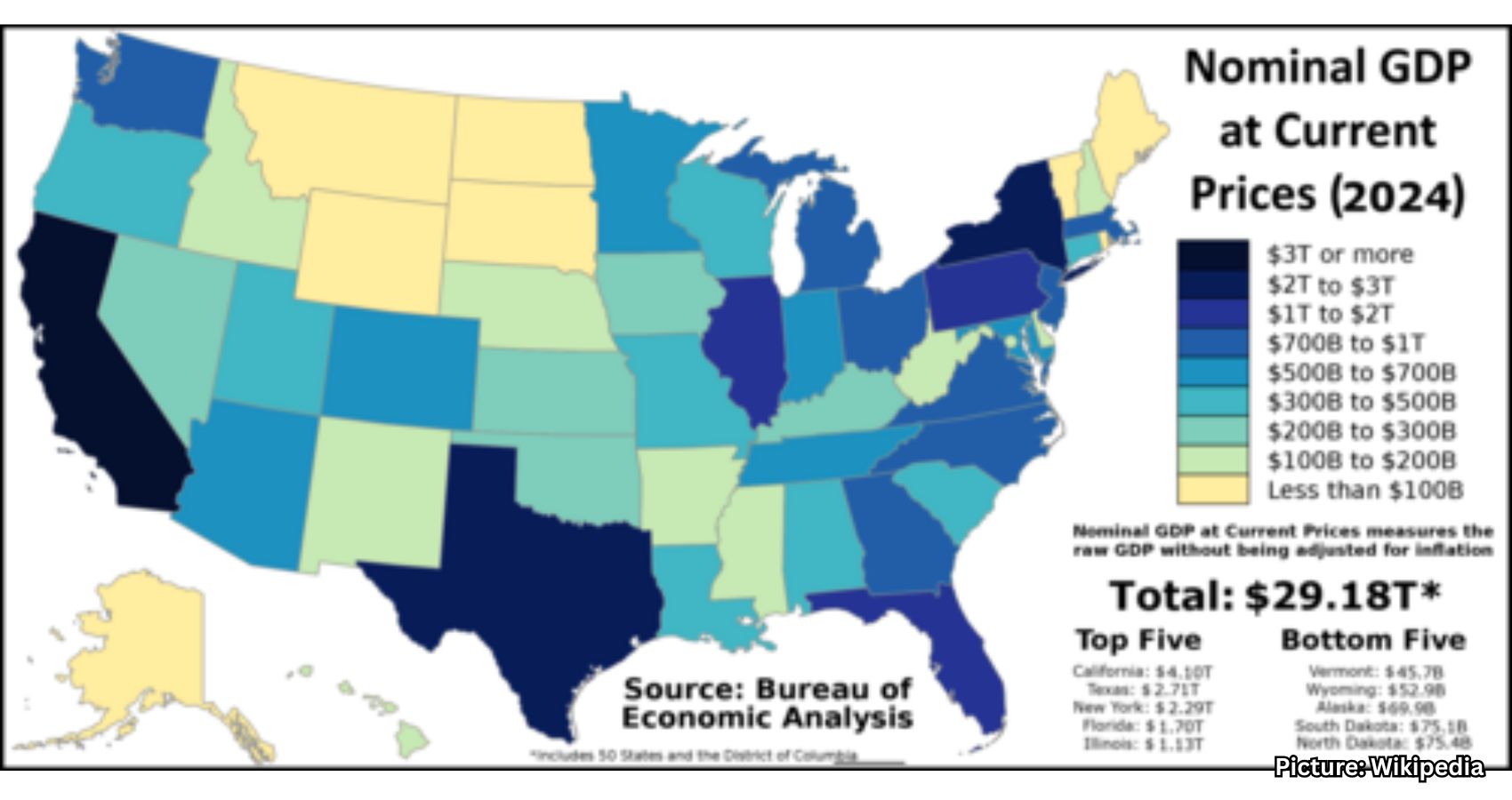
The United States has reached a historic milestone, with its total Gross Domestic Product (GDP) surpassing $30 trillion. However, recent visual data underscores a striking reality: this immense economic output is concentrated in a limited number of states. An infographic mapping each state’s share of U.S. GDP illustrates the uneven distribution of economic power across the country.
Leading the chart is California, which alone accounts for 14.5% of the national GDP, translating to over $4 trillion in economic output. If California were an independent nation, its economy would rank among the top five globally, competing with major world powers. The state’s economic dominance is anchored by its robust real estate, finance, technology, and entertainment sectors.
Following closely is Texas, contributing 9.4% of the U.S. GDP. Texas’s economy is fueled by a diverse mix of energy production, technology hubs, manufacturing, and business services, allowing it to steadily expand its national footprint. New York, at 7.9%, continues to be a financial powerhouse, while Florida, generating 5.8%, rounds out the top four with its strong population growth, tourism, and real estate activity.
Together, California, Texas, New York, and Florida account for more than 37% of the total U.S. GDP, highlighting how a small group of populous and economically diverse states drives over one-third of the nation’s economic engine.
“Population size and industry diversity continue to be the strongest predictors of state-level economic output,” noted a U.S.-based economist. This observation points to how migration trends and sectoral specialization have exacerbated economic disparities over time.
Beyond the top tier, states such as Illinois (3.9%), Pennsylvania (3.5%), Ohio (3.1%), Georgia (3.0%), Washington (3.0%), and New Jersey (2.9%) form a solid middle class of contributors. These states benefit from balanced economies that encompass manufacturing, logistics, healthcare, and technology.
However, the data also reveals a long tail of states contributing less significantly to the national GDP. The median U.S. state contributes between 1% and 2% of the national GDP, while 22 states account for less than 1% each. States like Vermont, Wyoming, and Alaska, despite their strategic or natural-resource importance, remain marginal contributors in terms of GDP.
This imbalance highlights a structural reality of the U.S. economy: scale matters. Larger populations, dense urban centers, and diversified industries consistently translate into higher economic output.
The GDP map arrives amid growing concerns about economic momentum at the state level. In the first 11 months of 2025, U.S. employers announced over 1.1 million job cuts, marking one of the highest tallies since records began in 1993.
According to Mark Zandi, chief economist at Moody’s Analytics, 23 states are already experiencing recession-like conditions, based on indicators such as employment, income growth, industrial output, and retail sales. Another 12 states, including major economies like California and New York, are described as “treading water,” indicating they could slip into recession if conditions worsen.
Despite these pressures, the national economy has shown resilience, growing by 3.8% in the second quarter of 2025, a sharp rebound from a 0.6% contraction in the first quarter.
“State-level data shows stress beneath the surface, even when headline national numbers appear strong,” Zandi cautioned in recent assessments.
This state-by-state GDP visualization does more than rank economies; it tells a broader story about migration, policy choices, industrial evolution, and regional inequality. As the U.S. navigates slower growth, workforce shifts, and rising fiscal pressures, understanding where economic power is concentrated will be critical for policymakers, investors, and businesses alike.
The map makes one thing clear: America’s economic future will continue to be shaped disproportionately by a small number of states, even as challenges ripple across the broader landscape, according to Global Net News.