
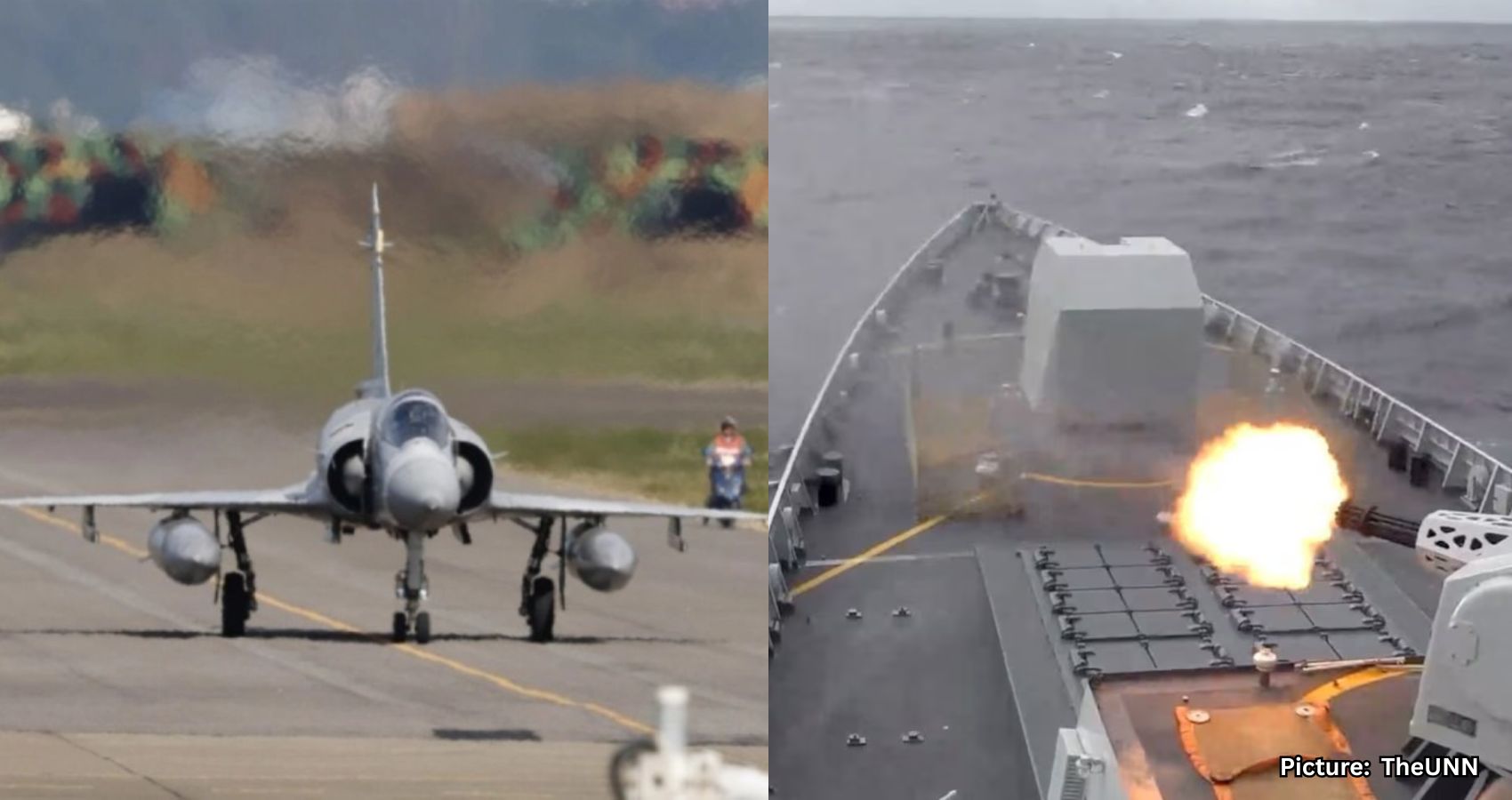
China has initiated extensive military exercises around Taiwan, signaling a stern warning against Taiwanese independence and external interference, following a significant U.S. arms deal with Taipei.
China has launched large-scale military exercises encircling Taiwan, deploying army, navy, air force, and rocket units in a demonstration of force that Beijing describes as a “serious warning” against Taiwanese independence and what it terms interference by “external forces.” These drills, occurring just weeks after the announcement of a landmark U.S. arms deal with Taiwan, have significantly heightened tensions in one of the world’s most sensitive geopolitical flashpoints.
The two-day exercises, officially named “Justice Mission-2025,” are being conducted by the People’s Liberation Army (PLA) under its Eastern Theater Command. According to statements from the Chinese military, the drills aim to test combat readiness and rehearse “blockade and control of key ports and critical areas” surrounding the self-governing island.
Both Chinese and Taiwanese authorities have confirmed live-fire activities and rocket launches. Taiwan’s Ministry of National Defense reported that rockets fired on Tuesday landed in waters north and southwest of the island, with some impacting closer to Taiwan than in previous exercises.
“These exercises are a blatant act of military intimidation,” Taiwan’s government stated, emphasizing that its armed forces are “fully on guard” and prepared to “take concrete action to defend the values of democracy and freedom.”
The scale of the drills has been notable. In the past 24 hours, Taiwan’s defense ministry reported that China deployed 130 military aircraft and 22 naval vessels around the island. Of those sorties, 90 crossed the median line of the Taiwan Strait—an informal boundary that Beijing does not recognize but had largely respected until recent years—and entered Taiwan’s air defense identification zone.
This marks the second-highest number of Chinese warplanes ever recorded around Taiwan, surpassed only by the October 2024 drills, which saw 153 aircraft deployed over a 25-hour period.
In response, Taiwan’s military scrambled fighter jets, deployed naval vessels, and activated coastal missile systems. Lieutenant General Hsieh Jih-sheng, deputy chief of the general staff for intelligence, noted that the proximity of some rocket landings represented an escalation. “Some of the projectiles landed closer than before,” he said, highlighting growing concerns in Taipei.
The drills have also disrupted civilian life. Taiwan’s Civil Aviation Administration reported that more than 6,000 travelers have been affected, with 76 domestic flights canceled and 14 delayed due to airspace restrictions.
Analysts suggest that the timing of the drills is unlikely to be coincidental. Earlier this month, Washington and Taipei announced what could become one of the largest U.S. military sales to Taiwan to date—a package valued at $11.1 billion that includes HIMARS rocket systems, anti-tank and anti-armor missiles, loitering drones, howitzers, and advanced military software.
Additionally, Taiwan’s President Lai Ching-te has proposed a historic $40 billion special defense budget, although it remains stalled in Taiwan’s opposition-controlled legislature.
Chinese Foreign Minister Wang Yi addressed the situation directly in Beijing on Tuesday, stating, “In the face of repeated provocations from the ‘Taiwan independence’ forces and the large-scale arms sales of the United States to Taiwan, it is only natural that we firmly oppose them and take forceful countermeasures.”
China’s defense ministry echoed this sentiment. “This exercise serves as a serious warning to ‘Taiwan independence’ separatist forces and external interfering forces,” said Eastern Theater Command spokesperson Shi Yi, in what appeared to be a veiled reference to the U.S. and its allies.
When asked about the drills, U.S. President Donald Trump maintained a calm demeanor, stating, “I have a great relationship with President Xi Jinping,” and adding, “Nothing worries me.” Trump suggested he did not believe China was preparing for an invasion, although he acknowledged awareness of the exercises.
The United States formally recognizes the People’s Republic of China as the sole legitimate government of China but maintains close unofficial ties with Taiwan under the Taiwan Relations Act, which obligates Washington to provide Taipei with the means to defend itself.
Beijing, however, views Taiwan as its principal “red line” in U.S.-China relations. The Chinese Communist Party claims the island as its territory despite never having controlled it and has vowed to bring it under its authority, by force if necessary.
Military analysts indicate that the latest drills appear more explicitly focused on denying foreign military access to the region. Notices issued by China’s Maritime Safety Administration outlined seven exercise zones, including areas designated for live-fire drills. Analysts argue that these zones effectively create a “de facto blockade” within the Taiwan Strait.
Chieh Chung of Taiwan’s Institute for National Defense and Security Research stated, “The PLA aims to deny intervention by foreign military forces in conflicts around Taiwan and keep them out.” He noted that Beijing is being very explicit about that objective in this drill.
A Taipei-based think tank, Secure Taiwan Associate Corporation, highlighted that the overall designated exercise area is larger than in recent drills, covering nearly all sea routes linking Taiwan to its strategically important outlying islands of Kinmen and Matsu.
Alongside the military maneuvers, Beijing has launched a wave of nationalist propaganda aimed at domestic audiences. State-linked social media accounts have circulated posters depicting fiery arrows raining down on Taiwan, captioned “Arrow of Justice, Control and Denial.” An AI-generated video titled “Joint Operations to Thwart ‘Taiwan Independence’ Attempts” featured robot dogs, humanoid machines, and warships advancing on the island.
In response, President Lai condemned China’s actions, stating that the country is “disregarding the international community’s expectations for peace” and undermining regional stability through coercion. “Taiwan will not escalate tensions,” he asserted, “but we will not back down in the face of threats.”
With Chinese aircraft and ships now appearing almost daily around Taiwan, and major exercises increasing in scale and sophistication, regional observers warn that the line between drills and real-world conflict is becoming increasingly blurred.
As Beijing, Taipei, and Washington exchange warnings and reassurances, the latest war games serve as a stark reminder that Taiwan remains one of the most dangerous fault lines in global geopolitics, where military signaling, political resolve, and miscalculation could have far-reaching consequences, according to Global Net News.