
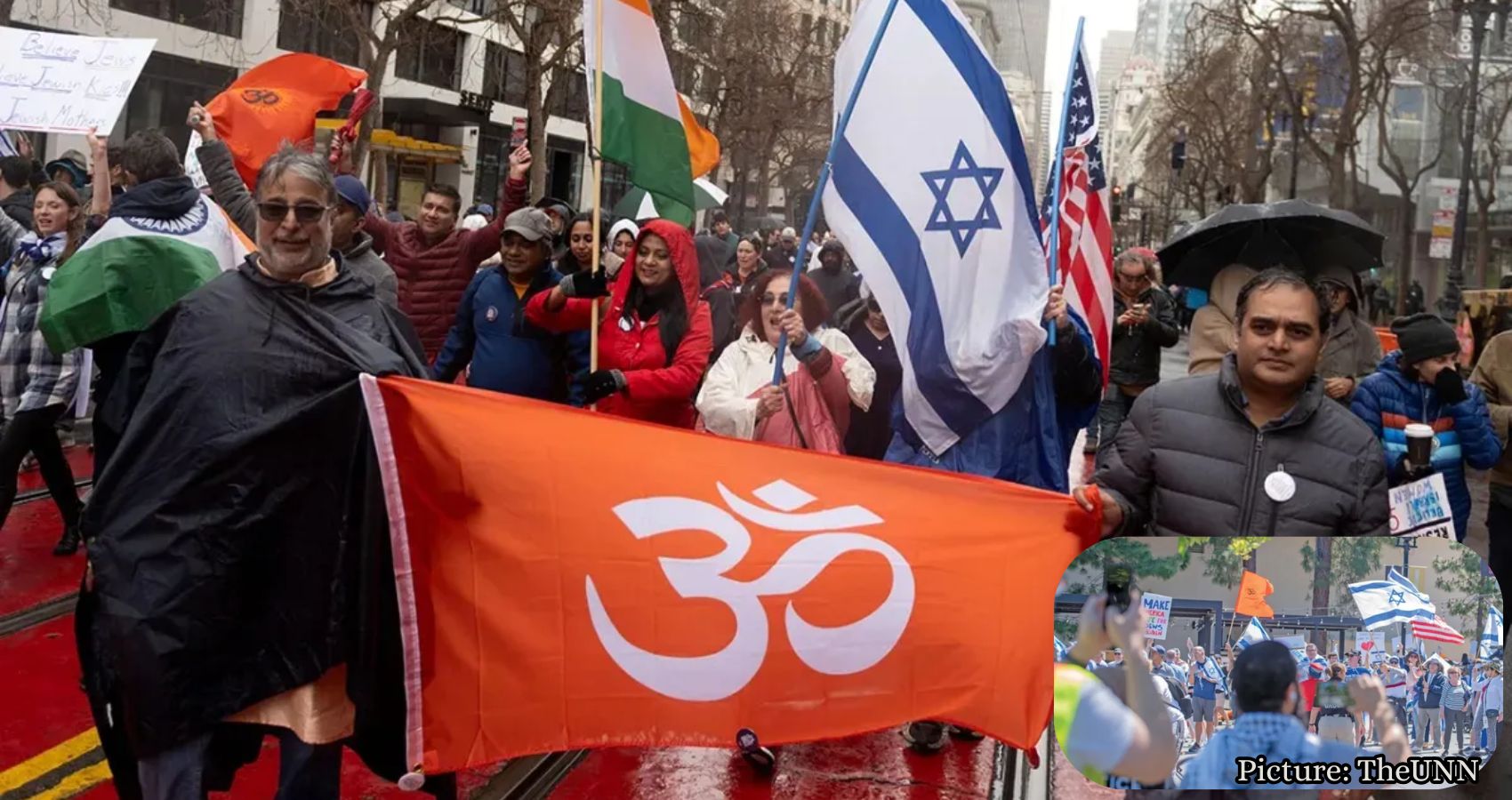
The Bay Area has emerged as a significant hub for a growing alliance between Jewish and Hindu communities, marked by shared experiences and mutual support in the face of adversity.
Tali Klima walked in the chilly rain in San Francisco, surrounded by thousands of fellow Jews carrying Israeli flags and signs denouncing antisemitism during the Unity March in early 2024. The atmosphere shifted when a group of protesters appeared, prompting tension among the marchers.
“They were heckling us from the sidelines, and everyone tensed up,” Klima recalled. “It was uncomfortable. It was scary.”
However, a powerful moment unfolded when two Hindus stepped between the marchers and the protesters, brandishing Indian flags in orange, white, and green as a protective barrier. “It was such a sign of strength and protection for us,” Klima said, describing the emotional impact of their gesture. “I saw so many people come up to thank them afterward.”
For Klima, a South Bay resident and spokesperson for the grassroots advocacy group Bay Area Jewish Coalition (BAJC), this incident symbolizes the deepening alliance between two minority groups. Over the past two years, Hindu and Jewish organizations across the Bay Area have increasingly found common ground, sharing resources and supporting each other at rallies, holidays, and political events.
Barry Kramer, a regional board member of the American Jewish Committee (AJC) and its local liaison to the Hindu community, noted that the relationship took a significant turn following the Hamas attack on Israel on October 7, 2023. “The Jewish and Hindu communities have had good relations for a long time, but the level of connection has increased significantly since Oct. 7 in many areas,” he said. “It’s been very heartening and rewarding to see this growth in our relationship.”
The alliance between Hindus and Jews has been developing nationwide for decades. A notable milestone occurred in 2003 with the launch of the Hindu American Foundation (HAF), which was explicitly modeled on the Anti-Defamation League. Since then, Hindu advocacy groups have established lobbying operations similar to AIPAC and diplomatic efforts aimed at strengthening U.S.-India ties, paralleling the long-standing efforts of Jewish organizations to bolster U.S.-Israel relations.
By 2007, the relationship had matured enough to host the first Hindu-Jewish Summit in New Delhi. Both communities in the United States share many similarities, including comparable income levels, similar political leanings, and a strong connection to their ancestral homelands.
Vijay Rajvaidya, who has observed these parallels for decades, explained that both groups are ancient civilizations with rich histories. “We both are ancient civilizations with old religions and beliefs,” he said. “We became independent nations at around the same time. And post-independence, our challenges were also the same.”
The Bay Area is home to large populations of both communities, with hundreds of thousands of individuals identifying as either Jewish or Hindu. According to the Pew Research Center, the region hosts the third-largest Indian American population in the country, with nearly half identifying as Hindu.
In Silicon Valley, many Israeli and Indian immigrants encounter one another in the tech industry, where both groups have a strong presence among entrepreneurs and software engineers. Oded Hermoni, co-founder of J-Ventures, a venture fund focused on Israeli and American Jewish entrepreneurs, noted the synergy between the two communities. “The best people of India and the best people of Israel sometimes are here in Silicon Valley, and then you can work with them directly,” he said. “It makes a lot of sense. We feel like brothers. It’s a very similar culture.”
These relationships have fostered joint events, including holiday celebrations. In December 2021, the Peninsula Multifaith Coalition brought Jews and Hindus together at Peninsula Temple Beth El in San Mateo to celebrate Hanukkah and Diwali side by side. About 40 attendees shared stories behind each group’s festival of lights.
In September 2023, AJC and HAF hosted their first joint cultural gathering in San Francisco, pairing Janmashtami, the birthday of Hindu deity Krishna, with Rosh Hashanah, the Jewish New Year. The largest event to date occurred in March 2025 when HAF collaborated with Jewish Silicon Valley and the Jewish Community Relations Council Bay Area for a Holi-Purim festival at the Addison-Penzak Jewish Community Center in Los Gatos, attracting over 500 participants for music, dancing, and cultural festivities.
BAJC also plans to participate in the annual India Day parade and festival in Fremont in mid-August. Mihir Meghani, a co-founder of HAF, noted that the October 7 attack sparked a wave of solidarity among Hindu Americans, as it resonated with their own historical experiences of violence. He attended several vigils and rallies following the attack, emphasizing the shared vulnerability felt by both communities.
“We didn’t look at it like ‘these were Jews killed,’” Meghani said. “This could have been us on a different day. It could have been a Hindu. It could have been an Indian. It could have been us at a local Hindu temple.”
In April 2025, a tragic incident in Pahalgam, Kashmir, where Islamist terrorists killed 26 people, mostly Hindus, further solidified this bond. Jewish groups like StandWithUs and BAJC participated in memorials and events across the Bay Area in response to the attack.
“It was almost like Oct. 7 flashing back, just replace the actors,” BAJC co-founder Oded Shekel said. “The victims were attacked not because of what they’ve done, but just because of who they are and what their identity is. I think that’s what connects immediately to us.”
Gilli Yahalom, who oversees BAJC’s partnerships with non-Jewish groups, pointed out that the two communities have bonded over shared threats. “Our people really felt such a strong connection because we really share the same pain and fear from radical Islam,” Yahalom said.
However, Klima emphasized that the relationship has evolved beyond a mere reaction to shared fears. “If that is all it was, then I think it wouldn’t hold over time,” she said.
Grassroots activism has flourished around local issues of mutual concern. Ahead of California’s June 2026 primary, BAJC-Action, the group’s political affiliate, mobilized hundreds of volunteers to create an online voter guide, collaborating with the Hindu American PAC to assess candidates’ positions on antisemitism, Hinduphobia, and the geopolitics of Israel and India.
Yahalom expressed a commitment to supporting public figures who advocate for both communities. “We are committed to supporting public and political figures in every role who are good for both the Hindu community and Jewish community,” she said.
Ties are also being forged around statewide issues. In June, HAF’s Samir Kalra and Jewish civil rights attorney Julie Marzouk articulated a shared grievance in an op-ed, arguing that California’s anti-hate infrastructure often overlooks the needs of both Jewish and Hindu Californians.
Meghani described their partnership as reflective of a moderate faction within both communities. “Our communities, we are, I would say, the silent majority,” he said. “We’re the middle ground, the moderates who don’t really get heard often in primaries.”
Not all Hindu-Jewish alliances in the Bay Area align with this perspective. A left-wing counterpart has emerged, focusing on opposing each other’s nationalistic pride. This dynamic was evident during a pro-Palestinian encampment at Stanford University in May 2024, where Hindus and Jews organized an “interfaith rally against terror” nearby.
Vivek Kembaiyan, a Bay Area organizer for the progressive group Hindus for Human Rights, expressed his motivation for participating, influenced by anti-Zionist activism. “I think JVP’s activism — and seeing people who are Jewish speak up for Palestine — is really significant,” he said.
Kembaiyan and like-minded activists have drawn parallels between Zionism and Hindu nationalism, viewing both as problematic. This perspective has gained traction, as evidenced by a sign at a San Francisco bar that read: “Death to Zionism, Hindutva, YT [white] supremacy.”
HAF rejects this framing, asserting that Hindutva is a cultural philosophy rather than a supremacist ideology. The organization contends that critics who equate it with supremacy misrepresent Hindus who embrace their identity and support a strong U.S.-India relationship.
One of the Jewish activists collaborating with Kembaiyan is Seth Morrison, active in JVP’s Bay Area chapter. In May 2025, they both opposed California’s antisemitism prevention law for K-12 schools, highlighting their shared position as minorities within their respective communities. “When you are a minority within a minority, it becomes particularly important to find allies,” Morrison said.
This evolving relationship between Jewish and Hindu communities in the Bay Area reflects a complex tapestry of shared experiences, mutual support, and differing perspectives, underscoring the potential for collaboration amid diversity.
According to J. the Jewish News of Northern California, the alliance continues to grow as both communities navigate their identities and challenges in a rapidly changing social landscape.