
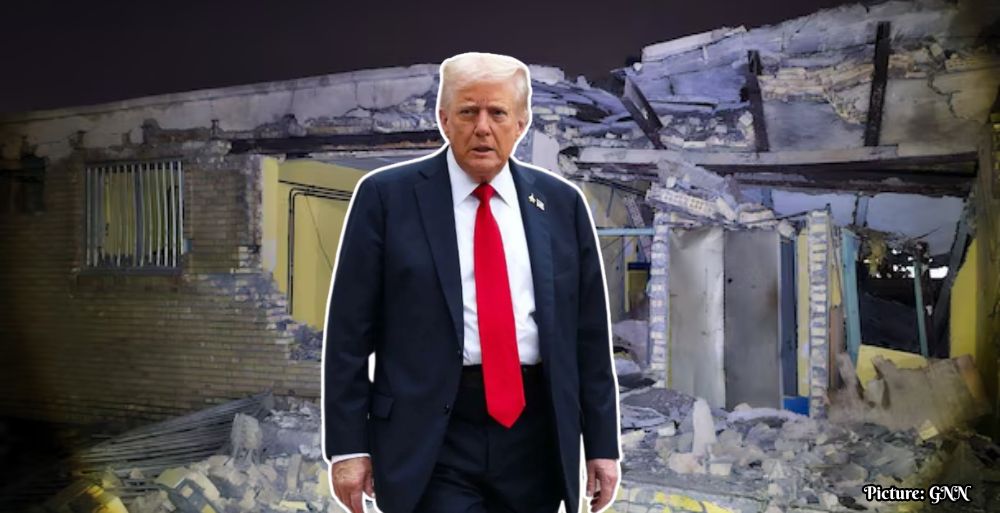
President Donald Trump warns of potential further military action against Iran following a controversial strike that reportedly killed civilians during a wedding ceremony.
The ongoing conflict between the United States and Iran has escalated significantly, with President Donald Trump asserting that American forces are prepared to launch additional strikes. This warning follows a recent incident in which Iranian officials accused the U.S. of targeting a wedding gathering, resulting in civilian casualties. The situation raises critical questions about the effectiveness of military pressure in achieving regime change in Iran.
During a press briefing at the White House on Wednesday, Trump defended the latest U.S. military actions, stating that Washington could strike Iran again at any time. His comments came in the wake of a series of attacks on Iranian targets near the strategically vital Strait of Hormuz.
“It was a very heavy attack last night, and we’re prepared to do another one any time we want,” Trump said, emphasizing the readiness of U.S. forces.
Iranian authorities reported civilian casualties from a strike in southern Iran, claiming that the attack hit a location in Kuhestak, Sirik County, where a wedding ceremony was taking place. The Iranian Red Crescent reported that four individuals were killed, including two women and two children, and 67 others were injured. Initial reports had indicated even higher numbers of injured civilians.
In response to the allegations, the U.S. military has denied intentionally targeting civilians. U.S. Central Command stated it is aware of the reports surrounding the incident and reiterated that American forces do not engage in actions that deliberately harm civilians.
Trump characterized the recent military operation as a success, claiming that U.S. forces had destroyed Iranian military equipment that was being established along the Strait of Hormuz. This waterway is a critical route for international energy shipments, making it a focal point of the ongoing conflict. The heightened military activity in the region has raised concerns about commercial shipping, oil supplies, and the potential for a broader regional confrontation.
“The U.S. military took out all of the new equipment that they tried to build along the Strait of Hormuz,” Trump stated, highlighting the strategic importance of the area.
The U.S. Central Command confirmed that the operation targeted various Iranian military capabilities, including air defense systems, radar installations, maritime assets, mine-laying facilities, and communication sites. These strikes were reportedly in response to Iranian attempts to attack commercial shipping in the region.
Iran has rejected the U.S. justification for the attacks, asserting that the strikes targeted civilian locations. The alleged wedding strike has become a particularly contentious issue, with Iranian officials labeling it a potential war crime and calling for an investigation by the International Criminal Court. Tehran has also urged the United Nations to condemn the attack.
The dispute over the wedding strike adds another layer of complexity to the conflict, which has entered a new phase of intense fighting after a period of relative calm.
In retaliation, Iranian forces have launched missiles and drones at U.S.-linked targets across the region, including locations in Jordan, Bahrain, Iraq, and Kuwait. This escalation marks one of the most serious confrontations since the recent de-escalation of hostilities.
The ongoing conflict has already begun to affect the broader region, with disruptions to shipping in the Strait of Hormuz raising concerns about energy supplies and pushing oil prices higher. The longer the confrontation persists, the greater the risk that it could draw in additional countries.
In a somewhat controversial statement, Trump suggested that the Strait of Hormuz could be renamed the “Trump Strait,” claiming that the U.S. now has control over the strategic waterway. However, when pressed by reporters, he appeared to downplay the seriousness of the proposal, stating, “No, no… it was just thrown out there.”
Beyond the immediate military actions, Trump’s comments reflect a larger question regarding U.S. objectives in Iran. Since the conflict began in February, Trump has encouraged Iranians to challenge their government, suggesting that the U.S. and Israel’s military campaign could create conditions for regime change.
However, the anticipated uprising has not materialized as Trump and his supporters had hoped. Instead, Iran’s leadership has remained resilient, with hard-line elements within the political and security apparatus gaining strength in the face of external pressure.
Reports indicate that the question of why Iranians have not risen up against their leaders has become a recurring theme in Trump’s national security discussions. While Trump initially believed that sustained military pressure could lead to widespread protests and the eventual downfall of Iran’s government, some officials within his administration warned that regime change was far from certain.
As the conflict continues, the gap between initial expectations and the current reality in Iran has become increasingly significant. Six months into the war, Iran’s leadership appears more entrenched, with hard-line figures dominating the political landscape and showing little willingness to capitulate to U.S. demands.
Despite the uncertainty surrounding the long-term strategy, Trump has signaled that military options remain on the table. His assertion that the U.S. can conduct another operation “any time we want” serves as a clear warning to Tehran that Washington is not treating the recent strikes as isolated incidents.
As the situation unfolds, Iran faces the challenge of responding to U.S. military pressure while avoiding an escalation that could engulf the region. For the United States, the pressing question remains whether continued military actions can achieve the political outcomes Trump initially envisioned or if they will only prolong a conflict that has already extended beyond its original scope.
According to The Sunday Guardian, the complexities of the U.S.-Iran confrontation continue to evolve, with significant implications for regional stability and international relations.