
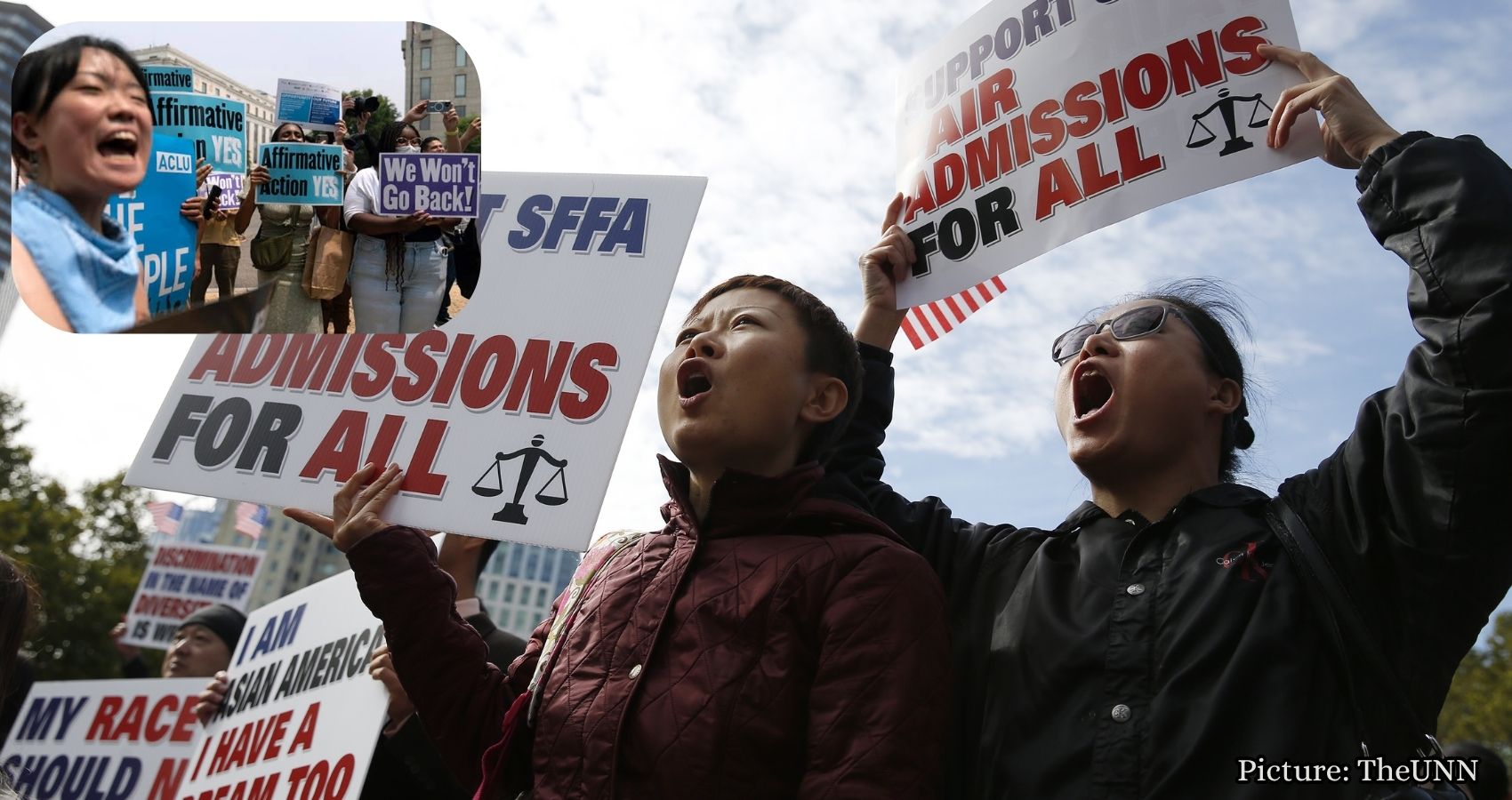
A federal ruling allows a lawsuit alleging anti-Asian discrimination in college admissions to proceed, raising important questions about equity in elite U.S. universities.
A federal judge has permitted a civil rights lawsuit filed by a California family to advance, alleging discrimination against Asian American students in college admissions. This ruling could lead to the discovery of critical university admissions data.
The lawsuit was initiated by Nan Zhong and his son, Stanley Zhong, whose experiences have sparked a broader discussion about the challenges faced by highly qualified Asian American students in the admissions processes of selective U.S. universities. Stanley, now 21, was rejected by 16 of the 18 colleges to which he applied after graduating from Henry M. Gunn High School in Palo Alto, California, in 2023. His academic credentials included a 1590 SAT score, a weighted GPA of 4.42, and a ranking in the top 9% of his class. Additionally, he founded a free electronic-signature startup and participated in coding competitions.
Despite these accomplishments, Stanley was hired by Google as a full-time software engineer shortly after his college rejections. His family’s lawsuit asserts that this position typically requires a Ph.D. or equivalent experience, and Google had recognized his programming talents when he was just 13 years old.
The stark contrast between Stanley’s college admissions outcomes and his subsequent employment has become a cornerstone of his family’s argument, suggesting that academic and professional qualifications alone do not account for the challenges faced by some Asian American applicants at elite universities. The lawsuit claims that admissions practices at these institutions disadvantage highly qualified Asian American applicants based on their race. These allegations remain unproven in court, and the universities involved have disputed them.
The latest development in the case centers on the University of Washington. U.S. District Judge James L. Robart denied the university’s motion to dismiss Zhong’s Title VI claim while dismissing several other claims. This decision allows the case to proceed partially, potentially enabling the family to seek access to internal university communications, admissions records, and statistical data.
Nan Zhong expressed that the ruling represents a significant step forward, as discovery could reveal how applicants are evaluated. In response, the University of Washington noted that many claims were dismissed and emphasized the competitive nature of its Allen School, highlighting that it prioritizes Washington residents, which often results in the rejection of out-of-state applicants regardless of their qualifications.
This case taps into a larger debate surrounding Asian American admissions. For many Asian American families, the lawsuit raises a critical question: can students who excel in conventional academic measures still face disadvantages in selective admissions processes?
This issue gained national attention during litigation involving Harvard College and the University of North Carolina. In 2023, the U.S. Supreme Court ruled that the race-conscious admissions programs used by these institutions violated the Equal Protection Clause of the 14th Amendment. The Court determined that race could not be used in the manner challenged in those cases.
While the Harvard litigation included claims that Asian American applicants were disadvantaged, the Supreme Court’s ruling focused on the legality of race-conscious admissions rather than establishing intentional discrimination against Asian American applicants. This distinction is crucial in evaluating the Zhong case, as the Supreme Court’s decision altered the legal landscape for universities but did not eliminate potential disputes over racial discrimination in admissions.
The Zhong family’s lawsuit aims to explore whether specific university admissions practices may discriminate against applicants based on race, despite claims that race is not a direct factor in admissions decisions.
Stanley Zhong’s father has emphasized that the lawsuit extends beyond his son’s individual experience. He stated in an interview that the family seeks to prevent similar experiences from affecting his younger son and future generations. Numerous Asian American families have reached out to the Zhong family, sharing their own stories of highly qualified students being rejected by selective colleges, highlighting the broader resonance of this case.
For many Asian American parents, academic success has traditionally been viewed as the most reliable path to educational opportunity. The possibility that race could influence admissions outcomes raises concerns about whether traditional measures of merit are applied equitably across all applicants.
However, the competitive nature of selective college admissions complicates this issue. High SAT scores, strong grades, and impressive extracurricular activities do not guarantee admission to elite institutions. Universities routinely reject many applicants with exceptional credentials, and individual rejection decisions cannot, by themselves, establish racial discrimination.
This is why the discovery phase of the Zhong case is critical. If admissions data and internal communications are made available, they could provide a clearer understanding of how Asian American applicants are evaluated and whether race played an inappropriate role in the admissions process.
Stanley Zhong’s situation presents a striking contrast: a student rejected by most of the selective colleges he applied to was nonetheless recruited by one of the world’s leading technology firms. While his experience does not definitively prove discrimination based on his Asian American identity, it raises an important question for many families: what happens when a student’s measurable academic and technical achievements conflict with the outcomes of highly selective college admissions?
The answer may depend on the evidence that emerges during the discovery phase. The University of Washington has defended its admissions process, while the Zhong family contends that examining the university’s admissions data and decision-making processes is essential to determine whether discrimination occurred.
As the lawsuit progresses toward discovery, it could serve as a significant test of how universities balance holistic admissions, diversity goals, and the legal obligation to avoid racial discrimination. For Asian American students and their families, the stakes extend beyond Stanley Zhong’s case. The litigation may help clarify whether concerns about unequal treatment in elite college admissions are substantiated by evidence or whether individual outcomes are misinterpreted as indicative of a broader pattern without sufficient data.
Regardless of the outcome, the case has reignited one of the most contentious debates in American higher education: whether a system designed to foster a diverse student body can do so without unfairly disadvantaging applicants based on their race.
According to The American Bazaar, the developments in this case could have far-reaching implications for the future of college admissions in the United States.