
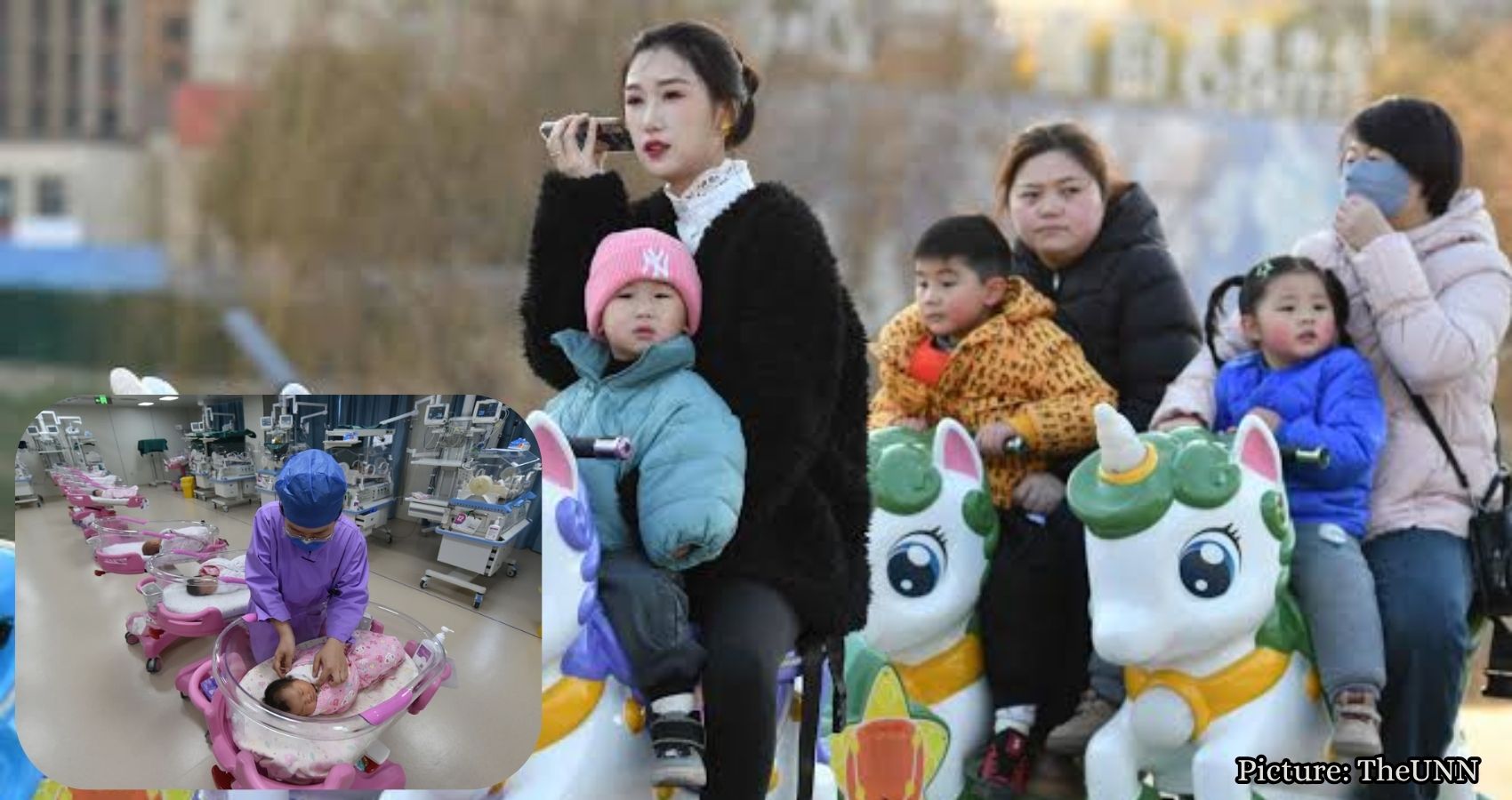
China’s birth rate sharply declined in 2025, with live births dropping to 7.92 million, highlighting ongoing demographic challenges amid economic pressures and a shrinking population.
China recorded 7.92 million live births in 2025, marking a significant return to demographic contraction after a brief increase in 2024, according to official data released by the National Health Commission (NHC). The national birth rate fell to 5.63 per 1,000 people, while deaths rose to 11.31 million, resulting in a natural population growth rate of -2.41 per 1,000 people. As the national population hovers around 1.4 billion, structural economic pressures, high childcare costs, and a declining pool of women of childbearing age continue to undermine Beijing’s multi-billion-dollar policy interventions aimed at stabilizing the workforce.
On Friday, China’s health authorities published comprehensive annual figures confirming that the nation’s birth rate resumed its downward trajectory in 2025, dispelling hopes that a minor bump in births during 2024 indicated a sustained demographic recovery.
The official statistical bulletin from the NHC revealed that the number of live births in 2025 represents a steep 17 percent decline from the 9.54 million births recorded in 2024. This figure constitutes the lowest annual birth tally since the founding of the People’s Republic of China in 1949.
With total deaths reaching 11.31 million against a population base of approximately 1.4 billion, China’s mortality rate climbed to 8.04 per 1,000 residents. Consequently, the natural population growth rate dropped to -2.41 per 1,000 people, further accelerating the structural population contraction that first emerged in 2022.
The latest metrics from the NHC highlight a persistent structural shift in Chinese family planning trends over the past five years. Annual birth totals illustrate a steadily diminishing baseline:
In 2021, there were 10.62 million births, followed by 9.56 million in 2022, and 9.02 million in 2023. The temporary rebound in 2024 saw births rise to 9.54 million, but the 2025 figures indicate that underlying socio-economic deterrents quickly reasserted themselves. The natural growth rate, which stood at -0.99 per thousand in 2024, deteriorated further to -2.41 per thousand in 2025, as total deaths outpaced live births by more than 3.3 million.
Independent demographers and economic analysts cite multiple overlapping factors driving the continued slump in fertility. A shrinking pool of potential mothers is a significant concern, a direct legacy of the one-child policy enforced between 1980 and 2016. United Nations estimates indicate that the number of Chinese women aged 15 to 49 has fallen by tens of millions over recent decades and is projected to contract sharply through the middle of the century.
Economic considerations also pose a central hurdle for young couples. High housing costs in major metropolitan areas, competitive educational environments, and general economic uncertainty have led many young adults to delay or forgo marriage and parenthood altogether. Marriage registrations, which serve as a primary indicator for birth trends in China, experienced significant volatility over the past two years, falling sharply in early 2024 before showing localized upticks in late 2025 following administrative reforms that made marriage registration easier across provincial lines.
The broader demographic balance is also adjusting under an accelerating aging process. According to the NHC bulletin, citizens aged 65 and older comprised 15.9 percent of the total population by the end of 2025, up 0.3 percentage points from the previous year. Meanwhile, the proportion of youth aged 0 to 15 narrowed to 16.4 percent, leaving a margin of just 0.5 percentage points between the young and elderly cohorts.
In response to the long-term threat posed by an aging workforce and shrinking labor pool, municipal and national policymakers in Beijing have rolled out a series of pro-natalist measures. In 2025, government expenditures aimed at supporting families included direct cash subsidies for parents of newborns, tax adjustments on essential goods, extended parental leave provisions, and expanded national medical insurance coverage for reproductive treatments, including in vitro fertilization (IVF).
The Department of Planning, Development and Informatization within the NHC noted that public system initiatives focused heavily on expanding early childcare access throughout 2025. By the end of the year, the country reported having 4.73 registered childcare places for children under three years old per 1,000 people, surpassing the government’s internal target of 4.5 per 1,000. County-level coverage for formal infant and toddler care services reached 98.8 percent nationwide.
Despite these social service improvements, demographers suggest that institutional investments and minor cash incentives may prove insufficient to reverse deep-seated societal shifts regarding family size. With the total fertility rate hovering near 1.0 birth per woman—well below the 2.1 replacement threshold needed for population stability—China faces similar long-term demographic challenges as neighboring East Asian economies, including South Korea, Japan, and Taiwan, according to Source Name.