
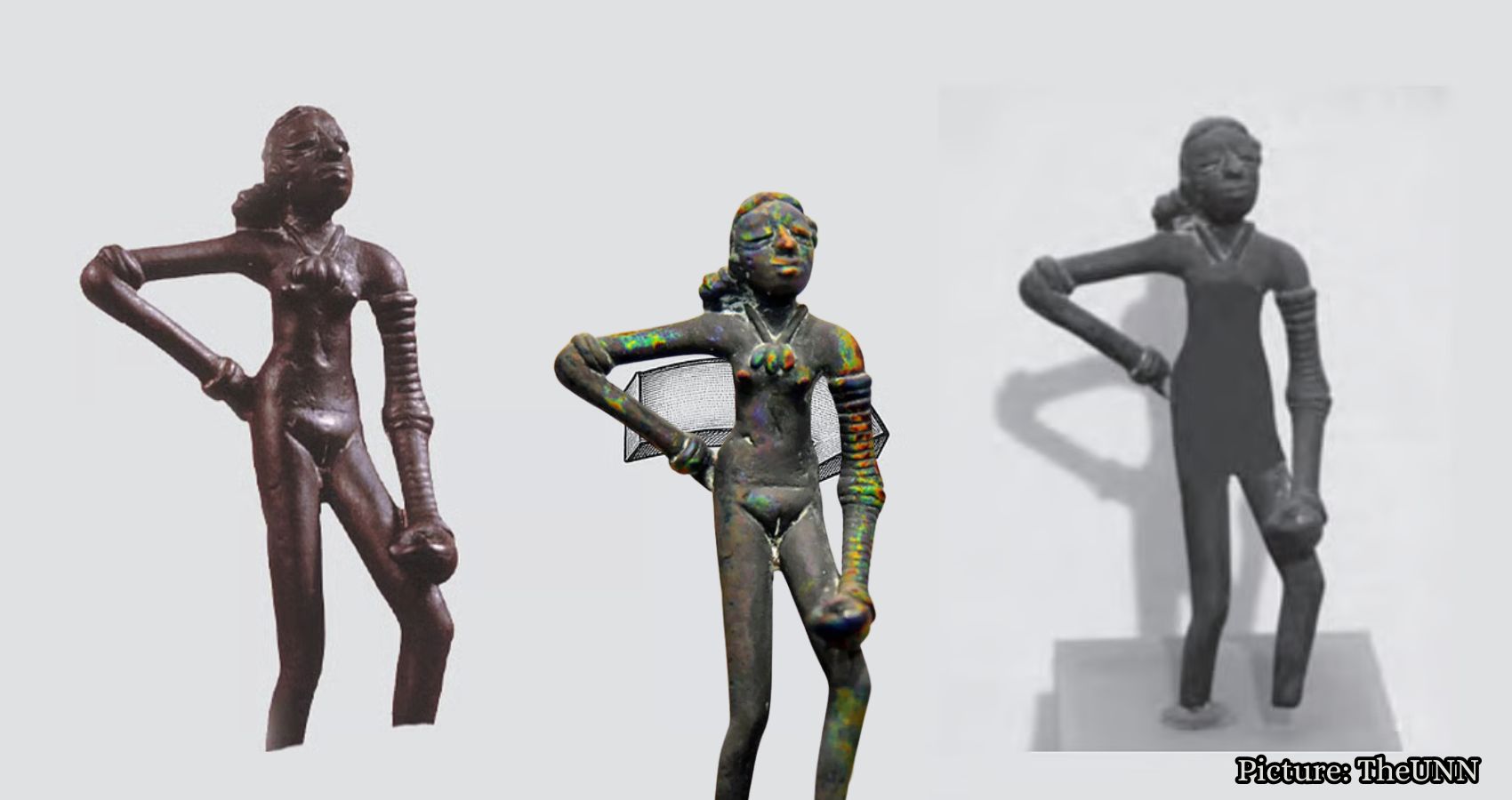
Exploring the significance of the ‘Dancing Girl’ from Mohenjo-daro reveals the complexities of women’s representation in history and the ongoing struggle for autonomy and recognition.
Visiting Mohenjo-daro and Harappa, two prominent urban centers of the Indus Civilization located in present-day Pakistan, offers a glimpse into a world long past. Standing among the ancient brick ruins, one cannot help but feel the weight of history—what remains tangible and what has faded into silence.
Years later, watching Omar Khan’s documentary, Mohenjo-daro: Unsealing an Ancient Indus City, reignited this tension: how much can an ancient city reveal, and how much does it continue to withhold?
The remnants of bricks endure, drains can be mapped, and seals catalogued. Metal objects are preserved and displayed, allowing us to trace evidence of trade, craftsmanship, and organized urban life. However, these artifacts do not tell us who performed specific tasks, how labor was divided, or how authority functioned within homes and communities.
Emotions such as affection, fear, domestic labor, negotiation, aspiration, and resistance rarely leave behind clear evidence. When we inquire about the women who lived in these ancient streets and homes, we often encounter silence.
A recent online session hosted by the Southasia Peace Action Network featured filmmaker Omar Khan in conversation with Sudeshna Guha, a historian specializing in the archaeology of the Indus Civilization, and author and poet Sehba Sarwar. The discussion included contributions from various participants, including dancer and activist Sheema Kermani, artist and educator Salima Hashmi, Indian peace activist Lalita Ramdas, feminist Khushi Kabir, and Nepali journalist Namrata Sharma.
The conversation traversed topics such as Mohenjo-daro’s urban planning, the still-undeciphered Indus script, debates surrounding the civilization’s decline, and the risks of projecting modern national identities onto a civilization that predates both India and Pakistan.
While it is tempting to let the surviving architecture of Mohenjo-daro and Harappa speak for the entirety of the civilization, such remnants do not easily reveal who held authority within their homes, whose labor sustained daily life, or whose choices were respected.
This brings us back to a crucial question: What do we know about the women who inhabited these ancient cities?
The honest answer is that we do not know. This uncertainty is one of the documentary’s strengths, as it highlights the distinction between what the archaeological record reveals and what it continues to withhold. Sometimes, the absence of evidence can be as illuminating as what survives.
Among the most recognizable artifacts associated with the Indus Civilization is the small bronze figure known as the ‘Dancing Girl.’ Unearthed by archaeologist Ernest Mackay in 1926, the figure was later named by John Marshall. She stands confidently, one hand on her hip and adorned with bangles, yet her familiar name is merely an interpretation. We cannot ascertain whether she was a dancer, a real person, a performer, a deity, or a product of artistic imagination.
Generations of archaeologists, historians, governments, artists, and the public have projected various meanings onto her. This urge to interpret and sometimes control her body became particularly evident when an altered image of the figure appeared in a new Indian school arts textbook. The figurine’s bare torso was shaded over, making her appear clothed. Following criticism from historians and academics, India’s National Council of Educational Research and Training announced on June 16, 2026, that the original image would be restored in future editions.
This controversy transcended a mere textbook illustration. A bronze figure cast thousands of years ago had been subjected to contemporary moral anxieties. Someone had deemed it necessary to make the past more “appropriate” for modern audiences.
This intersection of visibility and autonomy raises critical questions. A woman’s body may be highly visible, but not on her own terms. Others name it, interpret it, judge it, cover it, and decide what it signifies.
Autonomy encompasses more than freedom from physical restraint; it includes the power to define oneself, make choices, control one’s body and labor, claim resources, participate in decision-making, and be recognized as a full social actor rather than a symbol belonging to others.
We cannot know whether women in Mohenjo-daro possessed such autonomy. However, the controversy surrounding the bronze figure illustrates how readily authorities claim the power to define a female body.
Sehba Sarwar’s poem, “you live within us / mohenjodaro’s girl,” addresses the figurine as a symbol of women’s strength and resistance. Sheema Kermani noted that the figurine’s posture inspired a dance performance initially choreographed by her teacher, Guru Ghanshyam. Salima Hashmi invoked Faiz Ahmed Faiz’s poem, “The Unicorn and the Dancing Girl,” reflecting on the timelessness of Mohenjo-daro: “Time past is time present… we are so privileged to be in the continuum of that time.”
Their contributions shifted the conversation from archaeology to art, memory, and the ongoing reinterpretation of an ancient female body in contemporary contexts. They also prompted a deeper question: while we debate the covering of one part of one ancient woman’s body, what about the countless women whose entire lives have vanished?
The ‘Dancing Girl’ is visible because her bronze form has survived. Yet the absence of comparable evidence about other women does not imply their absence from the civilization, nor does it prove that they were oppressed, powerful, or equal. The absence of evidence cannot be irresponsibly converted into evidence for any preferred version of the past.
Ancient civilizations are often co-opted to validate modern political positions. Some envision a lost golden age of gender equality, while others project contemporary notions of modesty, hierarchy, religion, or family order onto people who cannot respond to our inquiries.
Both approaches manipulate the past to serve the politics of the present. A gender-conscious reading should not fabricate a feminist civilization for which we lack evidence, nor should it assume that today’s restrictions existed in the same form thousands of years ago. Instead, it should explore why certain human experiences are easier to recover than others.
The greatness of an ancient city is often measured by celebrating those who planned streets, engineered water systems, standardized weights, and constructed public buildings. However, a civilization is also sustained by the repetitive, intimate, and often unrecorded work of keeping people alive: preparing food, raising children, producing clothing, maintaining living spaces, sharing knowledge, and caring for the ill, elderly, or vulnerable.
Across many societies, much of this labor has historically been assigned to women. While we cannot assume that Mohenjo-daro followed the same patterns, the broader historical context helps explain why caring and domestic labor have often been undervalued in accounts of political and economic achievement.
The question is not merely whether women appear in history, but how they appear—and whether they are granted authority over their own narratives. Are they recognized as historical actors or merely displayed as decorative figures? Do we encounter them as workers, thinkers, creators, and decision-makers, or as symbols onto which ideas of beauty, purity, shame, and civilization are projected?
In contrast, the male figure known as the ‘Priest-King’ is surrounded by uncertainty regarding his role. We do not know whether he was a priest or a king, yet the masculine title grants him religious and political authority, while the female figure is identified solely through her body and presumed performance.
One is imagined as governing, while the other is imagined as dancing. This contrast may reveal less about the social order of Mohenjo-daro than about our own tendency to assign authority to men and embodiment to women.
The Indus Civilization cannot be confined to a single modern national narrative. It thrived across regions now divided between Pakistan and India, long before either state existed. The Southasia Peace Action Network gathering reflected this shared heritage, featuring a filmmaker from Pakistan, a historian from India, and artists, activists, and participants from across South Asia and its diaspora discussing a civilization that predates contemporary borders.
Archaeology can become another battleground for nations to compete over—whose civilization, whose artifacts, whose dance, whose history? Mohenjo-daro offers South Asia an opportunity to reflect on the past without fragmenting it into national possessions, recognizing that the region’s cultural memory is older and more interconnected than its modern states.
The Indus script remains undeciphered, leaving us unable to read the words its people used to describe themselves or understand what they called their city, their political arrangements, or the bronze figure that now traverses museums, textbooks, films, poetry, and dance.
This uncertainty should foster humility. Responsible public history must distinguish evidence from interpretation and interpretation from imagination. Artists can engage with these silences differently: a poem or dance performance need not claim to reconstruct an Indus woman’s life but can explore what an ancient object evokes in the present.
Perhaps this is why the ‘Dancing Girl’ remains so compelling. She cannot explain herself, while archaeologists, textbook editors, historians, nationalists, poets, dancers, and journalists attempt to define her.
Mohenjo-daro also prompts us to consider how future generations will understand us. Will they encounter women primarily through laws passed about them, crimes committed against them, images circulated of them, and arguments conducted over their bodies? Or will they discover women’s own journalism, scholarship, testimony, organizing, art, and accounts of everyday life?
Across South Asia, women continue to be viewed as bearers of family honor, religious identity, cultural authenticity, and national pride. Their autonomy is often treated not as their own but as territory over which families, communities, and institutions claim authority.
Visibility alone does not equate to liberation. A woman may be highly visible as an image, a controversy, a victim, or a symbol while remaining unseen as a complete human being with knowledge, judgment, and the right to define her own life.
The answer lies not in making assumptions about the women of Mohenjo-daro but in recognizing the silence surrounding them—and ensuring that we do not replicate that silence around women living today. The ancient bronze figure survived because metal endures, and her uncertainty serves as a reminder of all the women history cannot show us.
The challenge before us is to ensure that women’s lives—and their authority over their own stories—are not left among the ruins.
According to Source Name.