
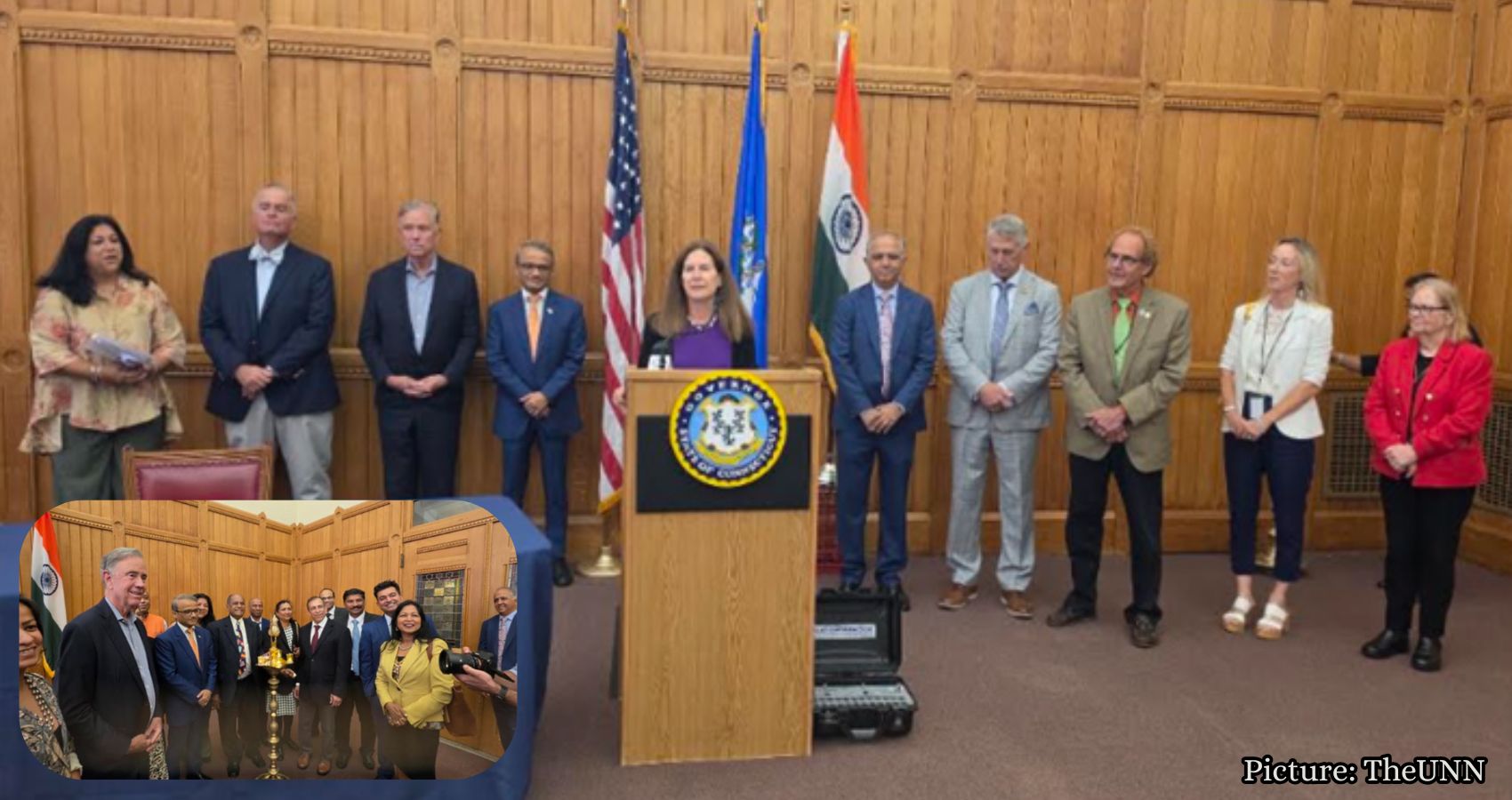
Connecticut Governor Ned Lamont has signed legislation establishing the Connecticut-India Trade Commission, aiming to enhance economic, educational, and cultural ties between the two regions.
Hartford, Conn., July 30, 2026 – In a significant step towards bolstering economic, educational, technological, and cultural connections between Connecticut and India, Governor Ned Lamont has officially signed legislation to establish the Connecticut-India Trade Commission. The ceremony took place at the State Capitol in Hartford.
The event was attended by a diverse group of elected officials, diplomats, business executives, community advocates, and civic leaders from across Connecticut. This historic occasion marked the launch of the Connecticut-India Trade Commission, which aims to create a formal framework for enhancing trade, investment, innovation, academic collaboration, and institutional partnerships between Connecticut and India, one of the fastest-growing major economies in the world.
The establishment of the commission follows years of increasing engagement between Connecticut and India. Created under Public Act 26-78, the commission will bring together legislators, representatives from higher education, business leaders, and members of the Indian-American community to foster long-term partnerships in various sectors, including commerce, technology, education, infrastructure, and the arts.
During the bill-signing ceremony, Governor Lamont emphasized that the commission represents more than just a trade initiative. He reflected on the profound historical and cultural ties between India and the United States, stating, “The relationship between India and the United States is much more than commercial. We both fled colonialism to become the largest democracies on the planet Earth.”
Governor Lamont highlighted his economic development mission to India in February 2025, where he led a delegation of Connecticut officials, business executives, and academic leaders to cities such as Chennai, Bengaluru, and Mumbai. The trip aimed to attract investment, strengthen existing partnerships, and promote Connecticut as a destination for Indian businesses seeking to expand in North America. “It’s not only the cultural ties, but that sense of entrepreneurship and optimism, which I think our two countries share,” he noted.
According to Lamont, the trade commission will enhance cultural, academic, and commercial ties, ultimately contributing to a better world. His remarks underscored a vision of globalization that prioritizes talent, innovation, and mutual respect over mere commerce.
Lieutenant Governor Susan Bysiewicz also spoke at the event, focusing on the potential economic benefits of the commission. She pointed out that Connecticut’s robust export economy and globally connected workforce make international partnerships crucial for future growth. “This trade commission, in addition to our existing international trade commissions, tells the world that Connecticut is open to new and innovative partnerships,” Bysiewicz stated.
She referenced data from AdvanceCT, which indicates that international companies employ over 115,000 residents across more than 800 businesses in Connecticut. Bysiewicz argued that expanding commercial relationships with Indian firms could lead to job creation, investment, and sustained economic activity. Her comments align with Connecticut’s broader strategy of attracting foreign investment while leveraging the state’s strengths in advanced manufacturing, bioscience, aerospace, and technology.
State Senator Sujata Gadkar-Wilcox, the first Indian-American senator in Connecticut’s history, also addressed the audience. She shared her personal connection to the initiative, stating, “I am here today not just as the Senator from the 22nd District, but as the child of Indian immigrants and the first Indian Senator ever to serve in Connecticut.”
Gadkar-Wilcox described the legislation as a recognition of the contributions made by Indian-Americans across various sectors in Connecticut, including business, education, healthcare, and civic engagement. She emphasized that the commission would create structured opportunities for collaboration in fields such as aerospace, manufacturing, biotechnology, green energy, and higher education. “Senate Bill 132 is more than a trade policy; it is a recognition of deep cultural, educational, social, and business ties between the United States and India,” she asserted.
With over 68,000 residents of Indian origin, Indian-Americans represent Connecticut’s largest Asian-American ethnic community and the second-largest foreign-born population in the state, making this initiative particularly relevant.
Ambassador Binaya Srikanta Pradhan, India’s Consul General in New York, described the commission as a significant milestone in state-level diplomacy and economic cooperation. “It’s truly, truly a historic moment,” Pradhan remarked, noting that the creation of the Connecticut-India Trade Commission was long overdue. He credited Governor Lamont’s 2025 visit to India for providing new momentum to the relationship and highlighted opportunities in advanced manufacturing, information technology, cybersecurity, healthcare, clean energy, higher education, and innovation.
Pradhan placed the initiative within the broader context of U.S.-India relations, noting that the United States is India’s largest trading partner, with bilateral trade valued at approximately $240 billion and ambitions to reach $500 billion by 2030. He pledged support from the Indian Consulate, stating, “The consulate would work together with the commission to make your vision a reality.”
Representative Stephen Meskers, speaking on behalf of himself and Commerce Committee Co-Chair Senator Joan Hartley, emphasized the vital contributions of Connecticut’s Indian-American community to the state’s social and economic fabric. He acknowledged the sacrifices made by immigrants and praised the impact of Indian professionals and entrepreneurs across Fairfield County and beyond. Meskers expressed gratitude that Connecticut was chosen to launch this partnership and pledged the Commerce Committee’s full support for the Connecticut-India Trade Commission.
The event also featured testimonials from local entrepreneurs Vikram and Preeti Butani, whose medical technology company, Kubtec, exemplifies the value of Connecticut-India business connections. Vikram Butani shared how their company evolved from a startup in a spare bedroom to a global healthcare technology leader serving hospitals in 40 countries. He noted that Kubtec established a presence in India three years ago and continues to expand internationally, stating, “We hope it will help us and other businesses like us to grow and build a relationship between Connecticut and India.”
The Connecticut-India Trade Commission will comprise legislative appointees, gubernatorial appointees, representatives from higher education, chamber of commerce members, and Indian-American community leaders. The commission aims to promote business and academic exchanges, encourage investment, identify policy opportunities, and recommend future legislative initiatives. Annual reports to the governor and state officials will commence in 2028.
Dr. Thomas Abraham, Chair of GOPIO Global, a key organizer of the event, remarked, “As Connecticut joins a growing number of states pursuing formal partnerships with India, the July 30 signing ceremony represented more than a legislative achievement. It reflected the growing importance of India in Connecticut’s economic future and acknowledged the contributions of a vibrant Indian-American community that continues to shape the state’s social, educational, and business landscape.”
Governor Lamont concluded that the commission’s success will ultimately be measured not only by trade figures but by the strength of the relationships it fosters. The enthusiasm displayed by public officials, diplomats, and business leaders at the Capitol suggests that Connecticut’s partnership with India has entered a significant new chapter, promising mutual benefits for both regions.
According to Source Name.