
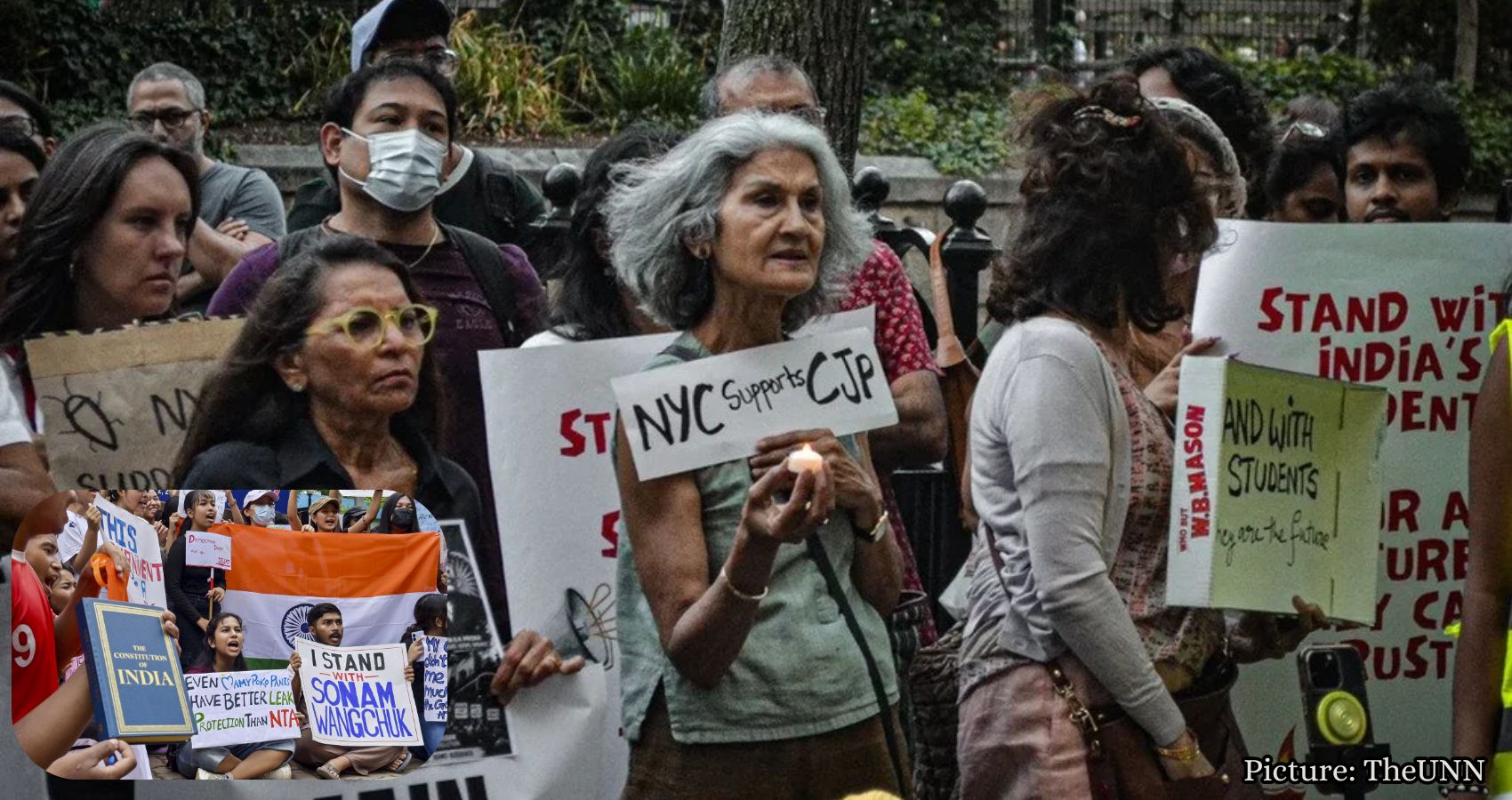
Demonstrations in the U.S. and abroad supported activist Sonam Wangchuk’s hunger strike, calling attention to alleged irregularities in India’s NEET examinations.
SAN JOSE, CA – Activist Sonam Wangchuk’s hunger strike, which protests alleged irregularities in the National Eligibility cum Entrance Test (NEET) examinations, has garnered international support through demonstrations held in cities such as New York, San Jose, London, and Dublin.
The rallies were organized by the advocacy group Hindus for Human Rights, which mobilized supporters to gather at Mahatma Gandhi’s statue in Union Square, New York City, as well as at a separate event in San Jose on July 20. Similar protests were also reported outside the Indian High Commission in London and the Indian Embassy in Dublin.
Demonstrators carried placards in support of Wangchuk and chanted slogans criticizing the Indian government, specifically calling for the resignation of Education Minister Dharmendra Pradhan.
In a statement released following the rallies, Hindus for Human Rights emphasized the need for fairness and accountability within India’s examination system. The organization stated, “Our protests sent a clear message, whether in New York or London, San Jose or Dublin: India’s students deserve to be treated with fairness and dignity.”
The statement further asserted that “the youth of India deserve honest answers and a future they can trust,” urging the government to engage in dialogue and implement necessary reforms.
Wangchuk, a prominent advocate for educational reform in India, has been vocal about the challenges faced by students in the current examination system. His hunger strike aims to draw attention to what he describes as systemic issues that undermine the integrity of educational assessments.
The NEET examinations, which are crucial for students seeking admission to medical colleges in India, have faced criticism over alleged irregularities and lack of transparency. Supporters of Wangchuk argue that these issues disproportionately affect students from marginalized backgrounds, limiting their access to quality education and future opportunities.
As the protests unfolded across various cities, participants expressed solidarity with Wangchuk and called for immediate reforms to ensure a fairer examination process. The demonstrations reflect a growing concern among the Indian diaspora regarding the state of education in India and the need for systemic change.
According to Hindus for Human Rights, the rallies not only aimed to support Wangchuk but also sought to raise awareness about the broader implications of educational inequities in India. The organization hopes that their efforts will inspire further dialogue and action towards meaningful reforms.
The international support for Wangchuk’s cause highlights the interconnectedness of educational issues and human rights, as communities around the world rally to advocate for fairness and justice in education.
As the situation continues to evolve, the calls for accountability and reform in India’s educational system remain a pressing concern for many, both domestically and internationally.
According to Hindus for Human Rights, the movement underscores the urgent need for change and the importance of student voices in shaping the future of education in India.