
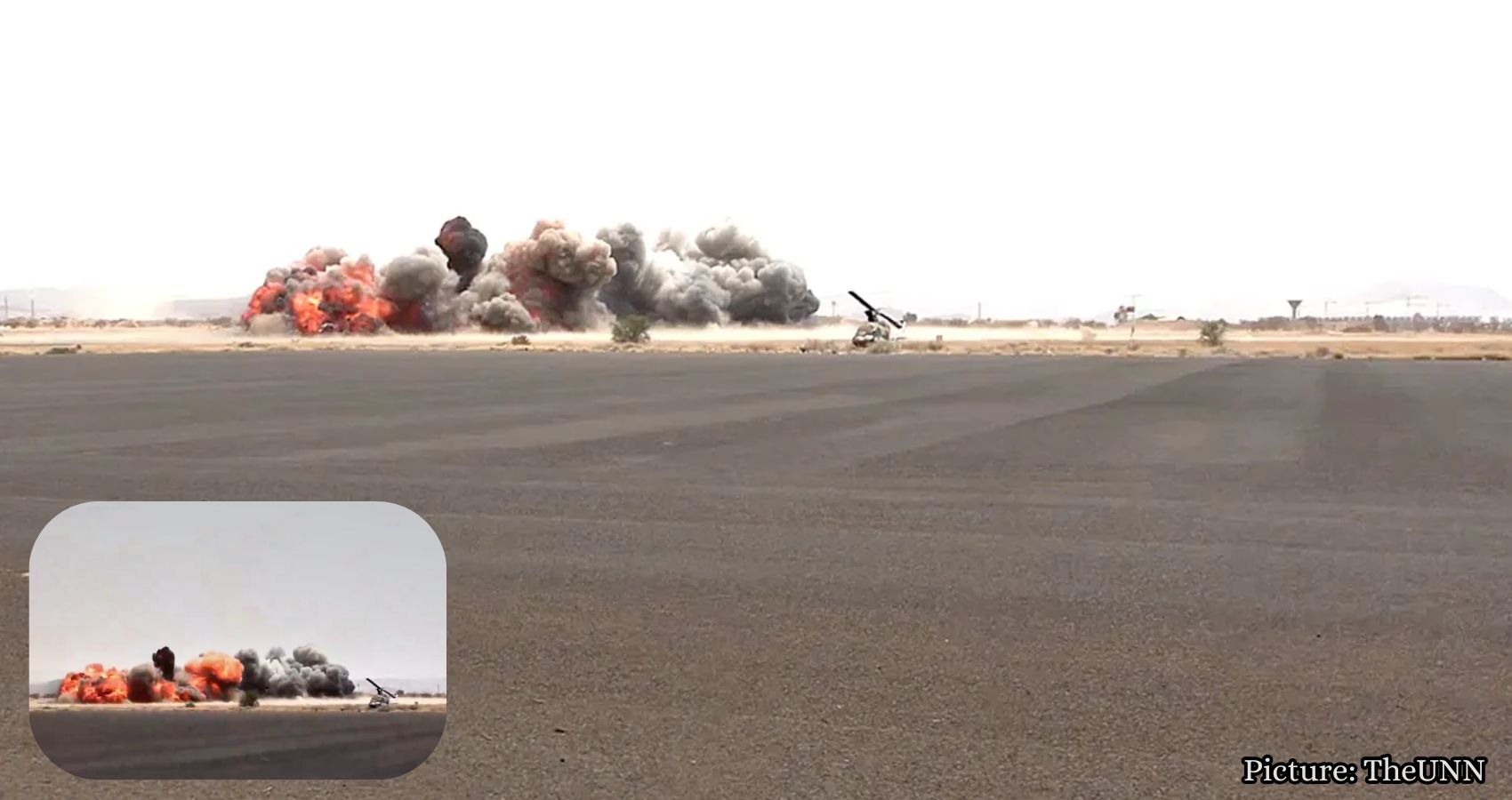
The Houthis have threatened to retaliate against Saudi Arabia following airstrikes on the Sanaa airport, raising concerns of renewed conflict in the region.
The Iran-backed Houthi movement, which controls northern Yemen, has issued threats to strike King Khalid Airport in Riyadh after condemning Saudi Arabia for what they termed “blatant aggression” against the Sanaa airport runway. This escalation follows a series of airstrikes that the Houthis allege were aimed at disrupting their operations.
Despite a truce established in 2022 between the Houthis and the Saudi-led coalition opposing their rule, tensions have surged recently. The Houthis have been implicated in disrupting commercial shipping in the Red Sea, particularly after aligning with Hamas following its invasion of Israel on October 7, 2023. The latest military actions could signal a potential resumption of hostilities between Saudi Arabia and the Houthis.
Houthi military spokesperson Yahya Saree characterized the recent airstrikes as a significant breach of de-escalation efforts, asserting that Saudi Arabia would face consequences for these actions. He emphasized that the Houthis would not let the attacks go unanswered, specifically threatening retaliation against King Khalid Airport.
Iran’s Press TV reported that the Iranian government condemned the Saudi strikes on Sanaa airport, labeling them a violation of international law and Yemen’s sovereignty. Earlier reports indicated that the Saudi government targeted the runway at Sanaa International Airport to prevent an Iranian plane from landing, although the aircraft ultimately landed at Hodeidah airport, which is also under Houthi control.
Salman Al-Ansari, a prominent Saudi geopolitical analyst, commented on the situation, stating that the Iranian-backed Houthi militia is in a precarious position. He suggested that the Houthis are attempting to prove their relevance to Iran amid the ongoing U.S.-Iran tensions. Al-Ansari clarified that the recent actions were taken by Yemen’s legitimate government in response to violations of its airspace and sovereignty, rather than by Saudi Arabia or its coalition partners.
He further explained that the Yemeni government had acted in response to unauthorized Iranian flights into Yemen, which contravened international regulations aimed at preventing the smuggling of weapons and explosives. Al-Ansari noted that the Houthis could have facilitated these flights through a Jordanian airport for inspection, but chose not to do so, indicating a deliberate defiance of established protocols.
Concerns about Iran’s influence in the region have been echoed by various nations, including Saudi Arabia, the UAE, Israel, and other Sunni Gulf states. These countries are wary of Iran’s ambitions to create a “Shiite crescent” extending from Iran to Lebanon, which includes the Houthis and Hezbollah as key proxies.
Nadwa Al-Dawsari, an expert on Yemen and an associate fellow at the Middle East Institute, remarked that the Houthis’ warning about the consequences of the strike on Sanaa airport should be taken seriously. She emphasized that the implications of the incident extend beyond mere retaliation, highlighting that the dispute was not solely about civilian aviation. The Yemeni government had previously agreed to facilitate the return of a Houthi delegation from Tehran aboard a Yemenia aircraft, but the issue arose from the Iranian aircraft itself.
Al-Dawsari pointed out that by allowing the Mahan Air flight to land in Houthi-controlled territory despite Yemeni objections, Iran and the Houthis were signaling a desire to normalize relations and challenge the restrictions that have been in place since 2015. The U.S. government has previously sanctioned Mahan Air for its role in supplying weapons and technology to terrorist organizations such as Hezbollah.
She noted a troubling trend wherein Iran and its proxies create facts on the ground, banking on the assumption that regional and international actors lack the will to escalate tensions. This pattern has been observed in other regions, including the Strait of Hormuz.
Al-Dawsari also highlighted the Houthis’ increasing significance within Iran’s regional strategy. While other members of the Axis of Resistance have faced setbacks, the Houthis have emerged as one of Tehran’s most capable and strategically vital partners, particularly in the Red Sea and Horn of Africa.
In response to the accusations, the Saudi government’s communication office did not immediately provide a comment. Meanwhile, Muhammad Al-Farah, a member of the Houthi Political Bureau, suggested that the alleged Saudi attack could lead to disruptions in the Bab al-Mandab Strait, potentially causing oil prices to spike significantly.
A spokesperson for the U.S. State Department stated that they are closely monitoring the situation and reaffirmed the United States’ strategic partnership with Saudi Arabia. The spokesperson condemned Iranian aggression and reiterated the commitment to countering the Iran-backed Houthis and other terrorist groups in Yemen that threaten U.S. interests in the region.
This ongoing conflict underscores the complex geopolitical dynamics at play in the Middle East, as various actors vie for influence and control amidst a backdrop of longstanding tensions.
According to Fox News, the situation remains fluid, with potential implications for regional stability and international relations.