
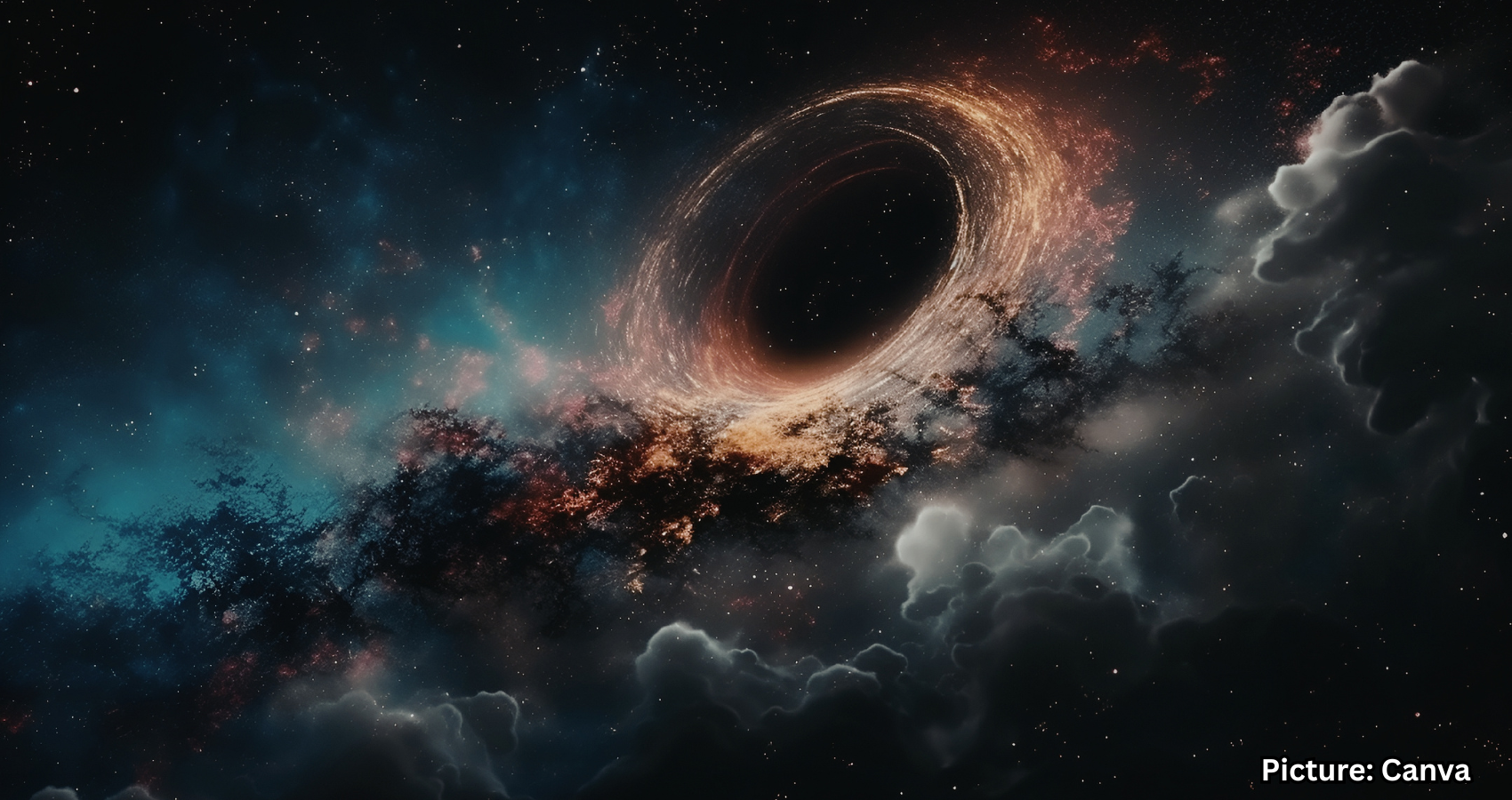
A new study connects the M87 black hole to its powerful cosmic jet, revealing how it launches particles at nearly the speed of light.
A recent study has successfully linked the renowned M87 black hole, the first black hole ever captured in an image, to its impressive cosmic jet. This research sheds light on the mechanisms behind the black hole’s ability to launch particles at nearly the speed of light.
Published in the journal “Astronomy & Astrophysics,” the findings reveal that scientists have traced a 3,000-light-year-long cosmic jet back to its likely source point. This breakthrough was made possible through “significantly enhanced coverage” provided by the global Event Horizon Telescope network.
M87, a supermassive black hole located in the Messier 87 galaxy, is approximately 55 million light-years from Earth and boasts a mass 6.5 billion times that of the sun. The first image of M87 was unveiled to the public in 2019, following data collection by the Event Horizon Telescope in 2017.
Dr. Padi Boyd of NASA highlighted the significance of the discovery, noting that M87 is not only supermassive but also active. “Just a few percent are active at any given time,” she explained in a video about the black hole. “Are they turning on and then turning off? That’s an idea… We know there are very high magnetic fields that launch a jet. This image provides observational evidence that what we’ve been seeing for a while is actually being launched by a jet connected to that supermassive black hole at the center of M87.”
The black hole is known to consume surrounding gas and dust while simultaneously emitting powerful jets of charged particles from its poles, which form the extensive jet stream. This dual behavior has been reported by outlets such as Scientific American and Space.com.
Saurabh, the team leader at the Max Planck Institute for Radio Astronomy, stated, “This study represents an early step toward connecting theoretical ideas about jet launching with direct observations.” He emphasized the importance of identifying the jet’s origin and its connection to the black hole’s shadow, calling it a crucial piece in understanding how the central engine operates.
The Event Horizon Telescope is a global network of eight radio observatories that work together to detect radio waves emitted by astronomical objects, such as galaxies and black holes. This collaboration effectively creates an Earth-sized telescope capable of capturing detailed images and data.
The term “Event Horizon” refers to the boundary surrounding a black hole beyond which no light can escape, as defined by the National Science Foundation.
The recent findings stem from data collected by the Event Horizon Telescope in 2021. However, the authors of the study caution that while the results are robust under the assumptions and tests performed, definitive confirmation and more precise constraints will necessitate future observations with higher sensitivity. This will require additional stations and an expanded frequency range to improve intermediate-baseline coverage.
As researchers continue to explore the mysteries of black holes, these findings represent a significant advancement in our understanding of how these cosmic giants operate and influence their surroundings, according to Space.com.