
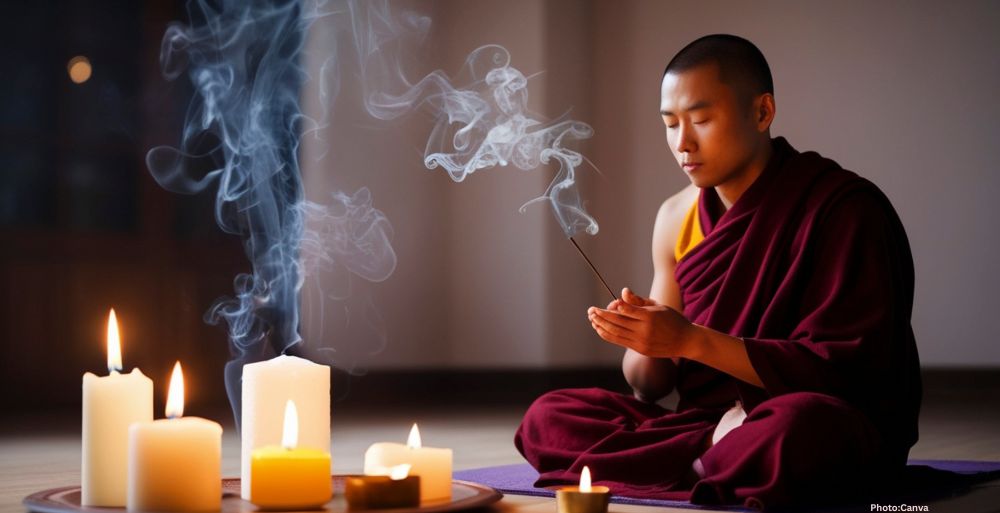
Exploring the concept of ‘kama muta,’ a Sanskrit term meaning ‘moved by love,’ reveals the profound emotional impact of compassion and connection, as exemplified by a group of Buddhist monks on a pilgrimage for peace.
I recently encountered the term “kama muta,” a phrase derived from Sanskrit that translates to “moved by love” or “undone by love.” This emotion manifests as warmth or fullness in the chest, unexpected tears, a catch in the throat, or even chills and goosebumps. It often arises in response to profound kindness, compassion, or genuine human connection.
The term was introduced by the Kama Muta Lab at the University of Oslo, a collective of researchers who recognized that while people across cultures experience this surge of emotion, many languages lack a precise scientific term for it. To find a word that encapsulated the depth of this feeling without modern cultural baggage, the lab’s founders, UCLA anthropologist Alan Fiske and University of Oslo psychologist Beate Seibt, turned to Sanskrit. They selected “kama muta” to describe this unique social-relational emotion that occurs when the heart is suddenly opened by love.
Upon reading this definition, I felt an immediate sense of familiarity. Finally, there was a term to articulate a feeling I have encountered frequently. In recent months, I have experienced waves of kama muta while watching videos and reading about Buddhist monks who undertook a pilgrimage for peace. Beginning at the Hương Đạo Vipassana Bhavana Center, a Vietnamese Theravada Buddhist monastery in Fort Worth, Texas, they walked 2,300 miles over the course of 110 days. To put this into perspective, they covered nearly a marathon’s worth of distance each day for four months.
Step by mindful step, these monks traversed rain, snow, and unforeseen challenges, sustained by unwavering faith. Their journey was a trust fall across a continent, relying entirely on the decency of strangers. Time and again, their faith was met with kindness. Local communities opened their churches and homes to provide shelter, while people lined the streets to offer water, food, and warm winter clothing to these robed men they had never met.
Among them was Aloka, a rescued pariah dog whose name means “divine light” in Pali. Aloka, a stray from the streets of Kolkata, had chosen to accompany the monks on an earlier pilgrimage in India. Despite undergoing surgery and facing health challenges, Aloka matched them step for step on the Walk for Peace, capturing the hearts of millions around the world.
What was it about these monks and Aloka that resonated so deeply with so many? What stirred thousands of individuals from diverse backgrounds to line the streets, offering flowers, kneeling for blessings, and finding themselves moved to tears? We were all touched by love, by kama muta, or what researcher Dacher Keltner describes as “moral beauty” in his studies on awe and wonder.
For me, this feeling arises from the same place that fractures open whenever I hear John Lennon and Yoko Ono’s song “Imagine.” Each time it plays, something catches in my throat. Perhaps it is the song’s vision of a peaceful world, free from harm over land, possessions, or religion. Or perhaps it is the grief stemming from the realization of how far we still are from such peace. In the case of the monks, it may have been the strength of their conviction, the simplicity and universality of their message, or their profound compassion for the suffering of all beings. Whatever the reason, I found myself following their journey day after day, a welcome antidote to the unsettling news cycle.
I have also experienced kama muta during my meditation practice, often surprised to find my face wet with tears upon emerging from silence. This love is not directed toward anyone in particular but is a recognition of our shared existence and fragility. Kama muta resonates deeply with “karuna,” or compassion. The tears of kama muta and karuna stem from the same ache, a recognition of our common vulnerability. These moments in meditation arrive unbidden, occurring when the ego shell is thin enough for love to overwhelm the heart. The 14th-century Persian poet Hafiz captured this thinning beautifully when he wrote:
“Love has befriended me so completely it has turned to ash and freed me of every concept and image my mind ever knew.”
At the closing gathering in Washington, D.C., Bhikkhu Bodhi described the Walk for Peace as one of the most significant events in the United States in the 21st century, revealing something essential about our shared humanity. He reflected on how individuals of every race, faith, and background came together to affirm kindness and compassion, reminding us that beneath our differences, we are bound in a web of mutuality. The true significance of the walk lay not in the miles traveled but in the possibility it awakened—a world where we recognize one another’s humanity.
The full impact of this walk is yet to be realized. A moral act of courage does not conclude at the final mile marker; it ripples outward in widening circles, touching hearts, shaping conversations, and planting seeds of awareness in ways beyond our understanding. Each mindful step and each act of loving kindness received along the road contribute to a larger karmic field of goodness. The monks spoke of peace, compassion, and living with greater care for one another. If their journey has sparked even a small turning of the heart in those who witnessed it, then its ripples are already moving through us. Perhaps, just perhaps, the vision of “Imagine” will begin to feel less distant.
For now, I am grateful for the delightful phrase “kama muta.” May we continue to be moved by love, again and again.
According to India Currents, this article was inspired by the monks’ journey and the emotional resonance of kama muta.