
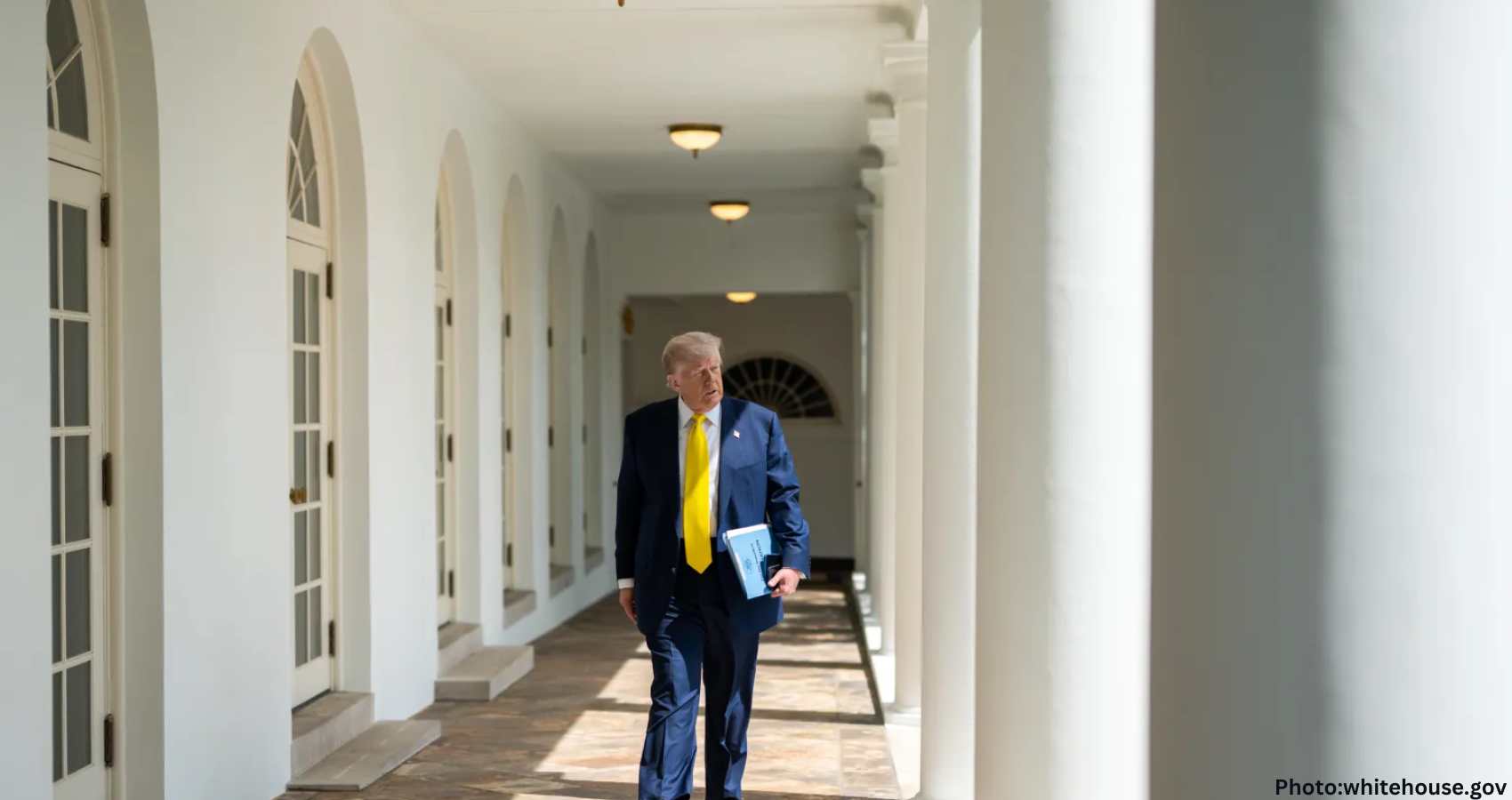
President Donald Trump expressed reluctance to allow Nvidia’s Blackwell chips to be shared with China, emphasizing national security concerns during a recent meeting in South Korea.
President Donald Trump has indicated a firm stance against sharing Nvidia’s Blackwell chips with China. Following a meeting in South Korea on Thursday, Trump addressed reporters aboard Air Force One, stating that while discussions about semiconductors had taken place, he was clear that “we’re not talking about the Blackwell.”
Nvidia’s Blackwell architecture, which was announced in 2024 and is set to be rolled out throughout 2025, marks a significant leap forward in GPU technology, particularly for artificial intelligence (AI) and large-scale machine learning applications. Named after the renowned mathematician David Blackwell, this architecture succeeds the previous Hopper design and introduces several key innovations, including the second-generation Transformer Engine, multi-die “superchip” configurations, and high-bandwidth interconnects.
The flagship models of this architecture, such as the B200 and GB200, are engineered to enhance the training and inference of large language models (LLMs). Nvidia claims that these models can achieve performance improvements of up to 30 times compared to earlier GPUs in specific AI-related tasks, although actual results may vary based on model size, task, and configuration. Additionally, Blackwell aims to enhance energy efficiency, which also depends on the type of workload being processed. This architecture is designed to meet the rising demands of generative AI, facilitating the use of larger models and quicker computations while catering to both enterprise deployment and research environments. The gradual rollout of Blackwell in 2025 is influenced by supply constraints and selective adoption among major AI users.
Nvidia CEO Jensen Huang expressed optimism regarding the discussions between President Trump and Chinese leader Xi Jinping during their recent meeting in South Korea. “I have every confidence that the two presidents had a very good conversation. It doesn’t have to involve anything that I do,” Huang remarked.
The U.S. government has tightened export controls on advanced semiconductors, including GPUs, to limit China’s access to cutting-edge AI technologies that could be used for both commercial and military purposes. The Bureau of Industry and Security (BIS) has issued updated regulations that require broader licensing for high-performance chips intended for China, emphasizing national security concerns. These measures specifically target processors capable of enhancing AI and machine learning workloads, effectively restricting access to the most advanced hardware while permitting limited, regulated exports.
These export controls reflect the U.S. strategic goal of maintaining technological leadership in AI and high-performance computing while addressing geopolitical risks. Amid these restrictions, Nvidia has acknowledged the possibility of introducing its Blackwell-architecture GPUs to China, contingent upon U.S. government approval. Huang noted that any deployment in China would adhere to export regulations, potentially involving versions of the chips with limited performance capabilities. This situation highlights the tension between commercial opportunities and regulatory constraints, illustrating how major technology firms must navigate the complex U.S.-China geopolitical landscape while fostering global AI innovation.
For companies like Nvidia, balancing commercial prospects with stringent regulatory compliance is crucial. They must ensure that their technology deployment aligns with government policies and international market dynamics, reflecting the intricate interplay of technology, trade policy, and national security in 2025.
Source: Original article