
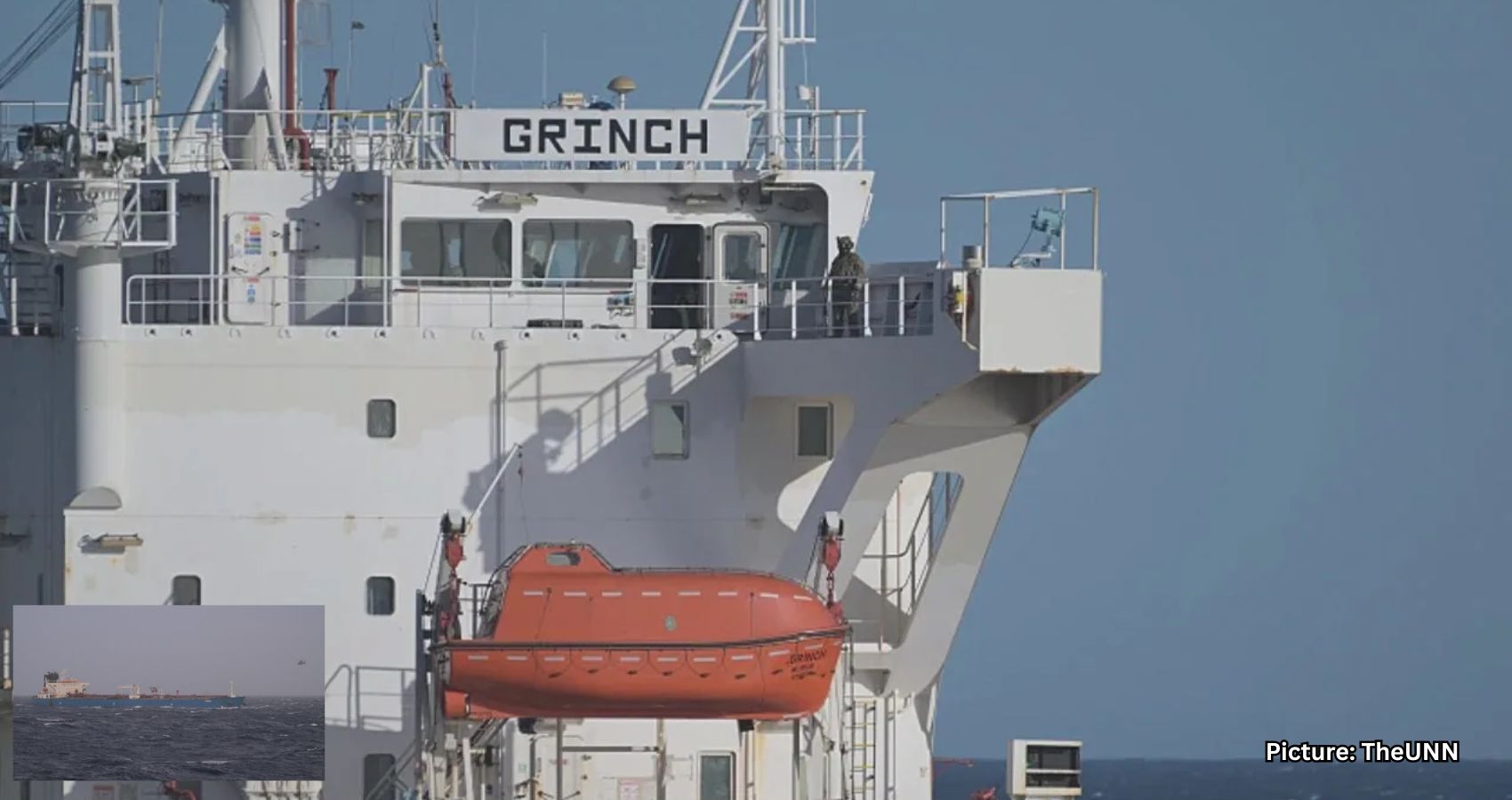
A Russian oil tanker, the Grinch, was intercepted by the French navy in the Mediterranean as Western nations ramp up efforts to disrupt Moscow’s sanctions-evading operations.
A Russian oil tanker was intercepted in the Mediterranean Sea between Spain and Morocco as Western powers intensify their efforts to disrupt Moscow’s sanctions-evading shadow fleet operations.
The French navy boarded and searched the tanker, which is reportedly operating under the Comoros flag and is subject to international sanctions. French President Emmanuel Macron announced the operation on Thursday, stating that it was conducted with the support of several allied nations.
In a post on X, Macron detailed that the operation occurred on the high seas and that the vessel had been diverted for further checks. The tanker, identified as the Grinch, was intercepted in the western Mediterranean, according to French maritime police.
The Associated Press reported that France and the United Kingdom had gathered and shared intelligence regarding the vessel prior to the interception. French military officials, who spoke on condition of anonymity, confirmed the collaboration.
This interception marks a continuation of a trend in which U.S. and European authorities have increasingly targeted Russian-linked vessels in recent months as part of a broader strategy to disrupt Russia’s oil exports. Earlier this year, U.S. forces seized another sanctioned tanker, the Russian-flagged Marinera, in the North Atlantic.
According to France’s Mediterranean Maritime Prefecture, the team that boarded the Grinch raised concerns about the legitimacy of the vessel’s flag based on the documents inspected during the operation. The tanker is now being escorted by the French navy to an anchorage for additional verification.
Since Russia’s full-scale invasion of Ukraine in 2022, the European Union has imposed 19 rounds of sanctions aimed at curbing Moscow’s oil exports. Despite these measures, Russia has managed to continue exporting millions of barrels of oil, primarily to China and India, often at discounted prices.
The so-called “shadow fleet” consists of hundreds of older, poorly regulated tankers that frequently change names, ownership structures, and flags to evade detection and sanctions. Maritime data firm Lloyd’s List Intelligence estimates that the global shadow fleet comprises around 1,400 tankers, many of which are subject to U.S., British, or European sanctions.
Ukrainian President Volodymyr Zelenskyy has criticized European nations for not doing enough to halt the transportation of Russian oil using sanctioned vessels, arguing that these operations help fund the ongoing war in Ukraine. At the World Economic Forum in Davos, Switzerland, he questioned why the U.S. could successfully stop tankers from the shadow fleet while Europe could not.
“Russian oil is transported right along the European coast. This oil funds the war against Ukraine. This oil helps destabilize Europe,” Zelenskyy stated.
The interception of the Grinch highlights the ongoing tensions surrounding energy exports and the international community’s efforts to hold Russia accountable for its actions in Ukraine. As Western powers continue to navigate the complexities of sanctions and enforcement, the fate of vessels like the Grinch remains a focal point in the broader geopolitical landscape.
According to The Associated Press, the situation underscores the challenges faced by Western nations in curbing Russia’s oil trade and the ongoing implications for global energy markets.