
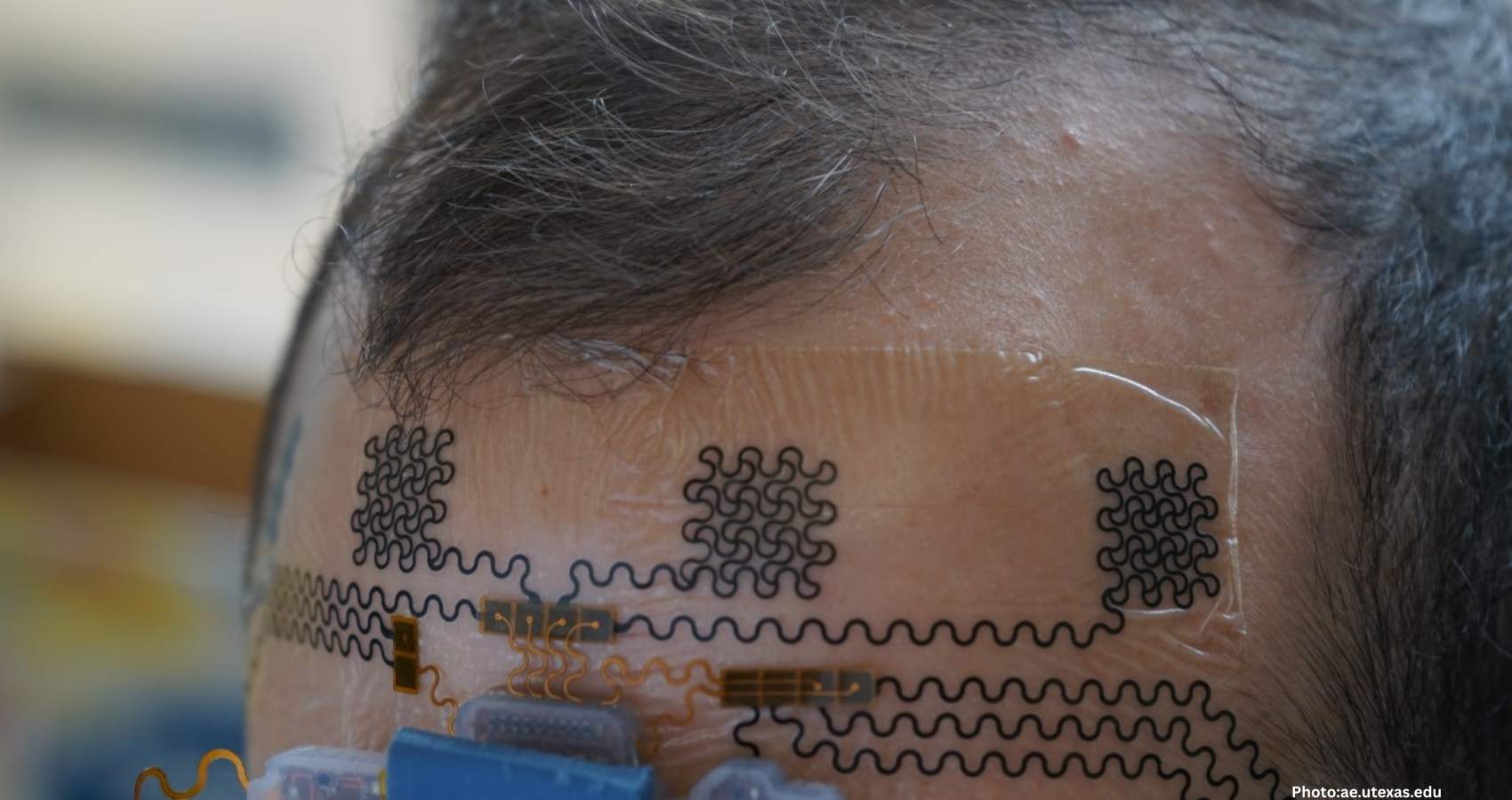
Researchers have developed a facial electronic tattoo, or “e-tattoo,” designed to monitor mental workload in high-stress professions by measuring brain activity and cognitive performance.
In a groundbreaking study published in the journal Device, scientists have introduced an innovative solution for individuals in high-pressure work environments: an electronic tattoo device, commonly referred to as an “e-tattoo,” that adheres to the forehead. This device is intended to track brainwaves and cognitive performance, offering a more cost-effective and user-friendly alternative to traditional monitoring methods.
Dr. Nanshu Lu, the senior author of the research from the University of Texas at Austin, emphasized the importance of mental workload in systems involving human operators. According to Lu, mental workload significantly influences cognitive performance and decision-making, particularly in high-demand jobs such as pilots, air traffic controllers, doctors, and emergency dispatchers.
Lu noted that the e-tattoo technology could also benefit emergency room doctors and operators of robots or drones, enhancing their training and performance. One of the primary objectives of the study was to develop a method for measuring cognitive fatigue in careers that require intense mental focus.
The e-tattoo is designed to be temporarily affixed to the forehead and is notably smaller than existing devices. It utilizes electroencephalogram (EEG) and electrooculogram (EOG) technologies to measure brain waves and eye movements, providing insights into cognitive workload.
Traditional EEG and EOG machines are often bulky and expensive, making the e-tattoo a promising compact and affordable alternative. Lu described the e-tattoo as a wireless forehead sensor that is thin and flexible, akin to a temporary tattoo sticker.
“Human mental workload is a crucial factor in the fields of human-machine interaction and ergonomics due to its direct impact on human cognitive performance,” Lu stated.
The research involved six participants who were tasked with identifying letters displayed on a screen. Each letter appeared one at a time in various locations, and participants were instructed to click a mouse whenever a letter or its position matched one of the previously shown letters. The tasks varied in difficulty, and the researchers observed that as the complexity increased, the brainwave activity shifted, indicating a heightened mental workload.
The e-tattoo comprises a battery pack, reusable chips, and a disposable sensor, making it a practical tool for cognitive monitoring.
Currently, the device exists as a lab prototype, with a price tag of $200. Lu acknowledged that further development is necessary before commercialization can occur. This includes the implementation of real-time mental workload decoding and validation in more realistic settings with a larger participant pool.
As the demand for effective cognitive monitoring tools grows in high-stress professions, the e-tattoo represents a significant advancement in understanding and managing mental workload, potentially leading to improved performance and decision-making in critical situations, according to Fox News.