
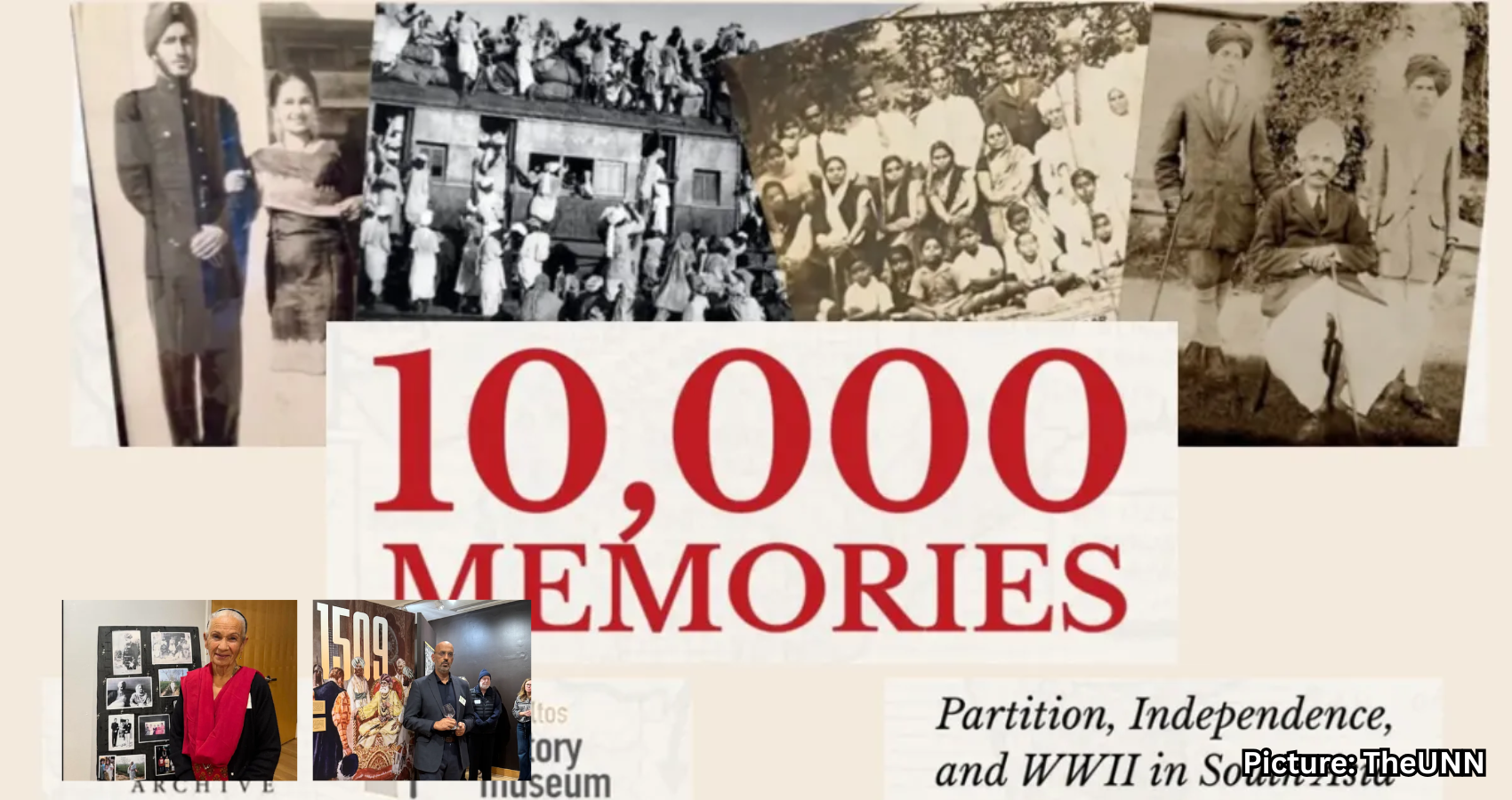
“10,000 Memories” at the Los Altos History Museum highlights the profound impact of the 1947 Partition of India through personal stories and historical context, running until May 2026.
In 1947, the Partition of India irrevocably altered the landscape of British India, dividing it into two nations—India and Pakistan, with East Pakistan later becoming Bangladesh. This division was marked by the hastily drawn Radcliffe Line, created by British lawyer Sir Cyril Radcliffe, who had never set foot in India before making decisions that would affect millions.
The Radcliffe Line was drawn based on religious majorities, cutting through Punjab and Bengal. However, its arbitrary path unleashed chaos, slicing villages in half, tearing families apart, and dividing farmland overnight. As borders solidified, millions fled across them, leading to mass migrations and waves of communal violence. Estimates suggest that between 10 and 15 million people were displaced, leaving a lasting trauma etched into the histories of India, Pakistan, and Bangladesh.
A powerful yet often overlooked history now takes center stage at the Los Altos History Museum. The exhibition, titled “10,000 Memories – Partition, Independence, and WWII in South Asia,” runs through May 24, 2026, and brings the past to life through the voices of those who experienced it firsthand. Curated by the Berkeley-based 1947 Partition Archive, the exhibit combines personal accounts, rare archival photographs, and immersive multimedia storytelling to capture the human experience of Partition.
“Part of our mission is to tell intercultural, intergenerational stories of the local people of Los Altos,” says Kuljeet Kalkat, President of the Board of the Los Altos History Museum. He emphasizes the importance of South Asian families seeing their experiences reflected in the exhibition. “Your experience and what you went through—we feel should be preserved,” he adds, highlighting a deep sense of belonging.
Anna Toledano, Executive Director of the Los Altos History Museum, echoes this sentiment, stating, “If it happened to people who live in Los Altos, if it’s part of their family stories, if it’s part of their family history—then it’s part of our history too. It’s important for us to talk about it.”
At the heart of the exhibition lies a shared conviction that memory matters. “We want people to know that their stories and their histories also matter,” says Dr. Guneeta Singh Bhalla, founder and Executive Director of the 1947 Partition Archive.
The exhibit opens by tracing the early colonization of the Indian subcontinent, beginning with the Spanish and Portuguese efforts to bypass Arab intermediaries and trade spices directly with India. This global race for access reshaped the world. “Of course, Columbus ended up in the Americas, believing he had reached India. All of this unfolded within about five years,” Dr. Bhalla explains. “For a long time, the Americas were even called the West Indies because Europeans thought they were part of Asia or somehow connected to it.”
Dr. Bhalla notes that much of this history remains unfamiliar to audiences in the United States, which is why the exhibit starts with this context. It tells the larger story of empire by spotlighting various East India companies—not just the British—and their gradual conquest of India. The narrative builds toward the collapse of the British Empire after World War II, creating a power vacuum that erupted into violence and ultimately led to Partition.
The 1947 Partition Archive preserves intimate oral histories and personal testimonies that reveal the human cost of Partition through the voices of those who lived it. While the organization has collected over 10,000 stories worldwide, this exhibit highlights twenty firsthand accounts from individuals who now call Los Altos home.
During the exhibit’s launch on January 28, two survivors shared their deeply personal journeys, bringing history into the present. Baljit Dhillon Vikram Singh, who has raised her family in Los Altos since the late 1960s, recounted how Partition shattered her childhood at the age of six. One night, violence forced her family to flee. She recalls being awakened suddenly and carried down the stairs to a waiting Jeep, where her father urged them to leave before dawn to avoid being stopped.
As they fled, she witnessed horrific scenes that continue to haunt her. “I remember a canal filled with bloated human bodies, some headless, some without limbs,” she recalls. When her family was stopped by Pakistani soldiers, an officer chose mercy, recognizing her grandfather as a man who had once saved his life.
Decades later, Singh grapples with questions that have no easy answers. “Why was the Motherland partitioned? Why did millions get displaced and millions lose their lives? Why was I among the lucky ones?” she reflects. The trauma remains, and her fear of drowning serves as a constant reminder of her past. Yet, she honors the sacrifices of her ancestors, carrying forward the truth that a single act of mercy can save an entire family.
Another survivor, Narinder Lal Kasturia, was just 17 when Partition changed his life forever. He recalls the violence he witnessed and struggles to understand how such brutality could take hold. “Before Partition, the two communities lived without division or distrust,” he notes.
“We can talk about everything that happened… but will it patch up all this difference?” Kasturia asks, raising a poignant question about reconciliation.
Dr. Bhalla emphasizes that the exhibit is evidence-based and intentionally complex. “It’s not a clean story. It’s very messy, and it’s important that we learn it that way. It’s very multidimensional.”
Kuljeet Kalkat hopes Los Altos residents will recognize Partition as a world-shaping event with lessons that resonate today. Dr. Bhalla places it alongside the twentieth century’s most defining moments, urging visitors to understand the impact of polarization. “We want to awaken everybody to what polarization can unleash and what lessons we could learn from the past,” she states.
Anna Toledano points out that this history rarely surfaces in the United States, despite its lasting impact. “This is a story that isn’t really talked about so much… and was a hugely impactful event,” she says, highlighting colonialism’s long shadow. The exhibit may surprise visitors by revealing how these earlier partitions and traumas continue to shape contemporary conflicts.
Raashina Humayun, a Los Altos resident and donor to the 1947 Partition Archive, reflects on the differing narratives of history across borders. “You read history in India, it tells one story; if you read it in Pakistan, it tells another story,” she explains. “But with lived stories, lived experiences—no one can say that’s not true.”
Anita Manwani, another local resident and donor, feels honored to share these stories. “I’m very honored to be part of this whole community in Los Altos that does so much for everyone who lives here and truly respects the diversity we have here,” she says.
Manwani emphasizes the exhibit’s significance for the South Asian community, as many parents lived through Partition. “It is the largest migration of refugees in the history of the world, and perhaps the least documented,” she notes, adding that countless stories remain untold as the generation that experienced them fades away.
Through this exhibit, the voices of those who experienced Partition rise above borders and textbooks, reminding us that history is not merely dates and events—it is lived, remembered, and preserved in the hearts of those who endured it. “10,000 Memories: Partition, Independence, and WWII in South Asia” is on display from January 29 to May 24, 2026, and is free to the public, open Thursday through Sunday from noon to 4 PM, according to India Currents.