
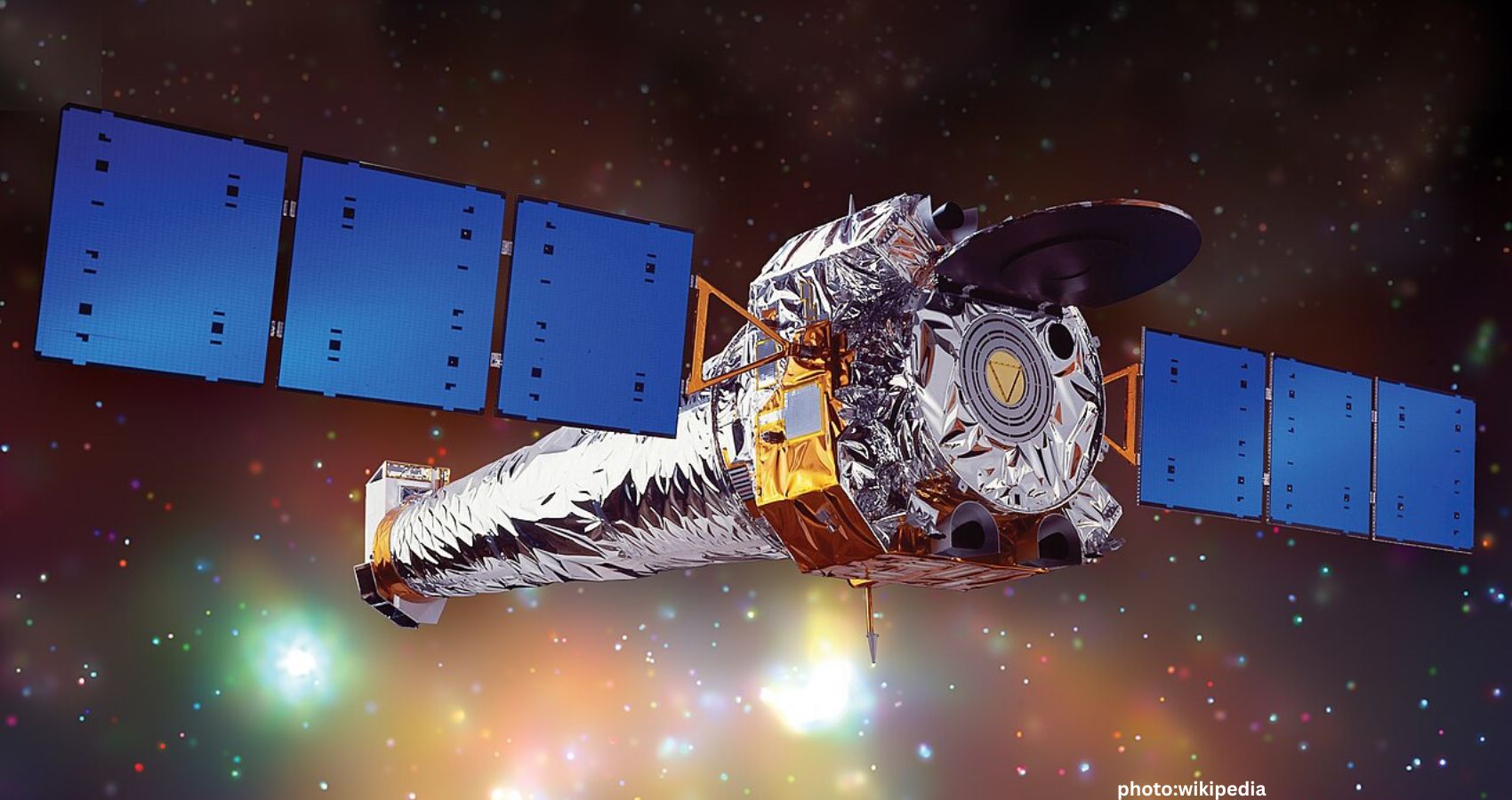
NASA’s Chandra telescope has revealed that the Milky Way’s spiral arms may extend farther into space than previously understood, thanks to precise measurements from rare gamma-ray bursts.
A recent study utilizing data from NASA’s Chandra X-ray Observatory and the European Space Agency’s XMM-Newton has led astronomers to conclude that the spiral arms of the Milky Way galaxy may stretch farther out into space than previously known.
The research team achieved remarkable accuracy in measuring the distance to dust clouds located within these spiral arms. They took advantage of rare, powerful gamma-ray bursts originating from distant galaxies. As X-rays from these bursts traversed the Milky Way, some of the light reflected off dust clouds, creating measurable rings that provided precise distance metrics.
“This is a very direct way — relying only on geometry — to precisely measure distances to the Milky Way’s spiral arms,” said Beatrice Vaia, the Italian Ph.D. student who led the study. “Most other methods rely on assumptions about how the Milky Way rotates, which become increasingly uncertain in the outer regions of our galaxy.”
The data collected by the team indicated that the dust cloud in the most distant arm of the Milky Way is approximately 3,500 light-years wide. While astronomers have recognized the existence of the Milky Way’s arms for over a century, mapping them has always posed challenges due to Earth’s position within one of those arms.
The breakthrough achieved through the study of gamma-ray bursts offers a new perspective on our galaxy, unencumbered by the limitations of Earth’s location. “The differences are small, but any revision of these distances is important because they are so fundamental for understanding our galaxy,” said Ilaria Fornasiero, a Ph.D. student and co-author of the study. “For example, this could mean that astronomers have to revise estimates of the mass of the galaxy because that affects how wide the arms stretch.”
Despite the promising results, the technique does have its limitations. Suitable gamma-ray bursts are rare, with researchers identifying only a handful over the past 25 years that were bright enough and positioned favorably to facilitate measurements of the Milky Way’s spiral arms.
“We will continue to be on the lookout for more,” said co-author Andrea Tiengo, emphasizing the ongoing quest for additional gamma-ray bursts that could further enhance our understanding of the Milky Way’s structure.
This groundbreaking research underscores the importance of innovative observational techniques in astronomy and their potential to reshape our understanding of the universe. According to NASA, the findings could have significant implications for how we conceptualize our home galaxy and its expansive reach.