
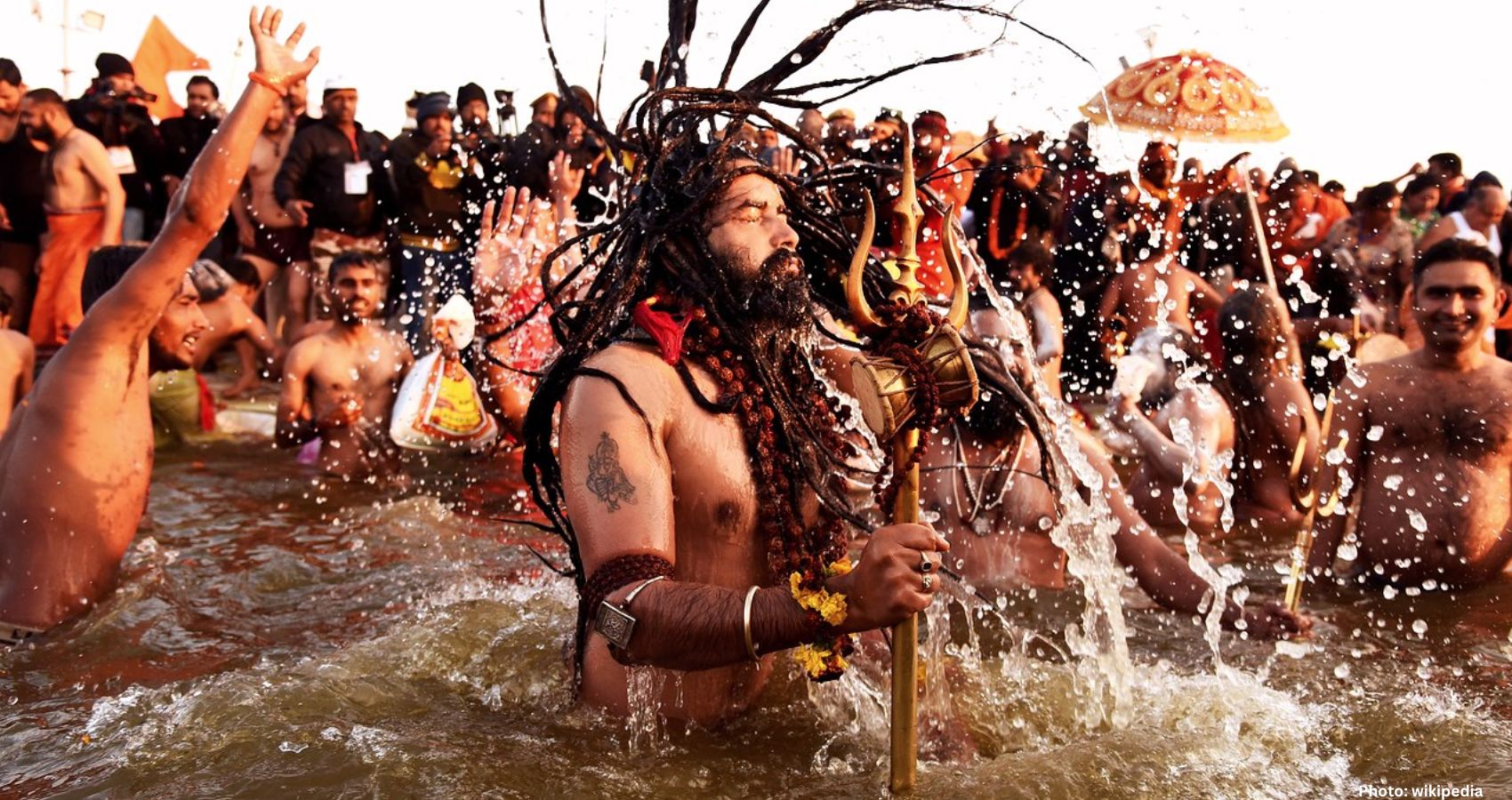
Yakub Mathew’s book, “Seeking the Infinite,” explores the Mahakumbh as a symbol of unity and spiritual awakening, transcending cultural and religious boundaries.
In an era where individuals often feel compelled to align with polarized ideologies, a remarkable book has emerged, illuminating the potential for reconciliation and harmony. “Seeking the Infinite,” launched at the Indo-American Arts Council (IAAC) Literary Fest 2025, redefines the Mahakumbh as a shared heritage of humanity, extending beyond its Indian and Hindu roots.
At the heart of this work is the metaphor of water, representing purification, unity, and surrender. The Mahakumbh serves as a powerful reminder of the universal truth that transcends individual religions, inviting readers to reflect on the enduring ripples of faith that inspire hope for a healed world.
Authored by Yakub Mathew, “Seeking the Infinite” captures the essence of the Mahakumbh, a grand riverine confluence that occurs once every 144 years. The event, known as Triveni Sangam, took place in Prayagraj in 2025, attracting an estimated 640 million devotees. The convergence of three rivers—Ganga, Yamuna, and the mythical Saraswati—symbolizes unity, while the peaceful gathering of millions over nearly two months stands as a remarkable achievement.
This coffee table book spans 246 pages, featuring stunning photographs alongside illuminating quotes and narratives. It immortalizes the Mahakumbh in a way that has never been done before, celebrating the paradoxes inherent in the pilgrimage experience. As the dedication suggests, the outward journey reflects an inward quest, leading to a profound connection with the ineffable.
Turning the pages of “Seeking the Infinite” feels akin to embarking on a pilgrimage. The book opens with the chapter “Blessings,” featuring insights from mystics, Hindu yogis, and even a Cardinal, including Sadhguru, Swami Avdeshanand Giri Maharaj, Maharaj Radhanath Swami, and His Eminence Cardinal Oswald Gracias. As readers delve deeper, they are invited to explore the spiritual currents that resonate throughout India’s rich history.
Mathew’s vision is clear: the Mahakumbh is an international heritage that transcends geographical boundaries. Although he describes himself as an accidental author, his journey as a seeker is anything but accidental. His personal experience—a celebration of his 60th birthday with friends after overcoming a serious illness—has led to a lasting tribute to the Mahakumbh, reflecting a rite of passage in human life.
Raised in Delhi by a young widow, Mathew’s childhood was shaped by interactions with influential figures such as Mother Teresa and His Holiness Bishop Paulos Gregorios. These early experiences laid the groundwork for his faith. His upbringing, influenced by public servants in his family, provided him with insights into both the spiritual and temporal realms.
Mathew’s educational journey through St. Xavier’s and St. Stephen’s College instilled in him a unique perspective that blends Indian Christianity with a global worldview. After traveling the world, he found his place as a banker in New York City while remaining attuned to his inner yearnings. His previous perception of the Kumbh as merely a theatrical event transformed during his visit in 2025, leading him to recognize the profound spiritual significance of the experience.
The Mahakumbh became a transformative event for Mathew, who described it as a moment of realization: “I was just an insignificant speck of dust on the soap bubble of the universe.” The vibrant atmosphere around him was not mere noise but a reflection of his own soul’s pulsations. As he immersed himself in the waters among the throngs of devotees, he felt blessed to offer prayers for peace in a turbulent world.
The sheer magnitude of the Mahakumbh inspired Mathew to declare, “Shakti in Bhakti!”—a testament to the transformative power of devotion. The event reaffirmed the interconnectedness of the microcosm and macrocosm, as he felt his soul resonate with the music of the spheres.
“Seeking the Infinite” is a rich tapestry of personal experiences, literary craftsmanship, academic scholarship, and spiritual insights. It presents a multi-dimensional exploration of the Mahakumbh, drawing on contributions from luminaries across various fields, including spirituality, fashion, religion, administration, medicine, journalism, business, politics, theater, academia, sports, film, art, and music.
The book features a diverse roster of 55 contributors, including Pujya Swami Chidanand Saraswati, Ayaan Ali Bangash, Kabir Bedi, Dr. Shashi Tharoor, and Anupam Kher, among others. Their narratives provide fresh perspectives on the Mahakumbh, revealing its mythic and astronomical dimensions. Technology also played a role in the event, with 2,750 AI-driven CCTV cameras monitoring the festivities, as noted by Amitabh Kant. Dr. Dinesh Singh creatively interprets the legendary River Saraswati as a metaphor for the flow of humanity, while Dr. Achintya Moulick likens his surgical work to his own Mahakumbh—a confluence of science and faith where he witnesses miracles.
Importantly, “Seeking the Infinite” should not be viewed merely as a collection of essays by prominent figures but as a harmonious blend of voices paying homage to the Mahakumbh. The book ignites a reexamination of India’s role in the world, emphasizing the timeless message of unity in diversity.
As the festivities have concluded and millions have returned home, the waters of the Mahakumbh continue to resonate within those who participated. The pluralistic nature of the event reflects the eternal quest for the divine across various religious traditions, united by a shared yearning for the transcendental. Water, with its ability to flow and adapt, symbolizes the purification that transcends individual identities, revealing our shared humanity.
For those who could not attend the event, reading “Seeking the Infinite” serves as a means to relive the excitement and energy of the Mahakumbh. The book has successfully immortalized this sacred gathering, ensuring its significance endures for future generations. Ultimately, Prayagraj emerges as a holy site of pilgrimage, akin to Mecca, Jerusalem, or Kashi—a place where the heart reconciles contradictions and paradoxes, with love as the guiding force in all our journeys. As Cardinal Oswald Gracias beautifully articulates, “This book will help us listen more deeply—to the longings of our own heart, to the silent music of creation, and to the voice of the One who speaks through both.”
According to India Currents.